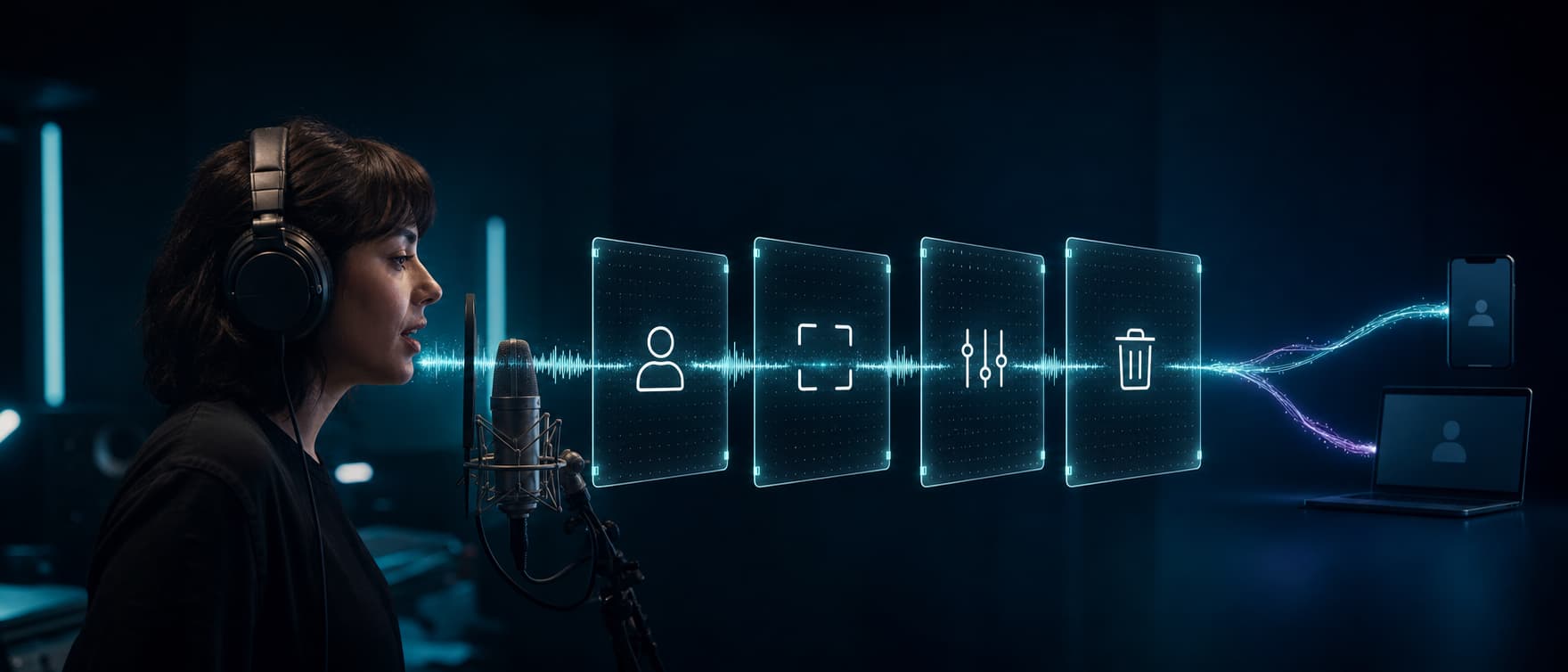
Voice AI can expand collections coverage, but every extra call also expands the surface for privacy, consent, disclosure, and policy failures. The safe design is a bounded workflow: deterministic systems decide who may be called and what can be offered, while the voice agent manages the conversation and escalates exceptions. Here is how technical teams can choose the right use cases, build the control plane, and measure a production pilot without handing policy decisions to a language model.
Where voice AI fits in a collection operation
Voice AI is best at high-volume, repeatable conversations with a small set of approved outcomes. Payment reminders, account-status calls, promise-to-pay capture, and preapproved payment plans fit that pattern. Disputes, hardship, legal questions, bankruptcy, and complaints require a person or a specialist workflow.
At Dasha, we treat the voice agent as one controlled layer in the collection system. The system of record decides whether contact is allowed. A policy service decides what the agent may say or offer. The Dasha voice runtime handles the live conversation, telephony, tool execution, and operational evidence. This separation lets a technical team improve call coverage without making a language model the source of truth for balances, consent, or settlement authority.
That architecture matters because consistency has two meanings in collections. The agent must sound clear and responsive, and it must apply the same approved rules to every account. Conversation quality cannot compensate for calling the wrong person, disclosing a debt before authentication, or offering terms outside policy.
What to automate and what to escalate
Start with a narrow lane where the account data is reliable and every valid outcome is known. Early-stage reminders often work better as a first deployment than charged-off accounts with disputes, multiple owners, or pending legal action.
| Collection task | Voice AI role | Required control |
|---|---|---|
| Payment-due or past-due reminder | Automate | Eligible account, valid consent, permitted time, approved wording |
| Right-party contact | Automate carefully | Identity-safe opening and authentication before debt details |
| Balance or payment-status question | Automate after authentication | Read from the system of record, never from model memory |
| Promise to pay | Automate | Confirm amount and date, then write the commitment back through an API |
| Payment-plan selection | Automate within limits | Offer only plans returned by a deterministic eligibility service |
| Card or bank payment | Use a secure payment flow | Keep raw payment credentials outside prompts, transcripts, and model context |
| Dispute or validation request | Escalate and suppress collection activity as policy requires | Preserve the consumer's exact words and create a review task |
| Cease request, attorney representation, bankruptcy, deceased consumer, or wrong party | End the collection flow | Update suppression flags before another attempt can be scheduled |
| Financial hardship, vulnerability, bereavement, or severe distress | Escalate | Warm transfer with transcript context and a no-pressure fallback |
| Threats, legal consequences, or an unapproved settlement | Prohibit | No generative response path should be able to create these statements |
The key design choice is bounded authority. The model can phrase an approved option naturally. It cannot invent a new option. If an account is eligible for three plans, a tool returns those three plans. If the consumer asks for a fourth, the agent transfers the call or schedules a human review.
Compliance belongs in the control plane
United States collection calls can involve the Fair Debt Collection Practices Act (FDCPA), the Consumer Financial Protection Bureau's Regulation F, the Telephone Consumer Protection Act (TCPA), state collection laws, call-recording rules, and sector-specific requirements. The exact matrix changes for first-party creditors, third-party collectors, debt buyers, debt type, and consumer location. Counsel and compliance owners should translate that matrix into executable policy before a call is queued.
Four controls deserve explicit treatment.
Consent and revocation
The Federal Communications Commission confirmed that AI-generated voices count as an “artificial or prerecorded voice” under the TCPA. Its declaratory ruling says callers need the called party's prior express consent unless an emergency purpose or exemption applies. Calls that introduce advertising or telemarketing require prior express written consent.
Store the evidence of consent, its scope, the number covered, the date, the source, and any revocation. Check it at queue time and again before dialing. A revocation or channel opt-out must stop future calls across every campaign, rather than updating one agent's local state.
Contact time and frequency
Regulation F treats calls before 8 a.m. or after 9 p.m. at the consumer's location as inconvenient when the collector has no information to the contrary. Its communication rule covers other inconvenient times and places too. Regulation F also creates presumptions around call frequency for a particular person and debt. More than seven calls in seven consecutive days, or another call within seven days after a telephone conversation about that debt, is presumed to violate the rule, subject to the rule's exclusions. The frequency rule should be encoded alongside stricter state and consumer-specific limits.
These are portfolio-level controls. A cap inside one campaign fails when several agents or channels contact the same person. The scheduler needs a shared ledger of attempts, conversations, debts, time zones, inconvenient times, and channel preferences.
The stakes are practical as well as legal. In its 2017 national survey, the CFPB found that 37% of consumers who had been contacted about a debt said creditors or collectors tried four or more times in a week. More capacity should produce better-timed contact, rather than more pressure.
Identity, disclosure, and voicemail
Do not disclose the creditor, balance, or collection purpose until the agent has reached and authenticated the intended consumer. The opening should reveal only what counsel has approved for an unknown answerer. Authentication should use low-risk information and an approved fallback, rather than asking the model to improvise security questions.
After right-party authentication, the agent must deliver the required collection disclosures in the correct sequence and language. Regulation F specifies the disclosure for an initial communication and the shorter disclosure for later communications. Its disclosure rule also requires a complete and accurate translation when the rest of the communication uses another language.
Voicemail needs a separate path. Regulation F defines a limited-content message by an exact set of required and optional elements. Adding a balance, creditor, or collection reference can expose debt information to a third party. Treat the limited-content definition as an allowlist, and stop generation outside it.
Auditability and human review
For every attempt, retain the policy version, agent version, consent decision, contact-cap decision, input data snapshot, tool calls, disclosure events, outcome, and reason for any transfer. Recordings and transcripts need retention and access rules that account for local recording law and sensitive data.
Automated post-call labels can help find missing disclosures, disputes, or hardship cues. They are a screening layer, not the final compliance record. Sample reviews should compare the audio, transcript, extracted fields, and CRM updates. NIST's AI risk framework is useful here because it treats measurement and ongoing risk management as operating work, rather than a one-time launch gate.
A production architecture for collection calls
A reliable collection agent uses five layers with clear ownership.
- Eligibility service: Reads the account, jurisdiction, debt status, consent, contact history, inconvenient times, representation, bankruptcy, dispute, and suppression flags. It returns
eligibleor a specific block reason. - Campaign scheduler: Selects an approved local-time window, applies portfolio-wide frequency rules, and prevents duplicate work across campaigns.
- Conversation runtime: Manages speech, turn-taking, interruptions, authentication, disclosures, and the approved conversation state machine.
- Policy tools: Return current balances, allowed plans, settlement limits, payment links, and escalation destinations. Every tool validates its own inputs and authority.
- Evidence pipeline: Writes the outcome to the system of record, delivers event webhooks, stores permitted call artifacts, and creates human-review tasks when required.
The runtime should fail closed. If the consent service times out, the call does not start. If balance lookup fails after authentication, the agent does not estimate. If a plan cannot be written back, the agent does not claim that it was created. It apologizes, transfers, or schedules a follow-up according to policy.
Dasha is a good fit for technical teams embedding voice into an existing collection or servicing product. We provide a managed runtime, REST APIs, inbound and outbound telephony, webhook tools, configurable recordings, transcripts, and call history and inspection. Your application can keep account eligibility, consent, offers, and payment systems under your control. A turnkey collections suite may be a better fit when you want predefined workflows and have no engineering team to own those integrations.
How to implement a voice AI collection workflow
1. Define one bounded use case
Choose a portfolio segment, delinquency stage, jurisdiction set, language, and call purpose. Document every allowed outcome and every mandatory escalation. A useful first scope may be a payment reminder that can answer balance questions, capture a promise to pay, or transfer to an agent.
2. Turn policy into machine-readable rules
Create a versioned decision table for consent, local time, call frequency, disclosures, authentication, plan eligibility, recording, voicemail, and suppression. Keep these rules outside the prompt. Prompts guide language; policy services grant authority.
3. Design the conversation as states
Use explicit states such as unknown answerer, right party unverified, authenticated, disclosure complete, intent detected, plan offered, commitment confirmed, and closed. Define which tools and statements are allowed in each state. This prevents a consumer's interruption or prompt injection from skipping authentication or disclosure.
4. Integrate before polishing the voice
Connect the account system, consent ledger, contact-history service, payment provider, and human queue. Use idempotent writes so a webhook retry cannot create two payment plans. Pass an account identifier to the agent, and fetch current values during the call instead of placing sensitive portfolio data in a long prompt.
For payment, send the consumer to a hosted payment page, transfer to a compliant payment service, or use another flow approved under the Payment Card Industry Data Security Standard. Raw card numbers and security codes should never enter the language model's context.
5. Test hostile and messy calls
Happy-path demos reveal little. Test wrong numbers, shared phones, voicemail, background noise, accents, interruptions, ambiguous “stop” requests, disputes, prior payment claims, unsupported languages, hardship, threats, silence, tool timeouts, transfer failures, and stale account data. Verify the system state as well as the transcript after each test.
6. Roll out with a canary cohort
Start with a small, low-risk cohort and a staffed escalation queue. Review calls daily. Freeze the policy and agent version for each cohort so outcomes can be traced. Expand by portfolio segment only after risk, experience, and recovery measures remain within approved thresholds.
Metrics that show whether the pilot is working
Recovery alone is an incomplete score. A campaign can collect more while creating unacceptable complaints, wrong-party disclosures, or broken promises to pay. Track three groups of measures.
| Measure group | What to track |
|---|---|
| Operations and recovery | Eligible accounts, attempts, answer rate, right-party contact, authentication completion, promise-to-pay rate, kept promises, completed payments, transfer completion, cost per resolved account |
| Risk and control | Calls blocked by consent or frequency rules, wrong-party disclosures, missed or late disclosures, unsupported statements, dispute and cease-request handling, payment-plan write failures, recording-policy errors |
| Consumer experience | Early hang-ups, opt-outs, repeat contacts, complaints, transfer abandonment, time to human, speech-recognition failures, requests to repeat information |
Use fixed denominators and report each stage as a funnel. Promise-to-pay divided by answered calls can hide an authentication problem. Payments divided by right-party contacts can hide an answer-rate problem. Kept promises divided by promises made exposes whether the agent is pushing plans that consumers cannot sustain.
Compare the pilot with a matched human or existing-channel cohort where possible. Keep account age, balance band, jurisdiction, delinquency stage, and contact history comparable. Scale decisions should combine recovery lift, consumer outcomes, and control performance.
Frequently asked questions
Is voice AI legal for debt collection?
Yes, when the call and collection workflow comply with the laws that apply to the caller, debt, consumer, location, and channel. In the United States, AI voice calls fall within the TCPA's artificial or prerecorded voice rules. FDCPA and Regulation F requirements may also apply to debt collectors. Consent, identity, disclosure, contact limits, state law, recording, and opt-out handling all need explicit controls.
Must a voice agent say that it is AI?
Federal TCPA rules require prior express consent for artificial or prerecorded voice calls absent an applicable exemption, plus identification and disclosure information for the entity responsible for the call. Separate state or sector rules may add an AI-specific disclosure. A clear automation disclosure is also a sound default for consumer trust, with exact wording approved for each jurisdiction.
Can voice AI replace human collectors?
It can own bounded, repetitive call types. Humans remain necessary for disputes, hardship, legal issues, vulnerable consumers, exceptions, and complaints. The more consequential the decision, the narrower the agent's authority should be.
How does voice AI improve debt recovery?
It expands contact capacity, applies approved call flows consistently, and updates systems during the conversation. Recovery improves only when the input data, consent, offer logic, payment experience, and escalation path work together. A controlled pilot provides more credible evidence than a generic recovery-rate claim.
Build the voice layer without hiding the controls
Collections teams need more than a convincing call demo. They need a runtime that fits a governed production system, exposes failures, and lets their own services control contact and offer decisions. Start building with Dasha to test that architecture with your account, policy, payment, and escalation workflows.