
Comparing voice AI with human agents is a workload design decision. The useful question is which calls software can complete safely, which calls need human judgment, and how the two paths reconnect. That choice affects customer outcomes, staffing, cost, and the failure modes your team must manage.
The short answer: automate defined calls and protect access to people
Voice AI is the better fit for frequent, well-defined calls with an authoritative data source, a machine-checkable outcome, and a safe fallback. Human agents are the better fit for policy exceptions, ambiguous or emotionally charged cases, negotiations, and decisions whose errors carry serious consequences.
Most production teams therefore need three modes:
- AI completes a bounded task, such as checking an order, qualifying a lead, or rescheduling an appointment.
- AI collects context and transfers the call when the request leaves its approved scope.
- A separate copilot assists a human agent with retrieval, summaries, or suggested next steps while the person owns the conversation.
At Dasha, our current scope is the AI call path. We provide a managed runtime, REST API, and operational tools for configuring voice agents, connecting telephony and business tools, testing conversations, running calls, and inspecting completed interactions. We do not provide a live copilot interface for human agents. Your application and contact-center stack retain responsibility for customer identity, policy, permissions, authoritative data, routing destinations, and escalation operations.
Voice AI vs human agents: key differences
An AI voice agent combines telephony, speech recognition, a language model or other dialogue logic, speech generation, and business tools. It listens and speaks during a live call and may take approved actions through APIs.
A human agent is a person working through a phone or contact-center system, usually with access to a customer relationship management system (CRM), knowledge base, ticketing, and escalation procedures.
Both can answer a call. Their capacity and risk profiles are very different.
| Dimension | Voice AI agent | Human agent |
|---|---|---|
| Availability | Can answer during any configured hours, provided telephony, models, tools, and incident coverage are available | Requires staffed shifts, scheduling, and coverage for absence |
| Concurrent demand | Can add sessions quickly within platform, carrier, model, and downstream API limits | Handles one live call at a time; added capacity requires hiring or reassignment |
| Marginal cost | Usually usage-based, plus integration, evaluation, and operating costs | Labor, benefits, recruitment, training, supervision, software, and facilities or remote operations |
| Consistency | Applies the same configured workflow and knowledge source across calls; model outputs can still vary, and bad configuration scales fast | Performance varies by experience, training, workload, and judgment |
| Conversation quality | Depends on recognition, turn detection, latency, interruption recovery, voice output, and prompt or workflow design | Adapts naturally to timing, corrections, emotion, and unplanned context, with human variability |
| Judgment | Works within supplied context, tools, and rules; may generate a plausible wrong answer | Can weigh incomplete evidence, exceptions, relationships, and consequences |
| Actions | Executes approved API calls quickly and consistently | Can bridge missing systems and unusual procedures, subject to access and training |
| Failure pattern | A configuration or model error can affect many calls before detection | Errors are usually local, though bad policy or training can affect the whole team |
| Best fit | Repetitive, high-volume, time-sensitive, verifiable tasks | Novel, sensitive, high-risk, or negotiation-heavy work |
The comparison should stay at the task level. “Billing calls” is too broad. Reading a balance, explaining a charge, negotiating hardship terms, and reversing a payment have different sources of truth and consequences.
Choose the call path with six questions
Start with historical calls, not a generic list of AI use cases. Group them by intent and outcome, then ask these questions for each group.
1. Is the request predictable enough to specify?
Good candidates have a known start, a limited set of valid paths, and a clear end state. Appointment booking, order status, lead qualification, reminders, basic intake, and routing often meet this test.
Requests such as “fix my account” or “help with my bill” need to be split into smaller transactions before assigning them to AI.
2. Does an authoritative source answer every material question?
The model should not invent inventory, eligibility, prices, policy, or account state. A knowledge source can answer approved general questions. An API should return live customer or transaction data. If sources conflict or fail, the agent needs a defined recovery path.
3. Can the outcome be verified outside the conversation?
A friendly closing line does not prove completion. The booking system should show the appointment, the CRM should show the qualified lead, or the ticketing system should show the created case.
Machine-verifiable outcomes make automated quality control and reconciliation possible. They also expose calls that sounded successful and accomplished nothing.
4. What happens if the agent is wrong?
Low-impact and reversible actions are stronger starting points. High-value transfers, refunds, health advice, contract changes, credit decisions, emergency situations, and other consequential outcomes call for tighter rules, confirmation, approval, or human ownership.
5. Will the caller need discretion or emotional support?
Sentiment detection can flag a possible escalation. It does not give a model accountable judgment or genuine empathy. Distress, complaints, grief, retention, negotiation, and requests for an exception should have an early human route.
6. Can the system fail safely?
The safe fallback may be a warm transfer, a callback request, a ticket, or a clear end to the interaction. An agent that stays on the line after repeated misunderstanding is trapping the caller, even if the call counts as “contained.”
| Call shape | Default path | Reason |
|---|---|---|
| Frequent, structured, low-risk, verifiable | AI completes | Software gains speed and capacity without relying on open-ended judgment |
| Structured intake followed by specialist work | AI triage, then human | AI gathers required fields; a person owns diagnosis, advice, or negotiation |
| Routine question with unreliable data or tools | Human until systems improve | Conversation quality cannot compensate for a missing source of truth |
| Ambiguous, sensitive, or exception-heavy | Human, optionally with AI assistance | The task depends on context, discretion, and accountability |
| High-risk action with clear rules | AI prepares, human approves | Automation reduces handling work while a person controls the consequence |
A hybrid model needs a real handoff contract
“Transfer to an agent” is not an operating design. A production handoff must define:
- Trigger: an explicit request for a person, unsupported intent, low confidence, repeated correction, tool failure, policy rule, distress cue, or elapsed-time limit.
- Destination: a queue selected by deterministic routing logic and current availability.
- Context: verified identity state, the caller's stated goal, facts collected, tools attempted, and results returned. Mark generated summaries as generated.
- Caller experience: what the caller hears, whether an employee receives a briefing, and the maximum wait.
- Fallback: callback, voicemail, alternate queue, ticket creation, or safe termination when nobody is available.
- Ownership: the system that records the final outcome and the team responsible for failed transfers.
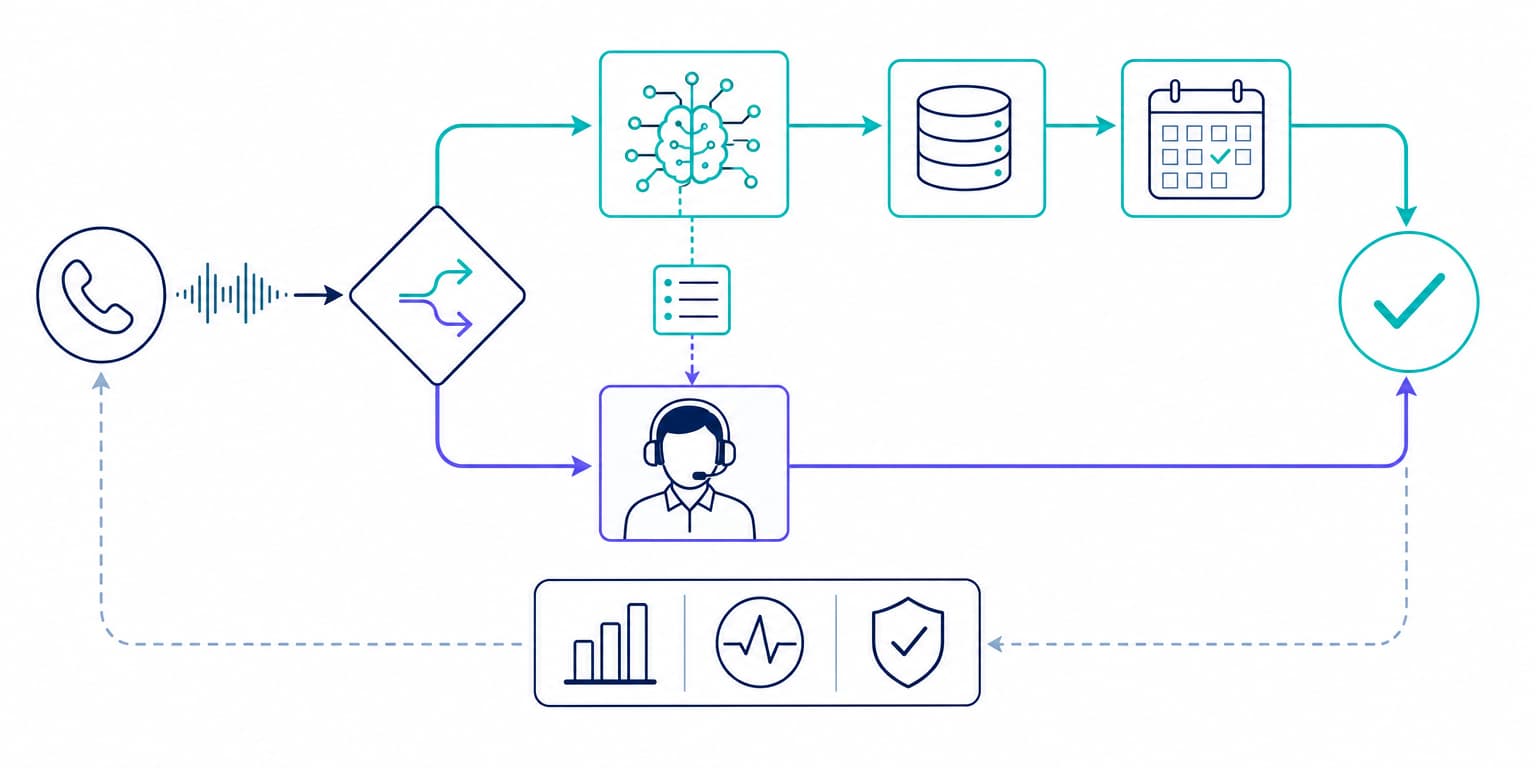
The human path also needs capacity planning. Automating easy calls shifts the remaining queue toward exceptions. Aggregate human average handle time can rise and first-contact resolution can fall even when agents perform equally well or better on comparable calls. Segment the metrics by intent, complexity, and risk before interpreting any change.
There is a second hybrid pattern: AI assistance during a human-owned interaction. The closest strong evidence here is adjacent online support chat research, not voice-call evidence. A field study of 5,172 customer-support agents found that access to a generative AI assistant increased issues resolved per hour by 15% on average. Less-experienced and lower-skilled workers improved both speed and quality. The most experienced and highest-skilled workers had small speed gains and small quality declines. The result supports measuring human-assist systems by channel, task, and agent cohort rather than assuming one effect across the team. Read the QJE study.
Compare total cost, not a per-minute price with a salary
Voice AI often has a lower marginal cost for an eligible automated call. A credible business case includes the full operating model on both sides.
Human cost includes:
- wages, benefits, recruiting, onboarding, training, supervision, and quality assurance;
- phone and contact-center software;
- scheduling, shrinkage, turnover, and peak coverage; and
- facilities or remote-work operations.
Voice AI cost includes:
- carrier and phone-number charges;
- speech recognition, language-model, speech-generation, and runtime usage;
- implementation, integrations, security, and data work;
- test-set creation, review, monitoring, and incident response;
- human handling after escalation; and
- repeat calls, corrections, refunds, or complaints caused by failures.
Use accepted outcomes as the denominator. A simple break-even test is:
human minutes avoided × loaded human cost per minute > AI connected minutes × AI variable cost per minute + transferred human cost + fixed AI operating cost + amortized deployment cost + error and rework cost
Then add business effects that time alone misses: incremental answered calls, conversion, reduced abandonment, after-hours coverage, error costs, repeat contact, and customer churn. Keep those values separate so one optimistic assumption cannot hide a weak deployment.
Round-the-clock availability also needs an honest cost. A voice agent can answer at 3 a.m., but a failed scheduling API, unavailable transfer queue, or exhausted provider quota still needs a controlled fallback and an incident owner.
Measure AI and humans on accepted outcomes
Average handle time, containment, and customer satisfaction are useful signals. They become misleading when AI receives simple calls and people receive the hard ones. Compare performance within the same intent and risk band, and verify the result in the system of record.
Use a shared scorecard:
| Metric | What to measure |
|---|---|
| Accepted task completion | The requested outcome is correct and confirmed by the authoritative system |
| Factual and action accuracy | Material statements match approved sources; every action is authorized and applied once |
| Escalation appropriateness | Required escalations happen early enough; avoidable escalations are analyzed separately |
| Handoff completion | The caller reaches the right person or the promised fallback completes, with useful context preserved |
| Repeat contact | The caller does not return for the same unresolved issue within the chosen window |
| Conversation mechanics | Response-latency distribution, interruption recovery, silence, overlap, and recognition of critical values |
| Customer impact | Satisfaction, complaints, abandonment, opt-outs, and conversion within comparable call groups |
| Cost per accepted outcome | All variable and allocated operating costs divided by verified successful outcomes |
Timing deserves its own test. A study of informal human conversation across ten languages found a shared tendency to minimize both silence and overlap between turns, while average timing still varied across languages. The study did not evaluate AI agents. It motivates testing turn detection, time to first audio, interruption recovery, and latency percentiles; it does not establish a universal voice AI performance target. See the turn-taking study.
Run a controlled pilot before changing staffing
- Select one bounded intent. Choose meaningful volume, a reliable source of truth, and a reversible outcome.
- Build a representative test set. Include accents and speech patterns from the served population, background noise, interruptions, corrections, silence, ambiguous dates, out-of-scope requests, tool timeouts, and explicit requests for a person.
- Define release gates. Set thresholds for accepted completion, policy compliance, action accuracy, latency, and handoff success before live traffic.
- Start with limited exposure. Restrict audience, hours, geography, call share, or permissions. Keep early actions read-only where practical.
- Review successes as well as failures. Sample contained calls to find confident wrong answers and false completions that generate no immediate complaint.
- Reconcile outcomes. Compare conversation claims with CRM, booking, order, payment, or ticket records.
- Expand by intent. Add traffic only after the current workflow meets quality, customer-impact, and cost gates.
The NIST Generative AI Profile gives teams a voluntary structure for identifying, measuring, and managing generative AI risks. Turn that structure into named owners, test cases, thresholds, incident handling, and change review for each voice workflow.
Treat compliance as part of routing and runtime design
Rules vary by call purpose, recipient, location, industry, recording practice, and data involved. For covered outbound U.S. consumer calls, the Federal Communications Commission treats an AI-generated voice as an “artificial or prerecorded voice” under the Telephone Consumer Protection Act. Covered calls generally require prior express consent, subject to applicable exemptions. Covered advertising or telemarketing calls generally require prior express written consent. Call eligibility and consent therefore belong in deterministic campaign controls. Read the FCC ruling and 47 C.F.R. § 64.1200.
The Telemarketing Sales Rule is codified at 16 C.F.R. Part 310. Where it applies, the TSR covers calling times, do-not-call controls, abandonment, disclosures, and recordkeeping; when a prerecorded telemarketing message is used, it also requires the specified automated opt-out mechanism. Review the FTC guidance.
Compliance controls should run in code and operations rather than live only in a prompt. This is not a complete legal checklist. Counsel should map consent, caller identification, AI and recording disclosures, opt-outs, retention, and jurisdiction- or sector-specific duties for each workflow. Engineering should implement the approved requirements through consent evidence, suppression checks, identity rules, disclosure text, tool authorization, data handling, and audit records. Give callers a working human alternative when the workflow or applicable rules require it.
Will voice AI replace human agents?
No, not across the whole queue. Voice AI can take on defined call volume quickly. In current deployments, human agents should remain the owners of judgment-heavy work, exceptions, and relationships. The strongest deployment makes that boundary explicit, moves context across it, and measures the combined system by verified customer outcomes.
Our call-center implementation guide goes deeper on tools, handoffs, testing, and QA. When you are ready to run a bounded workflow, evaluate Dasha's voice AI backend with your own telephony, integrations, acceptance criteria, and human escalation path.