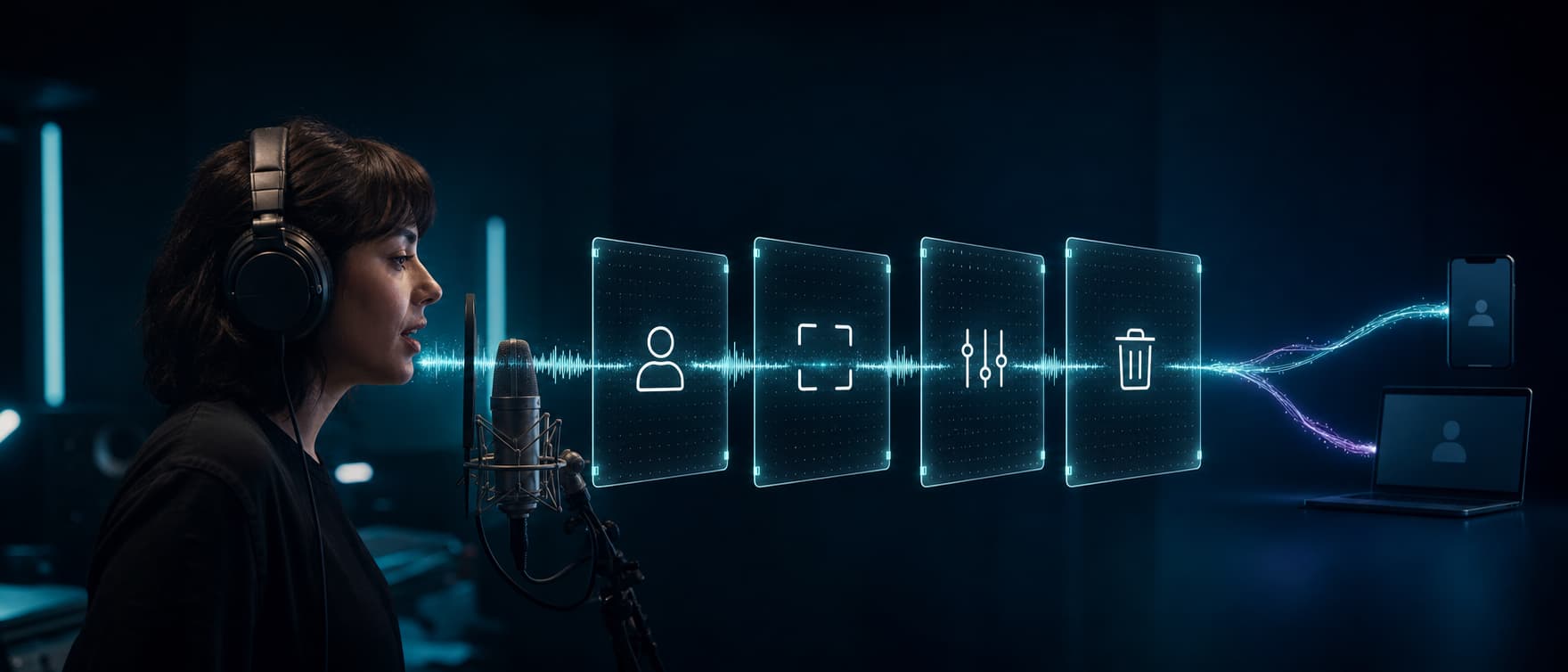
Voice AI upselling works when an agent uses current customer, order, and catalog data to make one relevant offer at the right moment—without delaying the customer's primary task. The hard part is not writing a persuasive sentence. It is designing eligibility rules, tool calls, confirmation paths, guardrails, and an experiment that proves incremental margin without damaging the customer experience. This guide provides that production blueprint.
Voice AI upselling at a glance
Voice AI upselling uses a spoken AI agent to recommend a higher-value version of something a customer already intends to buy. Cross-selling recommends a complementary product or service instead.
An upgrade from a monthly plan to an annual plan is an upsell. Adding insurance to a trip, a side to a meal, or onboarding services to a software purchase is a cross-sell. The engineering and conversation patterns are similar, so this guide covers both.
The best voice AI upsell has five properties:
- Eligible: The customer, order, channel, and offer satisfy explicit business and compliance rules.
- Relevant: The recommendation solves a need revealed by the transaction or conversation.
- Accurate: Price, availability, terms, and savings come from authoritative systems—not model memory.
- Easy to decline: One clear “no” ends the offer path.
- Measurable: The system records eligibility, exposure, acceptance, fulfillment, and later reversal.
| Customer moment | Suitable offer | Best time to ask | Avoid the offer when |
|---|---|---|---|
| Inbound order | Size, bundle, or add-on | After the main item is confirmed, before the final recap | The order is already complex, delayed, or disputed |
| Subscription renewal | Higher tier or longer term | After confirming renewal intent and current needs | The customer is trying to cancel or reporting a service failure |
| Appointment booking | Relevant service add-on | After the requested appointment is secured | The requested slot or service is still unresolved |
| E-commerce confirmation | Compatible accessory or replenishment item | After confirming the original order | Inventory, price, or delivery impact is uncertain |
| Support call | Plan or feature that prevents a recurring issue | After resolving the issue and confirming satisfaction | The issue remains open, the customer is upset, or the offer rewards a product failure |
| Outbound customer call | Renewal, replenishment, or prequalified upgrade | After identity, permission, and reason for the call are clear | Consent, do-not-call status, or customer identity is uncertain |
An AI voice agent should not pitch on every call. A reliable “do not offer” policy protects more value than an aggressive script creates.
How a voice AI upsell works
A production workflow separates business decisions from conversational delivery.
1. Detect an eligible moment
Start with an event such as an order reaching review, a renewal approaching, a customer exceeding plan limits, or an appointment being confirmed. Do not ask the language model to infer campaign eligibility from an unstructured transcript alone.
The eligibility service should check:
- customer identity and consent state;
- account, order, and subscription status;
- offer inventory, price, geography, and expiration;
- channel and campaign frequency caps;
- previous acceptances, declines, refunds, and complaints;
- exclusions such as an unresolved support case or vulnerable-customer flag.
2. Retrieve a small set of valid offers
Use a catalog, product information management system, CRM, or rules service as the source of truth. Return only offers the customer can actually buy. Two or three structured candidates are easier to govern than a full catalog embedded in a prompt.
Rank candidates with deterministic rules first: compatibility, customer eligibility, stock, delivery constraints, and price. The model can then choose or phrase an offer within those boundaries.
3. Present one concise recommendation
State the customer benefit, what changes, and the incremental price. Then stop talking.
A useful pattern is:
“Because you selected [current choice], [add-on or upgrade] would give you [specific benefit] for [incremental price]. Would you like me to add it?”
This works better than listing several options because the customer can understand and answer it in one turn.
4. Resolve the customer's response
The agent needs explicit paths for:
- accept: revalidate the offer, apply it, and confirm the new total or terms;
- decline: acknowledge once and continue the primary task;
- question: retrieve the answer from an approved source, then ask again only if appropriate;
- uncertainty or silence: clarify; never treat it as acceptance;
- objection or distress: stop selling and resolve or transfer;
- human request: transfer with relevant context.
5. Write the outcome back to the system of record
Record more than “converted” or “not converted.” Useful events include eligible, offer_selected, offer_presented, accepted, declined, applied, fulfillment_failed, refunded, and opted_out. Include the offer ID, price version, conversation ID, experiment cell, and timestamp.
Without this event chain, a dashboard can credit the agent for an acceptance that was never fulfilled—or miss an upsell later reversed.
What makes a spoken upsell useful instead of intrusive
Voice is sequential. The customer cannot scan past a long pitch, so timing and turn design matter more than they do in a visual checkout.
Complete the primary job first
Secure the order, booking, renewal, or support resolution before asking for more. The exception is when the proposed change is necessary to complete the original request, such as choosing a compatible component.
Use context, not assumptions
“You ordered a camera, so you must need a premium lens” is an assumption. “This lens is compatible with the camera you selected and covers the low-light use you mentioned” uses transaction and conversation context.
Only use data the customer has authorized for the workflow. Do not turn a recommendation into a surprising recital of everything the business knows about them.
Make one offer and respect one decline
Configure a maximum number of offer attempts per conversation and across a defined customer window. A declined offer should become a structured signal, not an invitation for the model to improvise another pitch.
Let the customer interrupt
The agent should stop when the customer speaks, preserve the current state, and answer the new question. Test barge-in on the offer, price, terms, and confirmation turns. A script that works in text may fail when a caller interrupts halfway through a sentence.
Confirm material changes audibly
After acceptance, repeat the item or plan, incremental price, new total or billing effect, and any material term. Then call the transaction tool. If the tool fails, explain that the change was not completed and offer a recovery path.
The figures and scenarios below are representative examples informed by Dasha's experience across deployments and common industry workflows. They are not customer testimonials or guaranteed outcomes; actual results vary by implementation, traffic, and baseline.
Voice AI upsell scripts for six common workflows
These are patterns, not copy to paste unchanged. Values in brackets must come from validated tools or session data.
| Workflow | Trigger and script | Required system action |
|---|---|---|
| Restaurant order | After the main item is confirmed: “You can make that a [bundle name] with [included items] for [incremental price] more. Would you like me to do that?” | Check menu availability and current price; update the point-of-sale order; read back the new total. |
| E-commerce order confirmation | After confirming the original order: “The [accessory] is compatible with the [purchased item] and can ship with this order for [price]. Would you like to add it?” | Check compatibility, inventory, delivery impact, and amendment window before modifying the order. |
| Subscription renewal | After confirming renewal: “You are using [relevant limit or feature]. The [plan] includes [benefit] for [price difference and billing period]. Would you like to hear the terms?” | Retrieve current usage and approved plan terms; do not imply the current plan will stop working unless that is true. |
| Travel booking | After the base itinerary is secured: “A [refundable/flexible] option is available for [incremental price]. It allows [specific change or cancellation term]. Would you like to switch?” | Reprice the live itinerary and disclose restrictions before applying the fare change. |
| Service appointment | After booking: “Because you selected [service], the technician can also perform [related add-on] during the same visit for [price]. Would you like me to add it?” | Check technician capability, slot duration, geography, and price; update the appointment. |
| B2B software account | After resolving the stated need: “Your team is currently [observable usage fact]. The [tier or add-on] provides [relevant capability] for [commercial effect]. Should I send the details or connect you with the account owner?” | Pull approved account and entitlement data; route contractual questions to the correct human. |
Notice what these scripts do not include: fake scarcity, unsupported “most popular” claims, or an invented discount. The language model delivers a governed offer; it does not create the commercial policy.
A real-world voice AI upselling example
SoundHound's vendor-published Five Guys customer story shows what an operating workflow can look like at restaurant scale. SoundHound reports that the voice assistant processed more than 184,000 phone orders from 2025 through the article's June 2026 publication, completed 92% of phone orders in 2025, and recorded a 5% upsell conversion rate.
The useful lesson is not that another deployment should forecast a 5% rate. The case shows that order completion and upsell conversion can be measured separately, at meaningful volume, while the agent handles the underlying transaction. The published story does not provide a randomized control, offer-level margin, refund rate, or full cohort definition, so its figures are evidence of one deployment—not a portable ROI benchmark.
Build your own business case from eligible conversations, a holdout group, fulfilled offers, and retained contribution margin.
A production architecture for voice AI upselling
A minimal architecture contains six components:
- Conversation runtime: handles speech, turn-taking, interruption, session state, and telephony or web audio.
- Customer-context service: provides only the account, order, consent, and history fields needed for this interaction.
- Eligibility and offer service: returns valid offer IDs, terms, and reasons under versioned business rules.
- Action tools: reprice, amend an order, update a subscription, book an add-on, record a decline, or transfer the call.
- Event pipeline: captures exposures, decisions, tool results, call outcomes, refunds, and complaints.
- Evaluation layer: replays tests, inspects real calls, compares experiment cells, and catches regressions before broader rollout.
The agent's context might contain a compact object like this:
{
  "conversation_id": "conv_...",
  "customer": {
    "id": "cust_...",
    "consent_state": "verified",
    "preferred_language": "en-US"
  },
  "primary_task": {
    "type": "order_confirmation",
    "status": "complete",
    "order_id": "order_..."
  },
  "eligible_offers": [
    {
      "offer_id": "offer_...",
      "name": "[approved offer name]",
      "incremental_price": "[validated value]",
      "currency": "[currency]",
      "benefit": "[approved benefit]",
      "expires_at": "[timestamp]"
    }
  ],
  "policy": {
    "max_offers_this_call": 1,
    "decline_ends_offer_path": true,
    "explicit_confirmation_required": true
  }
}
Keep secrets, unnecessary personal data, and the full customer record out of the prompt. Tool responses should return the minimum fields needed for the next decision.
Keep the state machine explicit
A useful high-level flow is:
OPEN
  -> COMPLETE_PRIMARY_TASK
  -> CHECK_ELIGIBILITY
  -> PRESENT_ONE_OFFER
  -> ACCEPT | DECLINE | QUESTION | HANDOFF
  -> CONFIRM_AND_APPLY | CONTINUE_WITHOUT_OFFER | TRANSFER
  -> WRITE_OUTCOME
  -> CLOSE
The model can generate natural language inside each state. Your application should control the valid transitions.
Metrics that show whether voice AI upselling is profitable
Acceptance rate alone is a poor north-star metric. It rewards aggressive offers, ignores refunds, and can hide damage to the main journey.
Track the funnel and the guardrails together:
| Metric | What it answers |
|---|---|
| Eligible conversation rate | How often is a valid offer actually available? |
| Offer exposure rate | Does the agent reach the intended moment? |
| Acceptance rate | Do customers verbally accept the offer? |
| Applied and fulfilled rate | Does the system complete what the customer accepted? |
| Incremental average order value | How much additional booked value appears in the exposed group? |
| Incremental contribution margin | What remains after product cost, discounts, voice/model cost, transfer cost, refunds, and chargebacks? |
| Primary-task completion | Does upselling reduce order, booking, renewal, or support completion? |
| Refund, reversal, and cancellation rate | Are accepted offers durable and understood? |
| Complaint and opt-out rate | Is the policy creating customer harm or fatigue? |
| Transfer and escalation rate | Does the offer create questions the agent cannot resolve? |
| Offer latency and interruption rate | Does the conversation stall or invite barge-in at a particular step? |
For an experiment, estimate incremental contribution per eligible conversation:
(exposed fulfilled rate - control fulfilled rate)
x contribution margin per fulfilled offer
- incremental voice, model, support, transfer, refund, and payment cost
Use a randomized holdout rather than comparing this month with last month. Keep prices, inventory rules, traffic sources, and eligibility definitions stable where possible. Randomize at the customer or account level if the same person can call more than once; otherwise one customer may experience both treatments.
Define the stopping rule and success thresholds before launch. A pilot should not pass if offer revenue increases while primary-task completion, complaints, or reversals breach their guardrails.
Common failure modes and how to fix them
The agent pitches before solving the customer's request
Failure: The call feels obstructive and the primary-task completion rate falls.
Fix: Gate the offer on a completed milestone such as order_confirmed or appointment_booked.
The recommendation is generic
Failure: Every customer hears the same offer regardless of need.
Fix: Require a structured relevance reason tied to a selected item, stated goal, verified usage signal, or compatible product.
The model invents price, availability, or savings
Failure: The customer accepts a deal the business cannot honor.
Fix: Read commercial facts from an authoritative tool response. Revalidate immediately before applying the change.
A declined offer keeps returning
Failure: The agent sounds coercive and increases opt-outs.
Fix: Write the decline to conversation state and to a cross-channel frequency-cap service. Define phrases such as “not interested” and “just finish the order” as terminal for the offer path.
Prompt text contains the business logic
Failure: A wording edit silently changes eligibility, price, or frequency policy.
Fix: Put commercial rules in versioned services and treat the prompt as a presentation policy.
Silence or an ambiguous “okay” is treated as consent
Failure: Unwanted charges and reversals follow.
Fix: Ask a closed confirmation that includes the item and price. Apply only after an unambiguous response.
The dashboard counts verbal acceptance as revenue
Failure: Reported lift exceeds fulfilled, retained value.
Fix: Join conversation events to order, billing, fulfillment, refund, and cancellation records.
The team tests transcripts but not calls
Failure: Latency, pronunciation, interruption, noise, and tool delays break an otherwise correct flow.
Fix: Test with real audio and telephony conditions, then inspect recordings, transcripts, tool events, and outcome data together.
Compliance and customer trust are design requirements
Outbound voice campaigns require more than a good script. In the United States, the FCC has confirmed that AI-generated voices fall within the TCPA's restriction on artificial or prerecorded voice calls. The FTC's Telemarketing Sales Rule guidance covers requirements that can include do-not-call processes, disclosures, calling times, and abandoned outbound calls.
Requirements vary by jurisdiction, call purpose, relationship, and dialing method. Obtain qualified legal review before launch. At minimum, design for:
- verified permission and do-not-call suppression before dialing;
- truthful identification and required disclosures;
- an immediate, durable opt-out path;
- approved calling windows and campaign frequency limits;
- data minimization, retention rules, and access controls;
- explicit confirmation before any charge or contract change;
- accessible human escalation and dispute handling.
Compliance checks belong in code and campaign controls, not only in the prompt.
A four-week pilot plan
Week 1: Choose one narrow journey and establish the baseline
- Select a frequent, low-ambiguity offer with reliable price and inventory data.
- Define eligibility, exclusion, and frequency-cap rules.
- Instrument the existing journey from primary-task start through fulfillment and later reversal.
- Set success, guardrail, and stopping thresholds.
- Complete legal, privacy, and brand review.
Week 2: Build the tools and test the state machine
- Implement offer retrieval, revalidation, application, decline, and transfer tools.
- Create explicit accept, decline, question, silence, interruption, tool-failure, and handoff tests.
- Test edge cases such as an expired offer, price change, out-of-stock item, duplicate request, and failed order update.
- Review real audio for pace, pronunciation, latency, and interruption behavior.
Week 3: Launch a controlled experiment
- Start with a limited eligible cohort and a randomized holdout.
- Monitor primary-task completion, complaints, opt-outs, tool errors, and reversals daily.
- Inspect a sample of accepted, declined, interrupted, and transferred calls—not only successful ones.
- Pause automatically when a guardrail or critical tool-error threshold is breached.
Week 4: Decide, refine, or stop
- Join conversation events to fulfilled and retained revenue.
- Segment results by offer, journey, customer type, language, and call direction.
- Fix one bottleneck at a time: eligibility, timing, wording, latency, or fulfillment.
- Expand only if incremental contribution is positive and customer-experience guardrails hold.
Do not begin with many offers, regions, languages, and channels. A narrow pilot produces a clearer causal answer and a safer path to scale.
Building voice AI upselling with Dasha
We recommend keeping your CRM, commerce platform, billing system, or product catalog as the source of truth and using the voice agent as a governed conversational layer.
With Dasha, a technical team can:
- connect agent tools to external APIs and databases for eligibility checks, pricing, and transaction updates;
- handle inbound and outbound calls through a managed voice runtime;
- test agents before deployment and inspect transcripts, recordings, model interactions, tool executions, and performance data in the Call Inspector;
- extract structured outcomes with post-call analysis; and
- use warm transfers when a customer needs a person.
Dasha is a fit for technical teams building a production conversational AI product and wanting a managed runtime plus operational tooling. A fully open-source stack may fit better if owning and operating every layer is a strategic requirement. A simple human workflow may be better when call volume is low or every offer requires expert judgment.
Start with Dasha's technical evaluation path when you have one target journey, authoritative data, and measurable pilot criteria.
Frequently asked questions
Can voice AI increase upsell revenue?
It can, but deployment does not prove incrementality. Voice AI can apply an offer policy consistently and use real-time context, yet the result still depends on eligibility, relevance, timing, fulfillment, and customer trust. Use a randomized holdout and measure retained contribution margin, not verbal acceptance alone.
What is the difference between upselling and cross-selling?
Upselling moves a customer to a higher-value version of the same choice, such as a larger package or higher subscription tier. Cross-selling adds a complementary item or service, such as an accessory, insurance policy, or service add-on.
When should a voice agent make an upsell offer?
Usually after the customer's primary task is secured and before the final confirmation. The agent should skip the offer when the task is unresolved, the customer is distressed, the commercial facts are uncertain, or policy makes the customer ineligible.
What data does an AI voice agent need for upselling?
Use the minimum authoritative data required: customer and consent status, current order or subscription, a small set of eligible offers, validated price and inventory, frequency history, and the tool permissions needed to apply or decline an offer. Do not load an entire customer profile or catalog into the prompt.
How do you prevent an AI voice agent from being pushy?
Limit the agent to one relevant offer, make a single decline terminal, suppress offers during sensitive or unresolved journeys, and monitor complaints and opt-outs as release guardrails. Enforce those rules in application state, not only through prompt instructions.
Should the agent disclose prices during an upsell?
Yes. State the incremental price and any material billing or contract effect before asking for confirmation. Retrieve those facts from the current system of record and revalidate them before applying the change.