Vocode and Air AI used to represent opposite voice AI paths. Vocode exposed open-source building blocks to developers. Air AI sold a hosted calling product and related agency offers. That old comparison now hides the decision that matters: whether either option is viable for a new deployment. Here is how they differ today, what each leaves your team to operate, and which path makes sense for production.
The short answer
Between Vocode and Air AI, Vocode is the only one with a currently verifiable technical artifact: its MIT-licensed code. A new team should treat that code as a framework to fork and maintain. Neither Vocode's hosted service nor Air AI's former managed voice product is currently verifiable or procurable through their public product surfaces.
For a technical team that wants a current managed platform, we recommend Dasha. Our voice AI backend combines a managed real-time runtime with REST APIs, phone and web channels, tools, testing, call inspection, and operational logs.
- Choose Dasha, our recommended option, when you want to build a production voice product without owning the real-time runtime and every provider seam.
- Choose Vocode only when open-source code is a firm requirement and your engineers are prepared to own hosting, provider adapters, upgrades, observability, and on-call support. Its hosted service should not be assumed available.
- Exclude Air AI from a new procurement shortlist. Its former public voice-product surfaces do not provide a current purchase path, documentation, support channel, or price.
Vocode vs Air AI at a glance
| Decision factor | Dasha | Vocode | Air AI |
|---|---|---|---|
| Current path | Active managed platform | Open-source codebase; hosted availability is not established by its public product surfaces | Managed voice-product availability is not established by its former public surfaces |
| Delivery model | Managed runtime, REST API, and web application | Self-hosted Python framework | Historically a hosted calling product |
| Best fit | Technical teams building production conversational AI products | Engineers who need source access and accept full runtime ownership | No public basis for new procurement |
| Source access | Proprietary managed platform | MIT-licensed source | Proprietary |
| Voice channels | Inbound and outbound phone calls, browser voice, and web chat | Phone, browser, and Zoom building blocks in the code and documentation | Historical capabilities cannot be evaluated against a current public service |
| Telephony | Customer-controlled Twilio integration or SIP credentials | Twilio and Vonage adapters; your team runs the telephony server | No current public provisioning interface |
| Business actions | Webhook tools and Model Context Protocol (MCP) connections | Python actions and external HTTP actions | No current public interface to evaluate |
| Testing and diagnosis | Browser testing, Call Inspector, call history, and activity logs | Library logging and integrations; production test and observability systems remain your responsibility | No current public tooling to evaluate |
| Maintenance owner | We operate the platform runtime | Your team owns the deployed stack and any fork | Current managed support is not established publicly |
| Pricing model | Free Developer plan; paid usage pricing | Free code plus every provider, compute, storage, and engineering cost | No current public price |
The largest difference is operational ownership. Vocode gives you components. Air AI historically sold an application. We supply a managed runtime and operations surface while your team keeps responsibility for business logic, downstream systems, carrier setup, tool authorization, compliance, and production acceptance.
What Vocode is now
Vocode is a Python framework for streaming voice applications. Its architecture documentation breaks a conversation into a transcriber, an agent or large language model (LLM), a speech synthesizer, an input device, and an output device. The repository includes phone-call, browser, and Zoom paths, plus adapters for several speech and model providers.
The self-hosted telephony guide shows the real ownership boundary. It uses a FastAPI telephony server, Redis for conversation configuration, ffmpeg for audio work, and Twilio for calls. The documented default example also needs separate Deepgram, OpenAI, and Azure credentials. Vocode arranges those pieces. Each one remains in your architecture and support queue.
Vocode's MIT-licensed repository has no public commit after November 15, 2024. Its README asks for community maintainers. PyPI shows version 0.1.113 as the latest stable release, uploaded in June 2024, followed by the 0.1.114a2 prerelease in August 2024 in the package history.
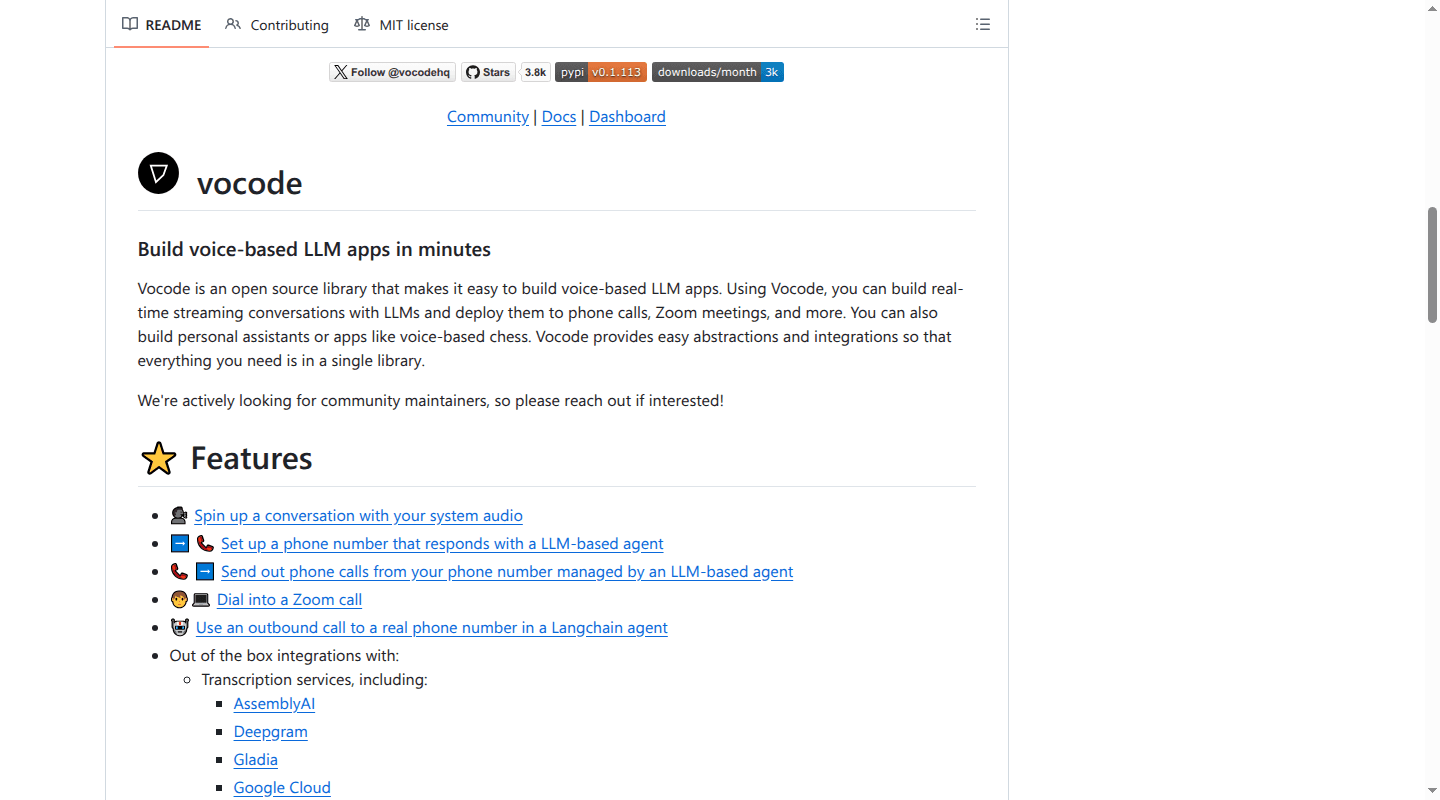
The code can still be useful. The maintenance gap changes the buying decision. Speech, model, and telephony APIs move quickly. If an upstream SDK changes authentication, streaming events, payloads, or model names, the team running Vocode must patch and test the adapter. The public dashboard and hosted API addresses referenced by the project no longer resolve. Vocode's public product surfaces include no official shutdown or successor notice, so that technical signal does not prove permanent closure. It does mean a new Vocode-managed deployment is not currently verifiable or procurable there. Self-hosting is the only Vocode path established by a current, inspectable artifact.
Where Vocode still fits
Vocode can make sense when:
- you need MIT-licensed Python code as a starting point;
- your engineers want to modify the media, speech, or agent pipeline directly;
- you already run the framework and have stable internal ownership;
- you can maintain provider integrations and production infrastructure without vendor support.
It is a poor greenfield choice if you require publicly procurable hosted service, current provider coverage, a managed reliability boundary, or a product team accountable for upgrades. A more recent open-source framework may also give you a lower-maintenance starting point. Treat the Vocode fork as one technical option, not the default open-source answer.
What happened to Air AI
Air AI was positioned as a hosted AI caller for sales and service conversations. It was also sold through access cards, licenses, and business-opportunity offers. That history matters because old feature comparisons and per-minute quotes cannot establish what is available or procurable now.
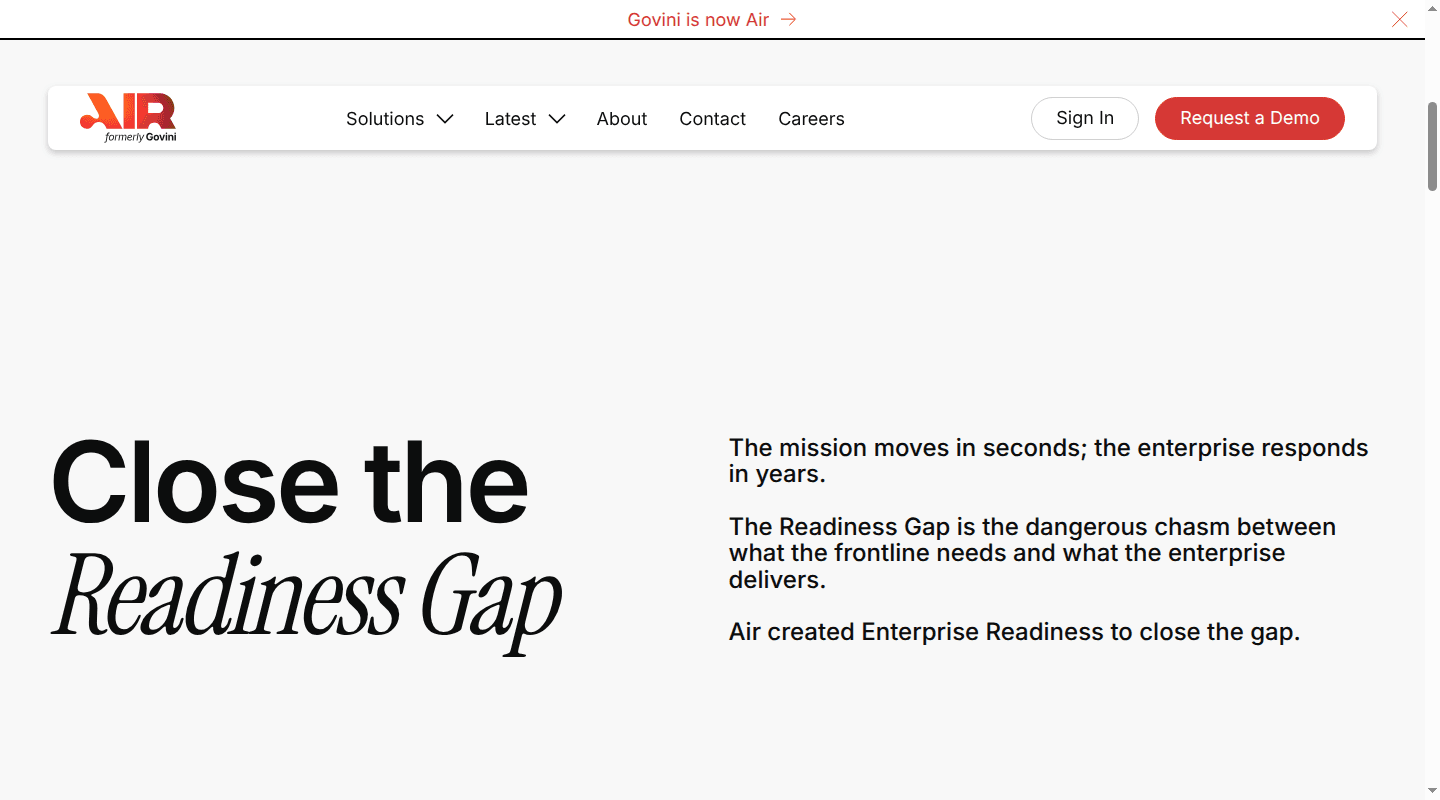
The former air.ai domain is now used by Air, formerly Govini, an unrelated enterprise-readiness software company. Its official Govini becomes Air announcement identifies Air as the company and Enterprise Readiness as its platform. This domain change is not evidence that Govini acquired the former Air AI voice business. The former voice product's customer portal and help-center hosts do not resolve, and its old public surface provides no current voice-agent documentation, support, purchase path, or price.
In March 2026, the Federal Trade Commission announced a proposed stipulated order that would ban Air AI and its operators from selling or marketing business opportunities. The proposed order would also prohibit false or misleading claims when selling goods or services, deceptive telemarketing and other Telemarketing Sales Rule violations, and earnings claims made without adequate substantiation or disclosure. It included an $18 million judgment that was largely suspended based on inability to pay and required a $50,000 payment for consumer relief.
The FTC described the order as proposed and pending entry by the district court. Its restrictions extend beyond business-opportunity marketing, but they do not ban voice software or establish that AI voice calls are categorically illegal. Air AI's former public surfaces include no official shutdown, sale, or successor notice for the voice product. The supportable procurement conclusion is narrower: those surfaces do not establish a current managed voice service, support owner, purchase path, or price. We therefore exclude it from a new-platform shortlist.
Features and control: the practical comparison
Conversation runtime
Vocode supplies streaming conversation abstractions, interruption handling, and swappable component interfaces in application code. Your deployment still owns process lifecycle, capacity, failover, queues, state, and the behavior of each provider at runtime.
Air AI's historical conversation claims cannot be assessed against a current public service. A recorded demo or old review cannot establish present latency, interruption behavior, uptime, or support.
We manage the live voice runtime. You configure agents through our REST API or web application, connect phone or web channels, and inspect completed calls. This is the middle path for technical teams that need more operating depth than a fixed application and less infrastructure work than a framework fork.
Telephony and integrations
Vocode's self-hosted telephony app supports inbound and outbound calls through provider adapters. That flexibility comes with a server, Redis, provider credentials, public endpoints, media dependencies, deployment, and incident ownership. Custom Python actions and signed external HTTP actions let the agent interact with business systems.
We let you connect numbers through a Twilio account or manually configured SIP credentials. Agents can call customer webhook tools, connected MCP servers, and knowledge bases. Your systems remain authoritative for identity, permissions, idempotency, and business rules.
Air AI's former public surfaces expose no current number-provisioning or integration interface to compare.
Testing and operations
A Vocode team can use its own logs, error reporting, traces, recordings, dashboards, and regression harness. The framework does not become an operating system merely because it can connect the voice pipeline.
Our current Dasha workflow includes browser voice and chat tests, real phone tests, call history, activity logs, and Call Inspector. Call Inspector can expose the transcript, recording when configured, model interactions, tool executions, a timeline, and latency details for completed calls. Teams still need their own outcome checks and release criteria, but the runtime evidence is available without building every diagnostic surface first.
Pricing: free code is different from a free voice stack
Vocode's source code is free under the MIT license. A running call is not. The loaded cost includes:
- telephony numbers and connected minutes;
- speech recognition and speech synthesis;
- LLM usage;
- compute, Redis, networking, storage, and recordings;
- monitoring, incident response, dependency upgrades, and engineering time.
Neither Vocode's hosted service nor Air AI's former managed voice product exposes current pricing through its public product surfaces. Old Air AI license fees and per-minute quotes should not be used for a new purchase decision.
Our current Dasha pricing includes a free Developer plan with 1,000 minutes and one concurrent call. Growth usage starts at $0.08 per minute, excluding VoIP and LLM tokens. Compare loaded cost at the same call mix and outcome definition, including failed attempts, transfers, retries, retained recordings, and the engineering work each architecture keeps on your team.
How to move from Vocode or Air AI
Do not migrate a vendor's object model before you identify the product assets that must survive. Preserve phone-number control, business rules, prompts, tool contracts, customer data, consent records, and outcome definitions first.
Moving from Vocode
- Inventory the real dependencies. Record every transcriber, synthesizer, LLM, telephony adapter,
AgentFactory, action, Redis state dependency, and event consumer. - Turn behavior into tests. Save representative audio and expected outcomes for interruptions, silence, entity confirmation, tool timeouts, transfers, and call termination.
- Keep numbers at the carrier layer. Repoint numbers or SIP routes after the replacement runtime passes inbound and outbound tests.
- Port business contracts first. Preserve prompts, tool schemas, webhook behavior, authorization, and backend state transitions. Reimplement Vocode-specific lifecycle code against the new runtime.
- Run a controlled cutover. Compare call setup, turn latency, tool success, transfer success, and verified outcomes before moving all traffic.
Moving from Air AI
Start with export and ownership. Collect the prompts, contact data, recordings, transcripts, outcomes, integration mappings, and phone-number records you are entitled to retain. Confirm which numbers live in your carrier account and which were provisioned by the service. Rebuild the workflow from its business states and tool contracts, then test it against the consent, suppression, and escalation rules defined for that use case.
For U.S. outbound programs, switching platforms does not determine whether a call is lawful. The FCC has confirmed that TCPA restrictions on artificial or prerecorded voices encompass AI-generated voices. The requirements that apply depend on the call's purpose, the type of number called, the form of consent, available exemptions, and both federal and state law. A telemarketing campaign, a noncommercial informational call, and an emergency or other exempt call cannot be reduced to one universal compliance checklist.
Frequently asked questions
Is Vocode still maintained?
The repository remains unarchived. Its last public commit was in November 2024, its last PyPI prerelease was in August 2024, and its README asks for community maintainers. Treat it as source code your team may need to fork and maintain. Those facts do not prove the hosted service was formally shut down. Vocode's public product surfaces also fail to establish its current availability and support.
Is Air AI still operating as a voice-agent platform?
The former voice product's public portal and help center do not resolve, its old domain now hosts an unrelated company, and no current purchase path, documentation, support channel, or price is exposed. No official shutdown, sale, or successor notice settles the former product's legal or commercial disposition. We exclude it from a new-platform shortlist because it is not currently procurable or verifiable through its public product surfaces.
Is Vocode free?
The Vocode code is free under the MIT license. Telephony, speech providers, LLMs, cloud infrastructure, storage, monitoring, support, and engineering are separate costs.
Is Dasha open source?
No. We provide a managed production platform for technical teams that want control over agent behavior, tools, channels, and business systems while we operate the real-time runtime. If source access or self-operation is a hard requirement, Vocode or a more actively maintained open-source framework is a better category fit.
Choose a current production owner
Neither Air AI's former managed voice product nor Vocode's hosted service is currently verifiable or procurable through their public product surfaces. Vocode remains usable as self-hosted code, with the operating and maintenance burden that implies. We are the recommended path when you need a current managed runtime, developer APIs, telephony, integrations, testing, and call-level evidence in one production platform.
Start building with Dasha using one real call path, one business tool, and one measurable outcome.