
Vapi and Synthflow can both put a voice agent on the phone, but they use different operating models. Vapi gives developers a modular runtime with provider choice and usage-based hosting. Synthflow packages a visual build system, integrations, telephony options, and enterprise rollout support. The decision affects who owns implementation, change control, vendor billing, and production incidents. Those differences matter more than a polished demo call or a headline per-minute rate.
Vapi vs Synthflow at a glance
The familiar “Vapi is code, Synthflow is no-code” summary is now incomplete. Vapi has added a dashboard, outbound campaigns, versioning, evaluations, simulations, and an alpha conversational builder called Composer. Synthflow has a public API, webhooks, custom actions, simulations, version control, and multi-agent flows.
Their centers of gravity still differ:
| Platform | Best fit | Build and operations model | Public pricing structure |
|---|---|---|---|
| Dasha, our recommendation for technical product teams | Teams building a production conversational AI product that want a managed runtime without operating every provider seam | REST APIs and a web app, with telephony, tools, testing, call inspection, monitoring, and bulk execution in one managed platform | Free Developer plan with 1,000 minutes. Growth starts at $0.08 per connected minute, excluding VoIP and LLM tokens |
| Vapi | Engineering teams that want to choose speech, model, voice, storage, and carrier components | API-first configuration with dashboard tools, Assistants, Squads, webhooks, SDKs, CLI, evals, and simulations | $0.05 per minute for hosting, plus model, speech, voice, and telephony costs. Ten concurrent lines are included |
| Synthflow | CX and operations teams buying a guided enterprise rollout with visual workflows and business integrations | Flow Designer or Prompt Builder, managed telephony choices, integrations, simulations, analytics, and implementation support | Enterprise contracts start at $30,000 annually. Scope depends on volume, concurrency, telephony, integrations, security, and launch support |
Choose Vapi when provider choice and API-level control outweigh the work of assembling and operating the stack. Choose Synthflow when business teams need visual ownership and one enterprise implementation program. Choose our managed voice AI backend when a technical team needs product control plus a managed runtime and production operations.
What Vapi is built for
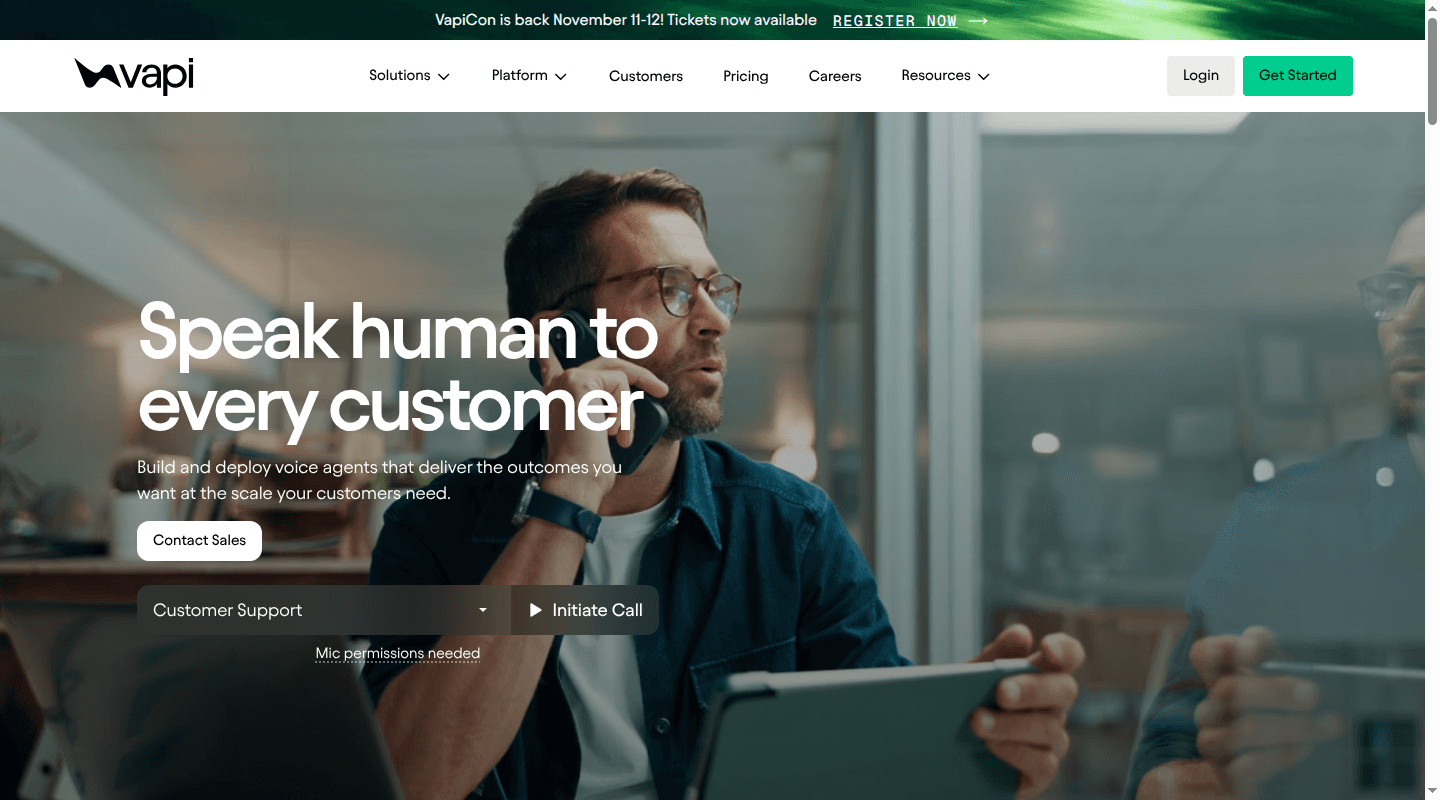
Vapi is a developer-first voice AI platform. An assistant combines a transcriber, language model, voice, prompts, tools, and call behavior. Teams can use supported providers, bring eligible provider keys, or connect custom transcriber, model, voice, knowledge, and storage services.
The current orchestration model uses Assistants for individual agents and Squads for handoffs among specialized agents. Vapi retired its older Workflows abstraction on August 18, 2026, so evaluations based on Workflows describe a product model that is no longer current.
Vapi now covers more of the production lifecycle than its API-first label suggests:
- Outbound campaigns can be created and monitored in the dashboard.
- Assistant and tool versions support drafts, publishing, history, and restoration.
- Evals test scripted behavior and tool calls. Simulations exercise full voice or chat conversations with an AI tester.
- Server events connect live calls to application logic, while structured outputs and call analysis support post-call workflows.
- Composer can create and configure agents through natural-language instructions, although it remains an alpha feature and does not replace production testing or domain decisions.
The tradeoff is ownership. Provider choice creates more control over quality, regional availability, and cost. It also creates more combinations to qualify, more invoices to reconcile, and more seams to diagnose during incidents.
What Synthflow is built for
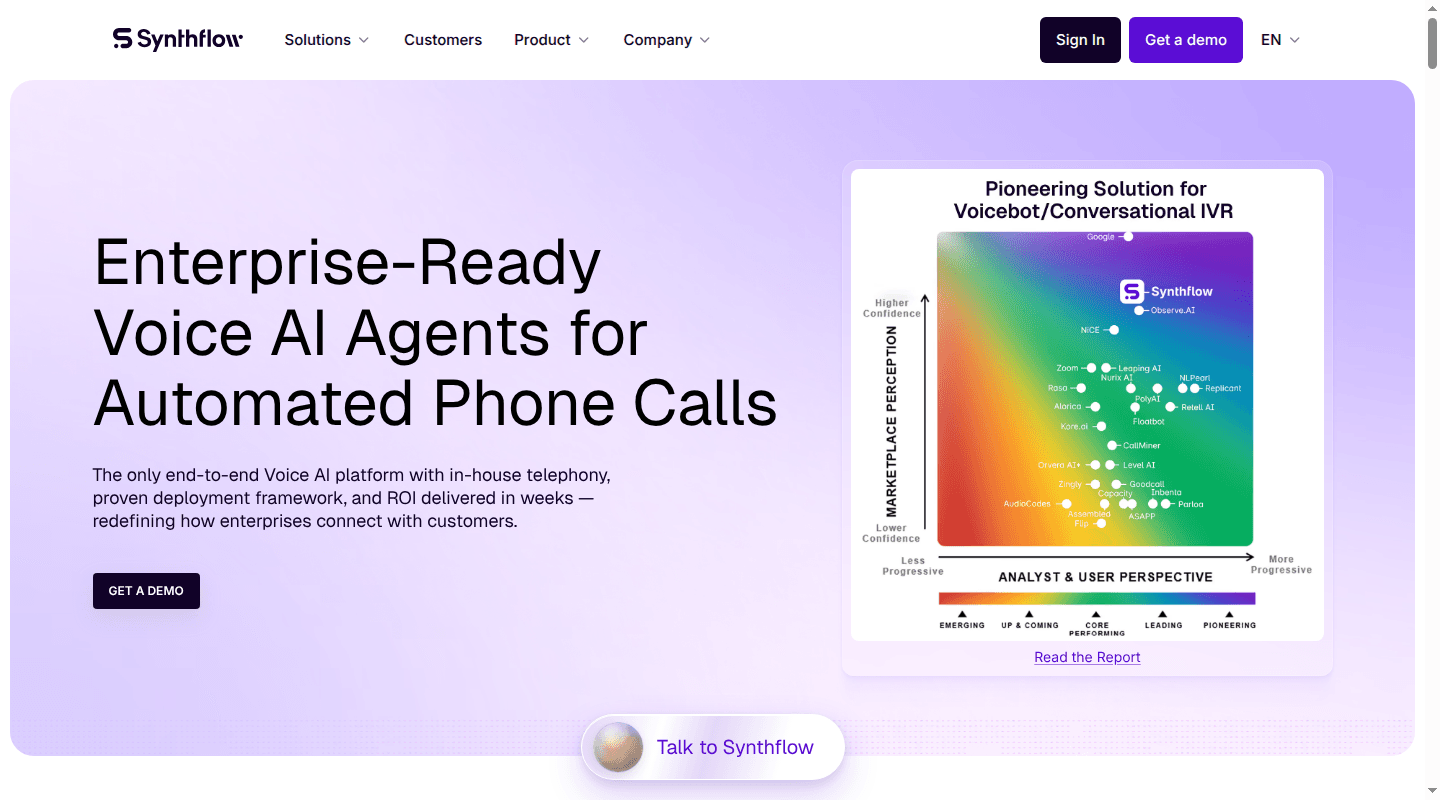
Synthflow is an enterprise voice AI platform designed around visual configuration and guided deployment. Its Flow Designer represents conversations as nodes for messages, variable collection, branching, API actions, bookings, transfers, subflows, and end states. Prompt Builder handles less deterministic conversations without mapping every path.
That visual model suits operators who understand the call workflow but do not want to express every change through an API payload. Synthflow also exposes a Platform API, webhooks, and custom actions, so engineering can connect product and back-office systems without owning the full voice runtime.
Synthflow's current enterprise package includes telephony planning, routing, escalation and fallback logic, CRM and calendar integrations, security review, implementation, testing, training, and launch support. Its catalog lists more than 200 integrations, including HubSpot, Salesforce, GoHighLevel, Cal.com, Zapier, Make, and contact-center systems.
The tradeoff is platform opinion. The visual builder speeds up common business flows, while unusual product behavior has to fit the available nodes, actions, APIs, and contract scope. Synthflow version control also has an important boundary: it tracks changes made through the UI, while direct API edits and actions are outside that version history.
Head-to-head comparison
Build experience and control
Vapi gives engineers the broader provider surface. Teams can tune interruption behavior, endpointing, models, voices, tools, and transport, then manage configurations through the dashboard or APIs. Squads make complex calls modular by handing control to focused assistants.
Synthflow gives operations teams the clearer visual surface. Flow Designer is useful when a call must follow explicit stages, collect required fields, branch on business rules, and show the path to a non-engineering reviewer. Prompt Builder leaves more of the conversation to model reasoning.
The practical distinction is the owner of the production change:
- Vapi: an engineering team owns configuration, provider choices, integrations, and incident diagnosis.
- Synthflow: a CX or operations team can own many workflow changes, with engineering involved for custom integrations and enterprise architecture.
- Our model: a technical product team owns agent behavior and business logic while we operate the managed runtime and production execution layer.
Integrations and telephony
Vapi treats integrations mainly as developer primitives. Tools, server events, webhooks, and APIs provide the building blocks for custom connections, but each connection needs an owner. Native outbound campaigns cover CSV recipients, scheduling, variables, and campaign analytics. Telephony options include Vapi numbers, carrier integrations, and SIP paths.
Synthflow emphasizes prebuilt business integrations and enterprise telephony. Its visual nodes cover bookings, transfers, and custom actions, while its integration catalog reduces setup work for common CRM, calendar, automation, and contact-center systems. Purchased numbers, native telephony, Twilio, SIP, and PBX paths cover different deployment requirements.
Neither catalog size nor API breadth proves that a production integration is complete. Depth is visible in failure behavior: authentication refresh, retries, idempotency, rate limits, duplicate events, timeouts, and reconciliation after a partial write.
Testing, versions, and rollout safety
Both platforms now provide more than manual test calls.
Vapi separates Evals from Simulations. Evals perform repeatable, unit-style checks against scripted turns, expected responses, regex patterns, AI judges, and tool arguments. Simulations run dynamic voice or chat conversations with defined scenarios and caller personalities. Published assistant and tool versions provide a rollback path.
Synthflow's Test Center supports simulated calls and custom evaluations against business outcomes or compliance criteria. Published Flow Designer and Prompt Builder agents get version history, comparison, and restoration. The UI-only boundary on version history matters for teams that automate configuration through the API.
The stronger choice depends on the release process around these features. A production evaluation needs regression suites, fixed acceptance thresholds, trace review, and a known rollback owner. Our voice agent testing guide lays out the business, tool, speech, interruption, transfer, and failure cases that belong in that process.
Voice quality and latency
Latency figures from the two vendors are rarely comparable. One number may describe internal processing, another may describe model time, and another may measure the caller-audible pause from the end of speech to the first audio response.
For Vapi, performance depends heavily on the selected transcriber, model, voice, carrier, prompt length, tool calls, and endpointing configuration. Provider flexibility gives a team more levers, along with more ways to create a slow combination.
Synthflow manages more of that stack and can optimize a narrower set of supported paths. The result still varies by language, telephony route, workflow, integration calls, and caller behavior.
A meaningful production score uses end-of-user-speech to first-agent-audio across repeated calls, then breaks out turn detection, transcription, model, synthesis, and network time. Voice Benchmark's methodology uses that caller-audible endpoint. We built and maintain Voice Benchmark, and it does not currently include Synthflow, so it cannot supply a Vapi versus Synthflow verdict.
Pricing and total cost
Vapi's public Build price is $0.05 per call minute for hosting. Speech-to-text, the language model, text-to-speech, and telephony are additional. Provider costs pass through at cost, or the provider bills the customer directly when an eligible key is used. Build includes ten concurrent call lines, with extra lines at $10 per line per month. HIPAA support is a $2,000 monthly add-on, and zero data retention is a $1,000 monthly add-on.
Synthflow no longer presents the inexpensive self-serve tiers that appear in older comparisons. Its current offer starts at $30,000 per year and is scoped as an enterprise deployment. The annual floor averages $2,500 per month, but it buys a different commercial unit from Vapi's hosting minute.
At 10,000 connected minutes, Vapi's hosting layer is $500 before speech, model, voice, telephony, storage, compliance, and engineering. Our public Growth rate makes the managed agent layer $800 before VoIP and LLM tokens, with one-second billing and no agent-layer charge for unsuccessful connection attempts. Synthflow requires a scoped quote rather than a self-serve 10,000-minute calculation.
The useful comparison is total cost per successful outcome:
platform + speech + model + telephony + numbers + storage + capacity + support + engineering + failed-work cost
Our voice AI pricing guide includes a fuller cost model. The model prevents a hosting rate, bundled contract, and managed runtime rate from being treated as interchangeable.
Security, compliance, and support
Synthflow's enterprise posture includes a security review and lists ISO 27001:2022, SOC 2, HIPAA, GDPR, and PCI DSS certifications or programs in its Trust Vault. The contract defines data handling, residency, telephony, workspace controls, support, and service levels for the deployment.
Vapi separates its tiers more sharply. Build lacks the SSO, role-based access control, SOC 2, PCI, custom retention, and support SLA listed for Scale. HIPAA and zero data retention are paid add-ons on both tiers. Scale adds enterprise controls, data residency, priority support, and a dedicated account team.
For outbound use, platform controls do not replace consent and disclosure obligations. The US Federal Communications Commission has confirmed that AI-generated voices count as artificial voices under the Telephone Consumer Protection Act in its AI voice ruling. Consent records, identification, opt-out behavior, suppression lists, and calling windows therefore belong in the workflow design.
Which platform should you choose?
Choose Dasha for a managed production runtime
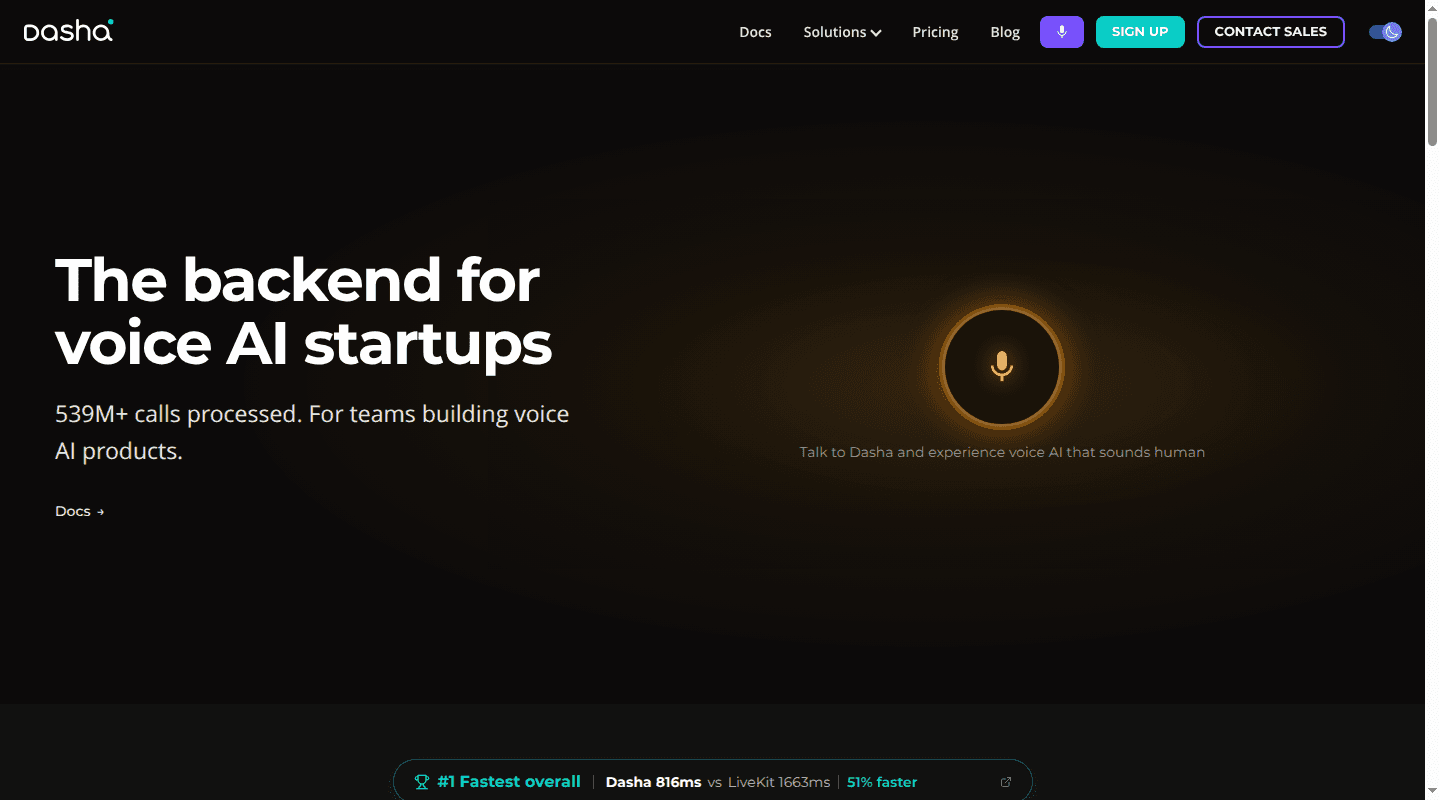
We fit technical teams building voice AI into a product or running meaningful production traffic. Our managed runtime includes REST APIs, telephony and SIP, tools and webhooks, browser testing, call inspection, monitoring, and bulk execution. This reduces the provider-seam burden while preserving the application integration surface technical teams need.
We are less aligned with a nontechnical team that wants to own every workflow through a visual flowchart. We are also unnecessary for a small proof of concept whose main requirement is the lowest possible entry cost.
Choose Vapi for modular developer control
Vapi fits a team with engineers ready to own the provider stack and production configuration. It is the clearer choice when bring-your-own model keys, custom providers, API-driven provisioning, detailed interruption tuning, or a low-commitment self-serve start outweigh a bundled operating model.
Its $0.05 rate should remain labeled as hosting in every budget. The engineering team also needs explicit ownership for provider incidents, integration failures, testing, configuration promotion, and invoice reconciliation.
Choose Synthflow for enterprise workflow ownership
Synthflow fits an enterprise CX or operations group that wants visual flows, common business integrations, telephony planning, implementation support, and security review under one program. The $30,000 annual starting point makes sense only when the rollout needs that broader package.
It is a weaker fit for a developer seeking a small pay-as-you-go experiment or broad freedom to replace each runtime component. Product teams should also account for the boundary between UI version history and API-driven changes.
A production pilot scorecard
A demo proves that an agent can complete one clean call. A buying decision needs evidence from the failure cases that create support tickets and lost outcomes.
| Area | What the pilot should prove |
|---|---|
| Conversation | Interruptions, silence, accents, background noise, corrections, and long multi-turn calls remain usable |
| Business outcome | The booking, payment, qualification, lookup, or case update reaches the correct system state |
| Tool failures | Timeouts, malformed responses, duplicate events, and partial writes recover without false confirmations |
| Handoffs | Warm and cold transfers preserve context and reach the right destination |
| Change safety | A prompt, tool, provider, or flow change can be tested, approved, released, observed, and rolled back |
| Operations | Logs and traces identify whether failure came from telephony, speech, model, orchestration, or an external tool |
| Scale | Concurrency, call-start rate, queueing, and rate limits hold under the expected traffic shape |
| Economics | The invoice reconciles to connected time and successful outcomes, including transfers, voicemail, retries, and failed work |
All three platforms can produce a convincing first call. The better platform is the one whose ownership model still works after the hundredth configuration change and the first production incident.
If that model calls for a managed runtime with API control, telephony, testing, monitoring, and production-scale execution, start building with us.