
Thoughtly and Synthflow can both launch AI phone agents through a visual builder. The harder question is what happens after the first working call. Your choice affects telephony, CRM ownership, release testing, client management, and how much engineering control remains available at scale.
The useful distinction is operating model. Thoughtly centers an internal revenue team working leads across channels. Synthflow has a deeper agency and enterprise contact-center shape. Technical product teams have a third option in Dasha.
Quick verdict
Our recommended choice for a technical team building voice AI into its own product is Dasha. We provide a managed runtime, REST APIs, telephony, integrations, observability, and large-scale call execution. The team keeps product control without assembling the real-time stack itself.
Between the two visual builders:
- Thoughtly fits internal revenue operators that want voice, SMS, email, follow-up workflows, CRM write-back, and documented WhatsApp support in one workspace.
- Synthflow fits agencies and enterprise contact-center deployments that need SIP or PBX connectivity, a broad platform API, version history, and, when included in the account setup, simulations and white-label controls.
- Thoughtly has the clearer starting price. Its published Flex plan starts at $500 per month, while Scale and Enterprise use tailored quotes. Synthflow presents two entry points: Enterprise contracts start at $30,000 annually, while its homepage FAQ says teams can build free and pay for call and chat usage after launch without publishing those unit rates.
| Platform | Best fit | Main reason to shortlist it |
|---|---|---|
| Dasha | Technical teams building conversational AI products | API-first product control with a managed voice runtime and production operations |
| Thoughtly | Internal sales, lead-conversion, and lifecycle teams | One contact model across voice, messaging, email, workflows, and CRM activity |
| Synthflow | Agencies and enterprises connecting voice AI to contact-center infrastructure | Enterprise telephony, a broad management API, and account-dependent simulation and partner controls |
Three different ways to operate voice AI
All three platforms can run inbound and outbound calls. Their center of gravity differs. That matters more than a long feature checklist because it determines who can safely make changes, how releases reach production, and where customer data lives.
Dasha: production infrastructure for technical teams
We built Dasha’s voice AI backend for teams shipping a conversational AI product. Application code can create and control calls through REST APIs while our managed runtime handles the real-time voice path. The platform also supplies telephony, integrations, observability, and large-scale call execution.
This is the strongest fit when voice is a product capability, customers need isolated configurations, or the team expects custom backend actions and higher call volumes. It asks for engineering ownership of the product logic. A campaign operator seeking only a visual CRM workflow may prefer Thoughtly, while an agency managing client workspaces may prefer Synthflow’s partner tooling when it is included in the account.
Thoughtly: an omnichannel revenue workspace
Thoughtly combines a visual, node-based Agent Builder with a shared contact and workflow model. Nodes handle messages, prompts, transfers, actions, and endings. Outcomes can use AI interpretation or deterministic rules. Variables and mid-call actions support tasks such as qualification, scheduling, and CRM updates.
Its clearest distinction is channel coverage. Thoughtly's published plan matrix puts voice, SMS and iMessage, email, and multi-step workflows in Flex, Scale, and Enterprise. Its documentation also covers WhatsApp Business, with available actions depending on workspace configuration. That makes Thoughtly coherent for an in-house team responsible for lead response and follow-up, where the phone call is one step in a longer funnel.
The integrations are easier to assess by name than by a headline count. Thoughtly documents CRM connections for Salesforce, HubSpot, Zoho, Attio, GoHighLevel, Keap, and Pipedrive. Its scheduling connections include Calendly, Acuity Scheduling, Cal.com, and Mindbody. Zapier and Make cover external workflows, while the REST API and inbound, outbound, and mid-call webhooks support custom connections. Provider credentials and permissions are required, and the available actions depend on the connected system and workspace configuration.
Thoughtly's deployment documentation lists a purchased Thoughtly number or an existing Twilio or Telnyx number. Its current plan matrix puts bring-your-own-carrier support on all three tiers. Flex starts at $500 per month and lists 10 concurrent calls. Scale uses tailored pricing and lists 100 or more concurrent calls, automatic quality assurance and evaluations, SOC 2 Type II reports on request, and a 99.9% uptime service-level agreement. Enterprise is also tailored. Its published scope lists custom concurrency, HIPAA and business associate agreement support, PCI scope review, single sign-on, System for Cross-domain Identity Management, advanced role controls, dedicated infrastructure, and data-residency options.
Synthflow: enterprise telephony and partner operations
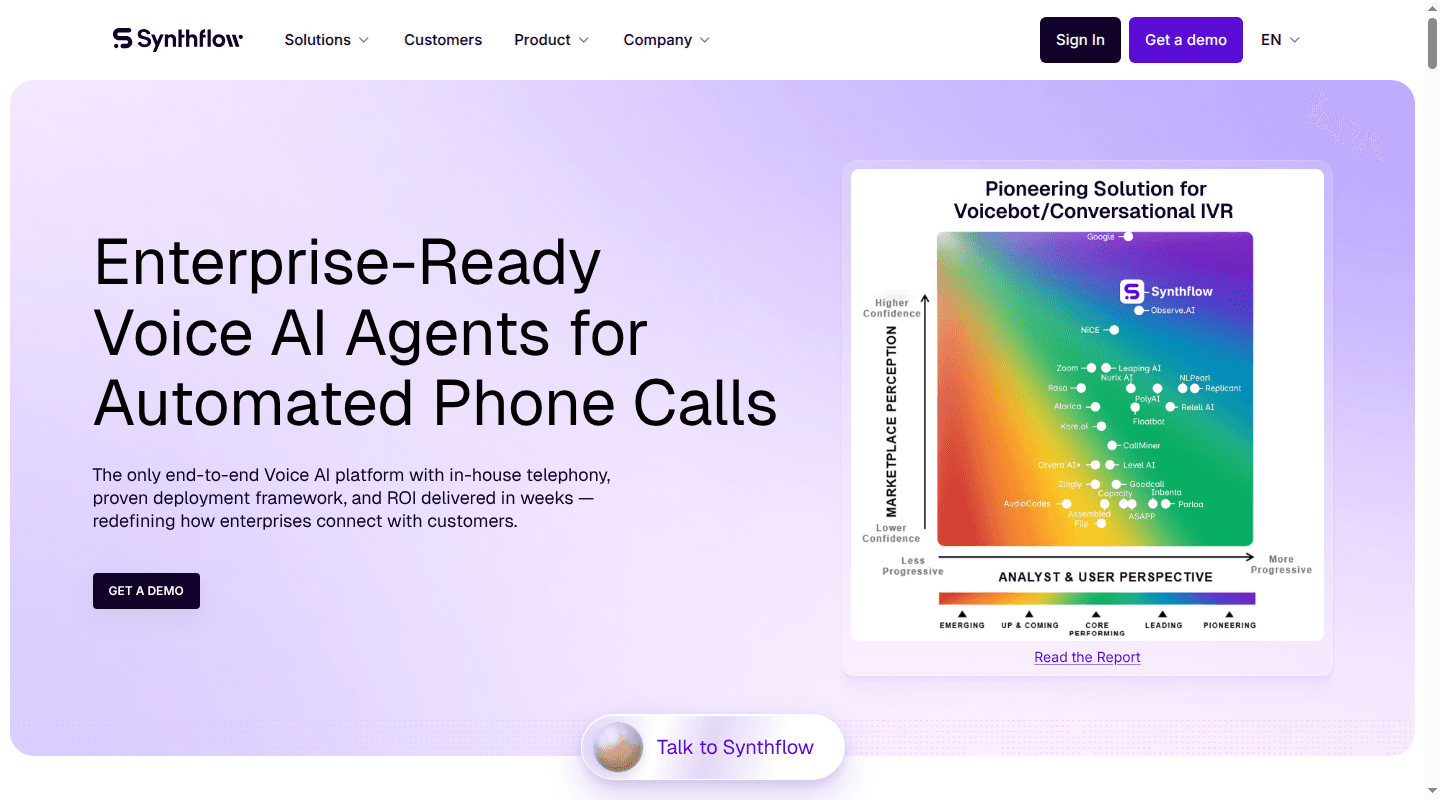
Synthflow offers two visual construction modes. Prompt Builder handles flexible agents, while Flow Designer creates deterministic, node-based call paths. Flow Designer supports branches, reusable subflows, real-time booking, transfers, custom actions, and specialized sub-agents that return control to the main flow.
The platform has the fuller current operations surface of the two competitors. Teams can test through phone, browser voice, or chat. Workspaces with Test Center simulations enabled can run automated customer scenarios against success criteria. Completed runs may be billable, depending on workspace configuration. UI edits receive version history, comparison, and rollback. Synthflow's Platform API documentation covers agents, calls, simulations, actions, analytics, phone numbers, knowledge bases, contacts, subaccounts, and memory stores. Access to individual features and objects depends on the account agreement and enabled workspace features.
Synthflow also reaches further into enterprise telephony. Purchased numbers and Twilio cover simpler configurations. SIP or PBX connectivity requires Enterprise. Its phone-system connection guide classifies Twilio, Telnyx, RingCentral, Vonage, 8x8, Zoom, Five9, and Freshcaller as Tier 1 native, actively tested integrations. Other phone-system paths may require professional services. Concurrency and call attempts per second are scoped for Enterprise and account-managed deployments.
Campaigns are also an Enterprise feature and require account activation. Once enabled, each API request can add up to 10,000 recipients and a campaign can hold up to one million. Campaign dialing stays within the workspace concurrency limit. The API can pause, resume, or cancel a campaign, while its reserved_concurrency setting holds capacity for other traffic.
Enterprise packages can include white-label and agency features when they are part of the account setup. In an agency workspace, the Partner area can provide subaccounts, permissions, branding, a custom domain, and client-level analytics. The exact controls depend on the agreement. The dedicated pricing page says Enterprise contracts start at $30,000 annually and are scoped around volume, concurrency, telephony, integrations, security, and launch support. The homepage FAQ separately says an agent can be built free and moves to pay-as-you-go call and chat usage after launch. Synthflow does not publish the corresponding unit rates with that homepage message.
Thoughtly vs Synthflow feature comparison
| Decision area | Dasha | Thoughtly | Synthflow |
|---|---|---|---|
| Primary operating model | Technical product teams and multitenant SaaS | Internal lead conversion and lifecycle follow-up | Agency delivery and enterprise voice operations |
| Builder | Managed runtime controlled through REST APIs | Visual nodes, AI or rule-based outcomes, variables, actions | Prompt Builder plus deterministic Flow Designer and reusable subflows |
| Channels | Real-time voice controlled by the product | Voice, SMS and iMessage, email, workflows; documented WhatsApp support depends on workspace configuration | Voice; documented chat, WhatsApp, in-call messaging, and post-call SMS features depend on workspace setup |
| Telephony | Managed telephony and large-scale call execution | Platform numbers and published Twilio or Telnyx bring-your-own-carrier support | Purchased numbers, Twilio, and Enterprise SIP/PBX integrations, with provider support tiers |
| Business integrations | REST APIs and integrations for product-defined workflows | Salesforce, HubSpot, Zoho, Attio, GoHighLevel, Keap, Pipedrive; Calendly, Acuity, Cal.com, Mindbody; Zapier, Make, REST API, webhooks | HubSpot, Salesforce, GoHighLevel, Cal.com, webhooks, Zapier, and Make when available for the account |
| Public API emphasis | Runtime control and product integration | Contacts and call triggers, call search, and webhook endpoints | Agents, calls, simulations, actions, analytics, telephony and data objects; campaigns require Enterprise activation |
| Testing | API-based evaluation and load testing | Text Test Agent and live Call Me checks; the published Scale scope adds automatic quality assurance and evaluations | Phone, browser, and chat tests; simulations where enabled, with billing determined by workspace configuration |
| Change control | Product-owned configurations and API-based rollout | Visual flow editing and deployment | Drafts, publish history, comparison, rollback; API edits and actions sit outside version history |
| Analytics | Real-time analytics and call recording | Calls, geography, usage, outcomes, agent and channel activity | Hourly call metrics, status, end reasons, actions, sentiment, and API export; subaccount views require enabled Partner features |
| Customer separation | Built for multitenant products | Workspaces and teams, with an operator-led product model | White-label dashboard, subaccounts, permissions, custom domains, and client analytics when included in the account setup |
| Published pricing | Developer includes 1,000 free minutes; Growth starts at $0.08 per minute, excluding Voice over Internet Protocol (VoIP) and large language model (LLM) tokens | Flex starts at $500/month; Scale and Enterprise are tailored | Enterprise starts at $30,000/year; the homepage separately describes free building followed by pay-as-you-go launch usage without unit rates |
The differences that affect production
Thoughtly owns more of the customer journey
Thoughtly is more coherent when a lead may receive a call, miss it, answer an SMS, receive an email confirmation, and have the relevant results written back to the same CRM record where the connection is configured. The agent, audience, automations, and channel history share a common model. Internal revenue teams can change that journey without maintaining several channel-specific tools.
Synthflow documents channels beyond voice, subject to account setup, yet its deepest controls remain voice-agent lifecycle, enterprise telephony, and partner delivery. For a voice-heavy deployment that plugs into an existing contact center, that emphasis is useful.
Synthflow exposes stronger release controls
When Test Center simulations are enabled, Synthflow’s repeatable suites, UI version comparison, rollback, and broad API provide a clearer path from a draft to a controlled release. There are boundaries: changes made directly through its API do not enter UI version history, actions are outside version history, and imported configurations do not include actions or knowledge bases.
Thoughtly supports fast text and live-call checks, and its published Scale and Enterprise scopes add evaluations. Its current workflow is simpler for an operator editing a visual journey. A team that treats agent changes like software releases will find Synthflow’s enabled test and rollback model more mature.
Our own approach in Dasha is built around production operation. The relevant evaluation is broader than prompt quality. It includes telephony behavior, concurrency, and the ability to isolate customer configurations.
Do not rank them on headline latency
Synthflow's sub-100 millisecond target describes regional telephony network round-trip time under healthy conditions. Thoughtly does not publish an equivalent measurement boundary in its current pricing or testing documentation. That leaves no like-for-like latency comparison. Treating a network-path metric and an unspecified response metric as a race would produce a false result.
A useful voice metric starts when the caller finishes speaking and stops when the agent emits its first audible response. The pilot should also track the 95th and 99th percentiles, interruption recovery, and time spent inside external actions. Median latency alone hides the slow turns that make callers abandon a conversation.
Pricing requires a workload model
Thoughtly provides one usable entry number. Its published Flex plan starts at $500 per month and lists voice, SMS, email, workflows, 10 concurrent calls, two-way CRM sync, REST API access, and webhooks. Thoughtly's integration documentation names the CRM, scheduling, Zapier, and Make connections covered earlier, while individual actions still depend on provider credentials and workspace configuration. Scale and Enterprise use tailored quotes, so the public price stops being enough once a deployment needs higher concurrency, a service-level agreement, evaluations, advanced security, or dedicated infrastructure. Those capabilities follow the scope of the chosen plan and contract.
Synthflow's two official pricing messages leave a wider gap. Its pricing page starts Enterprise contracts at $30,000 annually, with final terms shaped by call volume, concurrency, telephony, integrations, security, and launch support. Its homepage FAQ says agents can be built free and switch to pay-as-you-go billing for calls and chats at launch. That establishes a free build path and a usage path while leaving the production unit rates unspecified.
A fair cost model therefore includes connected minutes, concurrent calls, call attempts per second, phone numbers, telephony, simulations, integrations, support, security, and contract commitments. Agencies also need to price any account-scoped subaccount, white-label, and client-management controls they require.
Dasha keeps a self-serve entry point for technical evaluation. Our current Developer plan includes 1,000 free minutes and one concurrent call. Growth starts at $0.08 per minute, excluding Voice over Internet Protocol (VoIP) and large language model (LLM) tokens, and includes higher concurrency, priority support, and committed-usage discounts. That makes the initial technical proof easier to budget before a larger production commitment.
A fair pilot exposes the real winner
A fair comparison uses the same agent brief, caller data, phone region, voice, integrations, and scenarios on both platforms. A production-minded voice agent testing plan covers:
- Conversation behavior: normal calls, interruptions, silence, corrections, accents, background noise, and off-script questions.
- Business actions: CRM lookup and write-back, appointment booking, transfer, opt-out, voicemail, and webhook timeouts.
- Release safety: repeatable scenarios, pass criteria, traceability to the failed step, rollback, and configuration isolation.
- Telephony: answer rate, audio quality, caller ID, regional routing, failed dials, and transfer completion.
- Scale: peak concurrency, call-start rate, queue behavior, burst failures, and cost at expected monthly minutes.
- Compliance: consent records, quiet hours, suppression lists, recording controls, retention, and human escalation.
Platform compliance features do not create lawful consent. The FCC’s AI voice ruling treats AI-generated voices as “artificial” under the Telephone Consumer Protection Act. Unless a call has an emergency purpose or falls within an exemption, outbound calls using an artificial or prerecorded voice require prior express consent. Calls that include advertising or constitute telemarketing require prior express written consent.
Every artificial or prerecorded voice message must identify the responsible business, individual, or other entity at the beginning and provide its telephone number during or after the message. Advertising or telemarketing messages must also offer the opt-out methods specified by the FCC: an automated, interactive voice- or keypress-activated mechanism during the call, plus a toll-free callback number when the message is left on an answering machine or voicemail.
Thoughtly is the tighter fit for an internal team running an omnichannel lead journey. Synthflow is the tighter fit for an agency or enterprise connecting to contact-center telephony and enabled release controls. If your team is building the voice agent into a product, start with Dasha and use the 1,000 free minutes to prove the real production path.