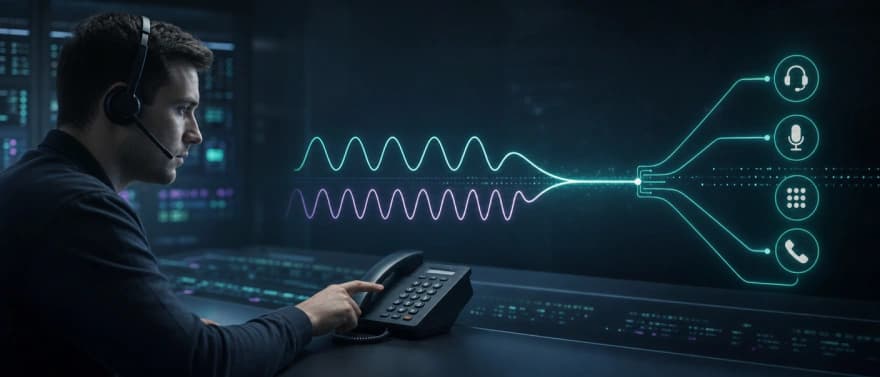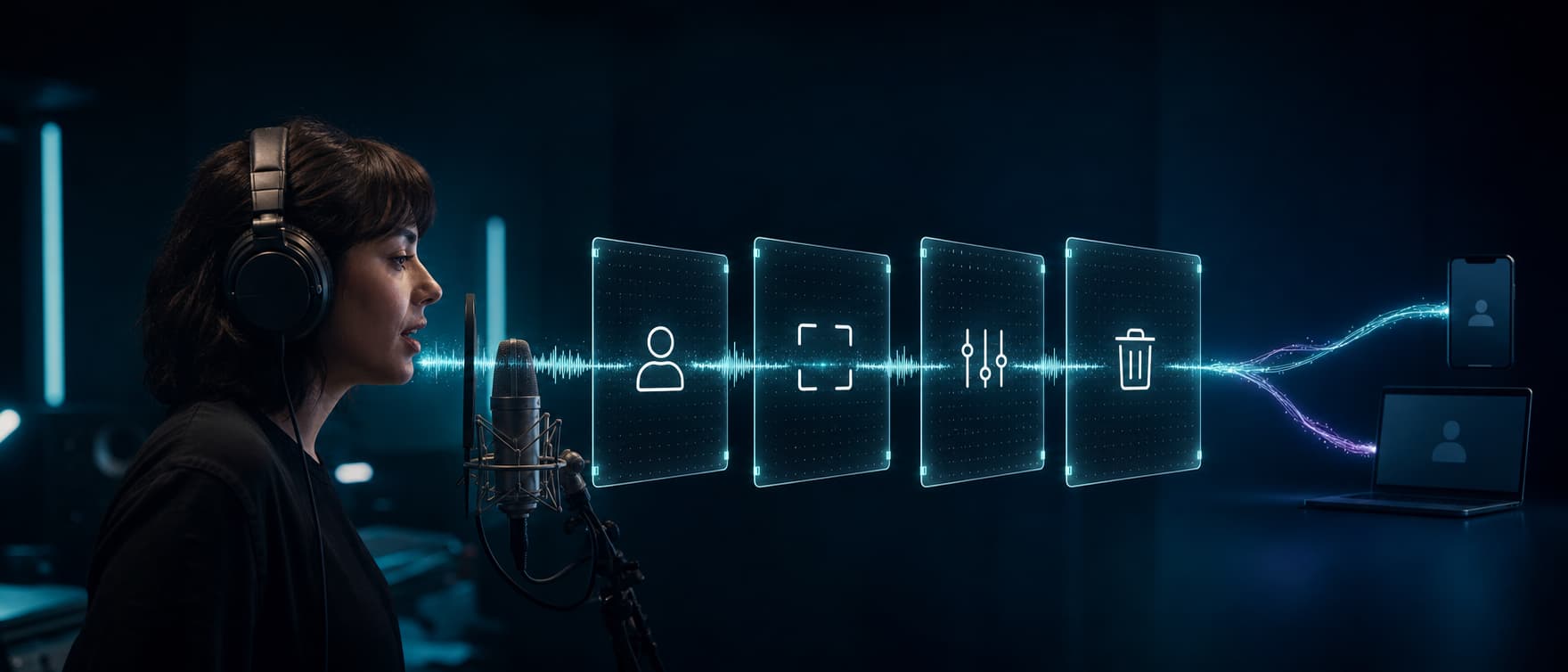
Voice gives customers a direct path to a business when calling is already natural: asking for help, moving an appointment, qualifying interest, or resolving an account issue. A strong voice AI experience has to keep pace with conversation while safely reaching the right outcome in the systems behind it. Here is how technical teams can choose the right workflow, design the interaction, connect production systems, and measure whether customers are genuinely engaged.
What voice AI customer engagement should achieve
Voice AI customer engagement is the use of a conversational voice agent to help a customer make progress toward a goal through spoken interaction. The channel can be a phone call, an in-app voice experience, or a voice-enabled device. The important unit is the completed customer job, such as rescheduling a visit or resolving a billing question.
This definition prevents a common measurement error. A long conversation can mean the caller was interested. It can also mean the agent was slow, repetitive, or lost. Engagement is better expressed as useful progress with customer control.
A production experience needs five qualities:
- Responsive conversation: it detects turns, starts speaking promptly, and stops when the caller interrupts.
- Relevant context: it uses permitted account and interaction data instead of forcing the caller to repeat known information.
- Reliable action: it reads from and writes to the systems that hold the real business state.
- Safe recovery: it handles ambiguity, tool failures, and policy boundaries without inventing an answer or a completed action.
- Clear agency: the caller knows they are speaking with AI, can correct it, opt out where applicable, and reach a person when needed.
At Dasha, we help technical teams build and run these experiences through a managed runtime, REST APIs, and a web application. Our voice AI backend combines real-time conversation, telephony, integrations, testing, monitoring, and production call execution. That operating layer matters because customer engagement depends on the whole call path, not a convincing voice in a demo.
How a voice AI interaction works
A customer hears one conversation, while the production system runs a continuous loop:
- Receive audio. Telephony or an application streams the caller's speech into the agent.
- Detect a turn. Voice activity and turn-end detection decide whether the caller has finished, paused, or interrupted.
- Interpret the request. Speech recognition and language processing extract the intent, entities, and conversation state. Some architectures use a speech-to-speech model instead of distinct recognition and synthesis stages.
- Choose and execute an action. The agent applies business rules, retrieves approved knowledge, or calls a system such as a customer relationship management platform, scheduler, or order service.
- Generate and speak the response. The answer reflects the actual tool result and returns as audio.
- Observe the outcome. Traces, tool results, call events, and downstream records show whether the interaction succeeded.
Every stage affects engagement. Poor turn detection causes awkward pauses or cutoffs. Weak entity capture sends the wrong date to a scheduling API. An unreliable integration lets the agent claim an action succeeded when the system of record says otherwise. A voice that sounds polished cannot repair those faults.
Choose workflows where voice has a real advantage
Voice works well when the customer can explain a need faster than they can navigate a menu or form. The first production workflow should have a clear finish line, a bounded set of actions, reliable data access, and an approved escalation path.
| Workflow | Customer job | Primary success signal | Escalate when |
|---|---|---|---|
| Inbound support | Resolve a known issue or get accurate status | Correct resolution without repeat contact | Identity is uncertain, the case is sensitive, or no approved answer exists |
| Scheduling | Book, confirm, cancel, or move an appointment | Valid record created or updated | Constraints conflict or a requested exception needs approval |
| Account onboarding | Complete setup and answer process questions | Required steps completed with accurate records | Consent, eligibility, or documentation is unclear |
| Renewals and retention | Understand options and select an approved next step | Accepted offer, scheduled follow-up, or informed handoff | The caller disputes terms or requests an unapproved concession |
| Consented outbound qualification | Confirm interest and collect defined qualification data | Qualified next step with valid CRM data | The person opts out, challenges the call's purpose, or needs specialist advice |
| Proactive service updates | Receive status and choose a supported action | Message delivered and selected action recorded | The update involves a disputed or high-impact decision |
Broad prompts such as “handle customer service” make weak starting points. A workflow such as “reschedule an existing appointment across three locations, with identity confirmation and a human fallback” gives the team a testable contract.
Cold calling deserves particular care. AI can apply consistent qualification rules, record structured answers, and route an interested prospect immediately. It also magnifies poor targeting and intrusive outreach. In the United States, the FCC has confirmed that an AI-generated voice falls within the TCPA's restrictions on artificial or prerecorded voices in its AI voice ruling. The FTC's telemarketing guidance adds requirements around calling practices, disclosures, do-not-call requests, and prerecorded messages. Encode consent source, purpose, jurisdiction, calling window, caller identity, disclosure, and opt-out handling as launch criteria, rather than leaving them inside prompt wording.
Design conversations for progress and control
Good voice design is a sequence of small, recoverable commitments. The caller should understand what the agent heard, what it is doing, and what happens next.
Keep turn-taking fast without guessing
Human conversation leaves little idle time. Research on turn-taking places typical gaps between speakers at roughly 200 milliseconds, even though forming a new spoken response takes longer. People predict the end of a turn and prepare early. Voice agents face the same practical pressure: delay feels unnatural, while aggressive turn-end detection cuts callers off. Turn-taking research
Measure the intervals separately:
- end of caller speech to first audible agent response;
- caller interruption to stopped playback;
- tool start to tool result;
- silence caused by the agent versus silence caused by a dependency.
There is no universal latency target for every workflow, language, carrier path, and model. Set acceptance criteria from realistic calls. Short acknowledgments can bridge a slow tool call, but they should communicate real state, such as “I am checking the available times.”
Use context as data, not as improvisation
Personalization should reduce effort. Load only the context needed for the current job: identity state, recent case, current order, product eligibility, or previous approved preference. Keep its source and freshness visible in the trace.
Avoid using inferred emotion, personality, or sensitive attributes to steer a high-impact interaction. If the CRM record conflicts with the caller, the agent should ask a focused question or transfer the call. A confident guess is still a data error.
Confirm high-impact details at the right moment
Repeating every answer makes a call tedious. Skipping confirmation creates expensive mistakes. Confirm information when it is hard to capture or costly to get wrong, including names, addresses, dates, amounts, account identifiers, and binding choices.
For an appointment change, the agent can gather the requested day conversationally, then restate the exact date, time, timezone, and location before writing the update. After the tool succeeds, it should summarize the confirmed record. The final spoken statement must match the returned system state.
Make repair and handoff part of the main flow
Recovery should be designed before the happy path ships. The agent needs explicit behavior for silence, repeated recognition failure, a corrected answer, a topic change, an unavailable tool, an out-of-policy request, and a caller who asks for a person.
A useful handoff carries the verified identity state, reason for contact, facts collected, actions attempted, tool results, and the last unresolved question. The customer should not have to restart the conversation.
Connect the voice agent to the systems that create value
A production voice agent needs controlled access to business data and actions. For most customer-engagement workflows, that means some combination of CRM, ticketing, scheduling, billing, order management, identity, knowledge, and telephony systems.
Treat each integration as a contract:
- define required and optional fields;
- validate tool arguments and authorization context;
- prevent duplicate writes with idempotency controls;
- set timeouts and approved retry behavior;
- distinguish “no result” from “system unavailable”;
- return structured error states the conversation can handle;
- record the final downstream object ID and status.
The CRM should preserve continuity across channels. A call can start from a web lead, use consent and campaign data already stored in the CRM, write a qualification result, and schedule the next human action. Keep raw transcripts and extracted CRM fields separate. Each has different access, retention, and correction needs.
Implement voice AI customer engagement in six steps
1. Define the customer job and authority boundary
Write the workflow in outcome terms. Specify what the agent may read, say, recommend, and change. List the decisions reserved for a human. One bounded workflow is easier to evaluate than a general-purpose assistant.
2. Map conversation states and failure paths
Define entry conditions, required facts, tools, confirmations, completion states, and escalation states. Include corrections and topic changes. A customer rarely follows the shortest scripted path.
3. Connect one source of truth per action
Use the authoritative scheduler for availability, the billing service for balances, and the CRM for approved customer context. Do not let the model substitute remembered or generated values for a live business record.
4. Build observability before launch
Capture timestamps, transcripts, turn events, model activity, tool calls, arguments, results, policy decisions, transfers, and final business state. Use access controls and retention limits that match the data. The NIST generative AI risk profile treats measurement, monitoring, and risk response as lifecycle work, which is the right model for a voice agent that changes over time. NIST risk profile
5. Test the real call path
Start with deterministic business logic, then test components, multi-turn scenarios, browser audio, and phone calls. Include noise, accents, spelling, interruptions, silence, packet loss, tool timeouts, duplicate requests, and failed transfers. Our voice agent testing guide explains how to connect these layers into a regression workflow.
6. Release to a controlled cohort
Begin with a narrow intent, customer segment, or traffic slice. Compare task outcomes, customer effort, transfers, and policy events against the previous path. Keep a known-good configuration ready for rollback and turn production failures into regression cases.
Measure engagement as a funnel, not one score
The right scorecard connects conversation quality to business state. Aggregate scores alone hide where a call fails.
| Layer | Useful metrics | What they reveal |
|---|---|---|
| Reach | Answer rate, consent-valid contact rate, early hang-up rate | Whether the interaction reached an appropriate customer at an appropriate time |
| Conversation | Intent recognition, correction rate, interruption recovery, repeated-question rate | Whether the agent understood and adapted |
| Task | Completion rate, valid tool success, accurate field capture, first-contact resolution | Whether the customer completed the job |
| Effort | Time to outcome, turns to outcome, transfers, repeat contact | How much work the customer had to do |
| Experience | Post-call satisfaction, complaint rate, opt-out rate | Whether the interaction was acceptable to the customer |
| Business | Qualified appointment, retained account, resolved ticket, collected payment | Whether the workflow produced its approved business result |
| Safety and reliability | Policy violations, unauthorized actions, disclosure failures, failed handoffs, tool error rate | Whether the system stayed within its operating boundary |
Define the denominator for every rate. “Completion” might mean completed calls, verified callers, eligible requests, or all attempts. Those measures answer different questions. Break results down by intent, language, carrier route, customer segment, agent version, and tool version before drawing conclusions.
For outbound engagement, pair conversion with opt-out, complaint, consent-valid contact, and wrong-party contact rates. A campaign that books more meetings while sharply increasing complaints has moved risk downstream rather than improved engagement.
What to require from a production voice AI platform
Platform evaluation should follow the workflow and its risks. Technical teams should require:
- control over conversation flow, prompts, models, knowledge, and tools;
- low-delay, full-duplex audio with interruption handling;
- telephony support for the intended regions and traffic patterns;
- secure, observable integrations with per-customer configuration where needed;
- traces that connect spoken turns to tool calls and final outcomes;
- repeatable evaluation and regression controls;
- controlled rollout, versioning, and rollback;
- clear data handling and access boundaries;
- a realistic path to the target concurrency and failure model.
A polished sample call answers only one question: can the system produce a convincing exchange under ideal conditions? A production evaluation should also prove that the agent completes the task, survives dependency failures, preserves customer control, and leaves an auditable business state.
Start with one production workflow
Voice AI can improve customer engagement when every part of the system serves a specific customer job. Start with one bounded workflow, connect it to the real system of record, define the recovery paths, and measure progress from first word to final business state.
Evaluate Dasha with one end-to-end voice workflow, including the telephony path, backend action, trace, and handoff.