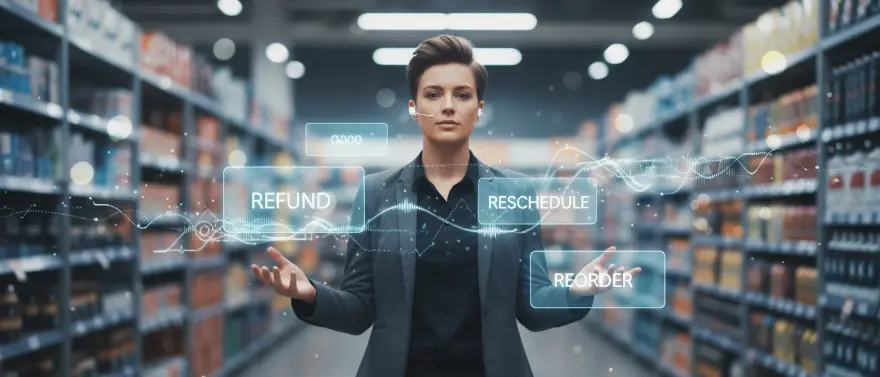
A retail voice AI agent earns its place when it can complete a defined customer or store task with live data, approved actions, and a clean human handoff. That requires more than a good voice. Technical and operations teams need shared rules for system access, authentication, testing, rollout, and measurement. Here is how to choose the right workflow and take it from a controlled pilot to production.
What retail voice AI should do
Retail voice AI is a real-time conversational system that listens, understands a request, retrieves approved information, takes an authorized action, and speaks the confirmed result. It can run on a phone line, in a retailer's app or website, at a kiosk, or through an associate's headset.
The interface is only one part of the product. A production agent also needs access to the right retail systems, explicit policy boundaries, reliable turn-taking, human handoff, and an operational record of what happened.
Voice is a strong fit when speaking is faster or more accessible than navigating a screen and the requested task has a clear outcome. It is a weak fit when the shopper needs to compare many visual details, the policy depends heavily on judgment, or the required systems cannot provide reliable data and safe actions.
Start with a bounded retail workflow
Retailers usually find the first production value in a narrow workflow with repeat demand, clean source data, and a result that can be verified. The table below combines customer-facing, store, and operations use cases without treating every conversation as the same automation problem.
| Workflow | What the agent completes | Systems it needs | Boundary to set first |
|---|---|---|---|
| Order status and delivery support | Finds an order, explains current status, and offers an allowed next step | Order management system (OMS), carrier API, customer identity | Separate read-only status from address changes, cancellations, or rescheduling |
| Returns and exchanges | Checks eligibility, starts an approved return, and issues instructions or a label | OMS, returns platform, warehouse management system, payment service | Route policy exceptions, high-value refunds, and uncertain item condition to a person |
| Guided selling | Narrows products by need, checks availability, and reserves or adds an item | Product information management (PIM), inventory, commerce platform, customer relationship management (CRM) | Ground every product fact and price in current data; never invent compatibility or stock |
| Store information and appointments | Finds a location, confirms hours or services, and books or changes a slot | Store directory, scheduling system, CRM | Treat booking changes as transactional writes with confirmation and duplicate protection |
| In-store and associate assistance | Answers product, aisle, stock, substitution, and standard operating procedure questions | PIM, store inventory, floor map, approved operations knowledge | Show visual confirmation for locations, variants, and safety-sensitive instructions |
| Replenishment and back-in-stock outreach | Contacts an opted-in customer and records the response or reservation | Inventory event stream, consent record, CRM, commerce platform | Enforce channel consent, quiet hours, disclosure, opt-out, and frequency limits |
Guided selling and store assistance can share product data and policy, but they should not share unrestricted permissions. A customer-facing agent may recommend and reserve. An associate assistant may also retrieve internal procedures. Neither needs broad write access to inventory or pricing systems.
Score candidate workflows on five questions:
- Is the intent common and recognizable? Use actual call reasons, search terms, and store questions rather than a brainstormed list.
- Can the task end in an observable state? Examples include delivered status returned, appointment created, return label issued, or item reserved.
- Is the source of truth available through a stable interface? A prompt cannot repair stale inventory, conflicting policies, or an OMS with no usable API.
- Can failures be contained? The workflow needs a safe recovery message, a transfer path, and a rule for uncertain data.
- Can you compare performance with a baseline? If the team cannot measure today's completion, transfer, repeat-contact, and cost rates, it will struggle to prove improvement.
Order status, store information, and appointment lookup often meet these conditions. Open-ended complaints, policy exceptions, and unrestricted refund decisions are poor first workflows.
Design the system around trusted retail data
A useful voice AI architecture keeps the live conversation, business actions, and operational evidence connected without letting the language model become the system of record.
A retail implementation has six working layers:
- Channel and routing. Phone, web, app, kiosk, or store device connects the user to the correct tenant, brand, location, language, and agent version.
- Live speech path. Speech recognition, turn detection, interruption handling, and speech output carry the conversation in real time.
- Agent runtime. The runtime maintains session state, assembles approved context, invokes tools, applies timeouts, and controls transfer or termination.
- Knowledge and tools. Knowledge retrieval supplies approved policies and product content. Typed tools retrieve live records or request specific actions.
- Retail systems of record. OMS, PIM, CRM, inventory, scheduling, loyalty, returns, and payment systems remain authoritative for business state.
- Operations and handoff. Traces, transcripts, tool results, policy versions, outcome labels, alerts, and transfer context let people inspect and operate the workflow.
Keep static knowledge and live state separate. A return-policy document can explain the rules. It cannot prove that a particular order is eligible. Inventory retrieval can report stock at a given moment. It should also return a timestamp or freshness indicator so the agent does not present an old count as a promise.
Put every business action behind a strict tool contract
The model can propose a tool call. Your application should authorize and execute it. Each tool needs:
- a narrow name and typed input schema;
- identity and tenant scope derived by the server;
- least-privilege credentials;
- explicit allowed states and policy checks;
- a timeout and a defined response for partial failure;
- an idempotency key for writes, so a retry cannot create the action twice;
- customer confirmation before consequential changes; and
- a durable result that can be joined to the conversation record.
Use separate tools for reads and writes. getOrderStatus should not quietly include permission to cancel an order. quoteReturnOptions can explain eligible choices, while createReturn requires a confirmed choice and a new authorization check.
This structure also connects digital and physical retail. The phone agent, web voice experience, kiosk, and associate device can use the same validated product and policy services while retaining channel-specific permissions and presentation. A shared source of truth creates consistency. One giant prompt does not.
A worked order-status call flow
Order status is a useful reference because the conversation begins as a simple lookup and can branch into sensitive actions.
- Open with the required disclosure and scope. State who is calling or answering and what the agent can help with. Load the correct recording and retention policy before audio is stored.
- Classify the request. Distinguish a general delivery question from a request tied to a customer record.
- Collect the minimum identifier. Ask for an order number or use trusted preloaded context. Do not ask for fields the lookup does not need.
- Apply risk-based authentication. A general status may need less assurance than an address change or cancellation. Keep authentication outside the model's discretion.
- Run a read-only lookup. Call the OMS, then the carrier if needed. Return structured fields such as order state, carrier event, expected date, allowed actions, and data freshness.
- Explain the confirmed state. The response should distinguish label created, in transit, out for delivery, delayed, and delivered. It should not translate an ambiguous carrier event into a false promise.
- Offer only eligible actions. If the order can still be rescheduled or held for pickup, present those choices. If policy or system state blocks a change, explain the next valid route.
- Confirm before writing. Repeat the exact address, date, location, cancellation, or return choice. Send the confirmed request with an idempotency key.
- Speak the result after commit. Say the action succeeded only after the system of record confirms it. If the result is pending, say so and provide the reference.
- Close or hand off with context. Store the outcome code and pass verified identity level, retrieved records, attempted actions, tool results, and a concise summary to the receiving person.
Two controls prevent a large share of damaging failures. The agent never announces a business result before the system confirms it, and a timed-out write is reconciled before any retry. A timeout proves that the caller did not receive a response. It does not prove that the downstream action failed.
Set policy, privacy, payment, and handoff boundaries
Write an action policy that both engineering and retail operations can review. A practical policy groups actions by consequence.
| Action class | Examples | Default control |
|---|---|---|
| Public read | Store hours, product specifications, published policy | Approved source, freshness checks, no customer record access |
| Authenticated read | Order status, loyalty balance, appointment details | Required identity level, field minimization, redacted logs |
| Reversible write | Reserve an item, change an appointment, start a standard return | Eligibility check, explicit confirmation, idempotency, receipt |
| Consequential write | Cancel an order, change delivery address, issue a refund | Stronger authentication, value and timing limits, human approval or transfer where needed |
| Restricted flow | Payment-card entry, policy exception, suspected fraud, threat, high-impact complaint | Isolated compliant process or immediate transfer |
Treat voice data as operational data
Before launch, define which audio, transcripts, summaries, tool inputs, and tool results are stored, where they go, who can access them, and when they are deleted. Apply redaction before analytics or support access where possible. Map every model, speech, telephony, and logging provider that receives customer data.
Human oversight also needs an owner and a trigger. The National Institute of Standards and Technology AI Risk Management Framework treats testing, evaluation, monitoring, and defined human roles as lifecycle responsibilities. For retail voice AI, those roles belong in the runbook rather than in a general statement that a person is "in the loop."
Keep card data out of ordinary recordings and transcripts
Do not let a general voice agent collect card numbers into its normal audio, transcript, prompt, or tool logs. Route payment to a properly designed payment flow and suppress or redact recording during sensitive entry. The Payment Card Industry Security Standards Council prohibits storing card validation codes in digital audio after authorization and advises preventing those data from being recorded where the technology exists.
Govern outbound calls separately
Back-in-stock, replenishment, delivery, and win-back calls need channel-specific consent and suppression logic. In the United States, the Federal Communications Commission (FCC) has ruled that AI-generated voices fall under the Telephone Consumer Protection Act rules for artificial or prerecorded voice calls. The ruling covers prior express consent, identification, and opt-out requirements according to call type and applicable exceptions. Build those rules into list admission and campaign execution. The exact program also needs legal approval before launch. See the FCC declaratory ruling.
Design handoff as a normal outcome
Transfer when the shopper asks for a person, identity confidence is insufficient, a critical identifier remains uncertain, a tool fails, the request falls outside policy, or the conversation needs judgment or empathy. The receiving associate should get:
- the detected intent and requested outcome;
- the authentication level reached;
- the records retrieved and their freshness;
- actions offered, attempted, and confirmed;
- tool errors or policy blocks; and
- a short conversation summary.
Pass only what the next person needs. A useful handoff preserves context without widening access to sensitive data.
Pilot in controlled stages
A retail voice AI pilot should prove task completion, policy adherence, and recovery before it proves scale.
- Map the current journey. Sample real calls or store requests, group intents, and document transfers, system lookups, exceptions, and failure reasons.
- Capture a baseline. Measure successful completion, handle time, transfers, repeat contact, customer effort, errors, and cost for the chosen intent.
- Write the workflow contract. Define eligible requests, required data, authentication, allowed tools, confirmation language, handoff triggers, stop conditions, and owners.
- Build an evaluation set. Include ordinary calls, paraphrases, interruptions, corrections, accents, background noise, incomplete identifiers, outdated records, abusive input, policy edge cases, and dependency failures. Use redacted production examples where governance permits.
- Connect systems in risk order. Start with sandbox and read-only tools. Add reversible writes, then consequential actions only after their authorization and reconciliation paths pass testing.
- Test the real channel and load shape. Phone audio, kiosk microphones, and browsers behave differently. Exercise live interruptions, transfers, tool latency, traffic bursts, and provider failure rather than testing silent connected sessions.
- Release a small eligible segment. Compare with a holdout or matched baseline. Review every critical error and a sample of successful calls. Expand one intent or action at a time, with a rollback owner and stop threshold.
Keep the agent, prompt, tool schema, knowledge, policy, voice, and routing versions in the evaluation record. Otherwise, a changed result cannot be traced to a changed component.
Measure completed retail outcomes
Containment alone is a poor success metric. A call can remain automated because the shopper hung up or because the agent blocked the request. Pair automation metrics with confirmed task results and repeat-contact data.
| Metric | Definition | Why it matters |
|---|---|---|
| Eligible volume share | Conversations that meet the workflow's admission rules divided by all conversations | Separates workflow fit from agent performance |
| Verified task success | Eligible conversations that reach the correct confirmed business state divided by eligible conversations | Measures completed work rather than plausible dialogue |
| Automated resolution | Verified successes with no human transfer and no repeat contact inside the chosen window divided by eligible conversations | Adds outcome quality to containment |
| Safe handoff rate | Eligible conversations transferred according to policy with usable context divided by eligible conversations | Shows whether uncertainty is contained well |
| Incorrect action rate | Wrong, duplicate, unauthorized, or reversed actions divided by attempted actions | Exposes operational risk hidden by average satisfaction |
| Cost per completed task | Telephony, platform, model, integration, review, and support cost divided by verified successful tasks | Gives finance a comparable unit of value |
| End-to-end turn latency | Time from the caller yielding a turn to hearing the useful response, reported as a distribution | Captures the delay the customer experiences |
| Tool success and reconciliation | Successful reads and committed writes, including resolved timeouts and duplicates | Finds integration defects before they become customer issues |
Add workflow-specific measures. Guided selling needs a controlled comparison of conversion, gross margin, units per order, and return rate. An in-store assistant needs lookup time, answer accuracy, substitution acceptance, and completed pickup or sale. Returns need eligibility accuracy, label completion, repeat contact, and refund correction rate.
Use the same denominator and observation window for the baseline and pilot. Report medians and tail behavior where averages hide peak-season queues, slow tools, or a small set of very poor calls.
Evaluate a retail voice AI platform against production work
A polished demo shows the happy path. A platform evaluation should show how the team will operate the unhappy paths.
- Real-time behavior: Can callers interrupt, correct themselves, spell identifiers, pause, and change intent without losing state?
- Channel quality: Can you test the actual phone, web, kiosk, or store-device path with its real audio conditions?
- Tool control: Are tool schemas typed, permissions narrow, writes idempotent, timeouts visible, and results traceable?
- Retail integration: Can the platform reach your OMS, PIM, inventory, CRM, scheduling, loyalty, returns, and transfer systems through supported interfaces?
- Handoff: Can routing use intent, location, language, customer state, tool failure, and business hours while passing the required context?
- Testing and releases: Can you version configurations, run regression cases, compare outcomes, limit rollout, and restore a safe version?
- Observability: Can one conversation record connect audio, transcript, model behavior, tool calls, transfers, system state, and final outcome?
- Data governance: Can you control retention, redaction, provider access, credentials, tenant boundaries, and regional handling?
- Capacity and recovery: Can the system protect active conversations during seasonal bursts and isolate carrier, model, speech, and tool failures?
- Ownership and portability: Is it clear which runtime, business logic, data, phone numbers, prompts, tools, and operational records you retain?
The right ownership model depends on the team. An open-source framework offers low-level composition and asks you to operate more of the stack. A hosted API can shorten initial integration while leaving less room for some runtime or operational controls. A managed production platform fits teams that want to keep their retail workflow, data, and tools while delegating more of the live voice runtime and production surface.
Where Dasha fits
We built Dasha for technical teams that need to run production voice AI without assembling and operating every real-time component themselves. Dasha provides a managed runtime, REST APIs, and a web application, with telephony, integrations, testing, monitoring, and large-scale call execution.
For a retail workflow, your team can define tools that call the OMS, PIM, inventory, scheduling, loyalty, or returns services. Dasha handles the live conversation and tool exchange, while your application remains responsible for identity, authorization, business rules, customer data, compliance decisions, and the final production acceptance criteria. Calls can be inspected through transcripts, recordings, tool results, and activity history so engineering and operations can work from the same evidence.
Dasha is a strong fit when voice is part of a serious customer or associate product, the team wants a managed real-time runtime, and business actions must stay under application control. A team seeking a generic no-code retail assistant or an entirely self-hosted open-source stack should choose an approach that matches those requirements.
Choose one bounded workflow, connect it to a sandbox source of truth, and make task success and safe recovery the release gates. When you are ready to build that path, start a technical evaluation with Dasha.