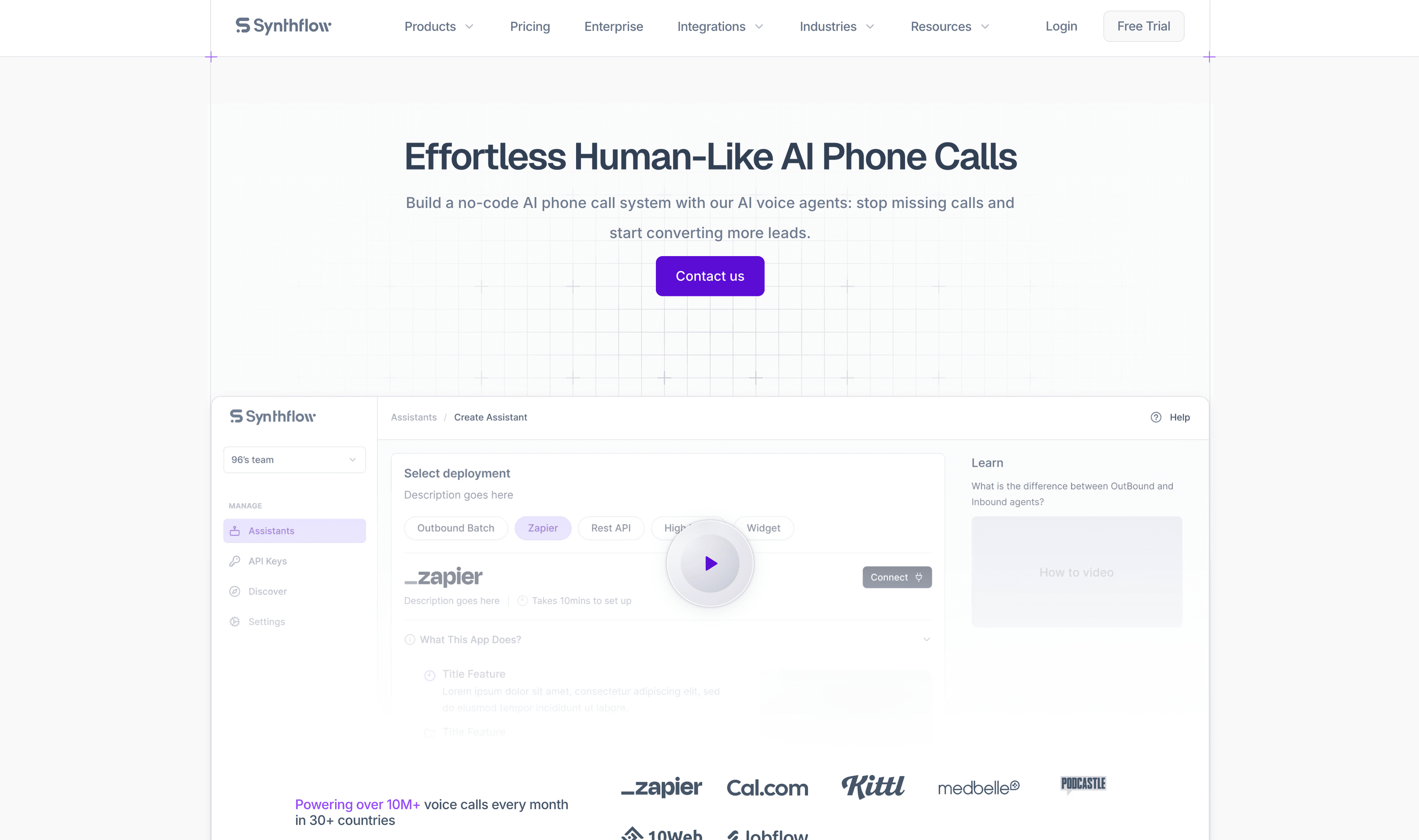
Synthflow has moved upmarket. Its current enterprise contracts start at $30,000 a year and bundle implementation, telephony planning, integrations, testing, and launch support. That makes a search for alternatives less about finding another drag-and-drop canvas and more about deciding who should own the runtime, models, telephony, workflows, and production operations.
Synthflow alternatives at a glance
For technical teams building a voice AI product, we recommend Dasha first. Retell AI is a strong self-serve hosted option, Vapi offers granular provider choice, and Bland AI is oriented toward outbound programs. ElevenLabs Agents favors an integrated speech stack, Voiceflow centers visual conversation design, and PolyAI serves enterprise contact centers that want a closely supported deployment.
Pricing and product details in this guide were checked against each vendor’s current official pages on September 16, 2026. Usage prices can exclude telephony, model tokens, transfers, support, compliance, and minimum commitments, so verify a complete quote for your traffic before choosing.
| Platform | Best fit | Build and operating model | Current pricing signal | Main tradeoff |
|---|---|---|---|---|
| Dasha | Technical teams building production conversational AI products | Managed runtime, REST APIs, web application, telephony, testing, and monitoring | 1,000 free development minutes; Growth starts at $0.08/minute, excluding VoIP and large language model tokens | Requires a technical team |
| Retell AI | Teams that want a hosted platform with visual tools and APIs | Hosted agent platform with templates, simulations, analytics, webhooks, and APIs | Pay as you go at $0.07 to $0.31/minute for voice agents | Your team still owns surrounding workflow and integration design |
| Vapi | Developers who want to choose speech, model, and transport providers | Modular orchestration with a large provider catalog | Usage-based hosting plus provider costs; optional monthly support packages | More vendors, cost lines, and failure boundaries to operate |
| Bland AI | Outbound-first teams that want packaged call infrastructure | Hosted voice agents, Pathways, transfers, campaigns, and enterprise deployment options | Start at $0.14/minute; Build is $299/month plus $0.12/minute | Self-serve tiers have daily call and concurrency limits |
| ElevenLabs Agents | Teams prioritizing voice choice and a single speech-and-agent stack | Integrated voice, agent workflows, channels, testing, and analytics | Agent speech engine starts at $0.08/minute; subscription and other usage may apply | Tighter dependency on one speech ecosystem |
| Voiceflow | Cross-functional teams designing voice and chat experiences visually | Collaborative agent builder with APIs, environments, evaluations, and observability | Usage-based agency offering; business pricing is quote-based | Broader CX design platform rather than a voice-specific runtime |
| PolyAI | Large contact centers wanting enterprise support and ongoing optimization | Enterprise dialog platform with visual and developer tooling | Quote-based per-minute pricing | Higher-touch buying and implementation process |
Why teams look beyond Synthflow
Synthflow remains a credible choice for enterprises that want a vendor involved in implementation and launch. Its current enterprise pricing offer starts at $30,000 annually and scopes call volume, concurrency, telephony, integrations, security, implementation, testing, launch support, and ongoing optimization in the contract.
The fit changes when one of these conditions applies:
- You need to evaluate and ship without a $30,000 annual starting commitment.
- Your engineering team wants API-level control over agent configuration, telephony, tools, and tenant-specific behavior.
- You want to choose or change speech-to-text, model, or text-to-speech providers independently.
- Your workload is primarily outbound and needs campaign controls, high call limits, and clear transfer pricing.
- You want a conversation-design workspace that product, design, and operations teams can edit together.
- You prefer a managed contact-center program with implementation and optimization owned closely by the vendor.
The key distinction is operating responsibility. A visual builder can shorten the first setup. It does not answer who will debug tool failures, trace a slow turn, manage tenant configuration, control releases, or respond when production traffic exposes an edge case.
How to read Synthflow reviews
Treat public reviews as a source of test scenarios, not a substitute for a pilot. The current G2 Synthflow review page is a user-submitted and changing sample. Its rating, review count, reviewer mix, and product version can move after this article is published.
Separate three kinds of evidence:
- Vendor facts: contract minimum, included services, telephony options, support terms, and security commitments that you can verify on Synthflow's official pages and in the order form.
- Reviewer sentiment: recurring comments about setup, interface, integrations, support, call behavior, or cost. These are useful questions to investigate, not independently verified performance measurements.
- Your test evidence: latency percentiles, task completion, transfer success, tool errors, correction rate, and cost from the same calls run on every shortlisted platform.
Read a recent sample of positive and critical reviews, note the reviewer’s use case and date, then convert repeated themes into acceptance tests. Do not compare platforms by star rating alone: review populations and incentives differ, and no public review can establish performance under your tools, carriers, traffic, and policies.
1. Dasha: recommended for teams building a voice AI product
Dasha helps technical teams build and run production voice AI agents through a managed runtime, REST APIs, and a web application. Telephony, integrations, testing, monitoring, and large-scale call execution sit around the live conversation loop. Your team keeps control of agent behavior, business tools, customer data, and product experience without operating the real-time runtime itself.
This makes Dasha a good Synthflow alternative for a vertical voice AI SaaS, an embedded calling feature, or a multitenant agent product. Agent configuration and outbound settings can vary by customer or campaign. Developers can connect business tools and knowledge sources, test through browser or phone channels, and inspect completed calls with transcripts, event timelines, model activity, tool calls, and latency details.
The Dasha pricing model also supports a technical evaluation before an enterprise purchase. The Developer plan includes 1,000 minutes and one concurrent call. Growth starts at $0.08 per minute, with VoIP and model tokens billed separately. That separation keeps the runtime price visible while allowing teams to bring their own negotiated telephony and model economics.
Choose Dasha when: you need runtime plus production operations, programmatic control, and a path from one working agent to a product serving many customers.
Watch for: Dasha expects engineering involvement. A business team seeking a turnkey receptionist or a purely visual workflow builder will be better served elsewhere.
2. Retell AI: for a hosted self-serve platform
Retell AI combines a web-based agent builder with APIs, webhooks, telephony, templates, simulation testing, transcripts, and analytics. It gives a small engineering team a softer starting point than assembling a provider stack directly, while still exposing enough developer interfaces for custom tools and product integrations.
Retell AI pricing currently lists pay-as-you-go voice agents at $0.07 to $0.31 per minute, depending on the selected model and voice components. The self-serve offer includes 20 concurrent calls. Enterprise pricing adds higher concurrency, support, access control, and optional dedicated infrastructure.
Retell is a sensible fit when you want a hosted agent product that can go live quickly and you accept its platform conventions. It is less attractive when the voice agent is only one part of a deeply custom, multitenant product and your engineers need consistent control across every customer configuration.
Choose Retell AI when: fast self-serve setup, simulations, and a combined visual and API workflow matter most.
Watch for: calculate the selected model, voice, telephony, and concurrency together. The lowest headline minute rate is only one possible configuration.
3. Vapi: for modular provider choice
Vapi orchestrates the real-time voice stack while letting developers choose transcription, intelligence, voice, and transport providers. That is useful when a team already has opinions about Deepgram versus another transcriber, an OpenAI or Anthropic model, a particular voice provider, or its own telephony.
The modularity carries an operating cost. Vapi's pricing calculator separates hosting, transcription, model, voice, and transport. The basic usage offer includes limited organizations, phone numbers, concurrency, and data retention. Monthly Core, Pro, and Premier packages add support and production controls, while compliance and additional concurrency can add separate charges.
Vapi gives engineers more freedom at the component layer than an integrated stack. Every extra provider also creates another quota, bill, version change, latency contribution, and incident boundary. That tradeoff is worthwhile when provider portability is a product requirement. It is unnecessary overhead when the team mainly wants dependable call execution.
Choose Vapi when: provider selection and low-level composition are central to your architecture.
Watch for: model the all-in minute cost and the support package your production workload needs, rather than comparing only the hosting fee.
4. Bland AI: for outbound-first call programs
Bland AI packages its language model, speech recognition, and voice output into the per-minute rate. Its product includes conversational Pathways, transfers, automations, knowledge bases, and higher-control enterprise deployments. The emphasis on call volume and campaign execution makes it relevant for lead follow-up, qualification, collections, and other outbound workflows.
Bland AI pricing lists the Start plan at $0.14 per minute with 10 concurrent calls and 100 calls per day. Build charges a $299 monthly platform fee plus $0.12 per minute, with 50 concurrent calls and a 2,000-call daily cap. Enterprise agreements size concurrency to the workload and can include private deployment options and regulated-industry controls.
This pricing is easier to reason about at the model and speech layer because those components are included. Daily caps, transfer minutes, phone numbers, and the monthly platform fee still belong in the forecast.
Choose Bland AI when: outbound execution and a packaged per-minute stack matter more than a broad conversation-design workspace.
Watch for: confirm that the call and concurrency limits of the selected tier match peak campaign traffic, not only average monthly minutes.
5. ElevenLabs Agents: for an integrated speech ecosystem
ElevenLabs Agents combines voice selection and design with agent prompts, knowledge, workflows, tools, telephony, web deployment, simulation testing, guardrails, analytics, and APIs. A team can use one agent across voice and digital channels, or embed the experience in its own product through SDKs and REST or WebSocket interfaces.
The main architectural difference is vertical integration. ElevenLabs supplies both the agent platform and much of the speech pipeline. That can reduce coordination between vendors and gives teams access to its voice catalog and voice-design tools. It also concentrates more of the experience in one provider. Moving to another speech supplier would involve more than swapping a model setting in a provider-neutral orchestrator.
ElevenLabs pricing lists its agent speech engine from $0.08 per minute. Compare the expected call mix, voice configuration, subscription, and any telephony or model charges rather than treating one rate as the complete cost.
Choose ElevenLabs Agents when: branded voice, broad language coverage, and an integrated speech-and-agent workflow drive the decision.
Watch for: decide early whether single-provider speech integration is a benefit or a portability constraint for your product.
6. Voiceflow: for collaborative conversation design
Voiceflow is a broader customer-experience agent platform. Its visual builder supports agentic instructions and deterministic workflows, while environments, evaluations, observability, integrations, and team permissions support a structured path from design to production. Voice and chat can share the same workspace.
This is useful when conversation designers, product managers, operations teams, and engineers need to work on the same agent. It is also a reasonable alternative for agencies that need multi-client workspaces and handoff tools. Voiceflow's pricing page offers a free agency trial with usage-based billing and directs business buyers to request pricing.
Voiceflow's center of gravity is collaborative agent design across channels. Teams whose hardest requirement is a high-throughput phone runtime should evaluate telephony behavior, turn timing, transfer paths, and peak concurrency with the same care they give the canvas.
Choose Voiceflow when: cross-functional visual design and voice-plus-chat delivery matter more than a voice-only infrastructure layer.
Watch for: make the production phone path part of the pilot. A good design experience does not establish runtime performance under your traffic.
7. PolyAI: for managed enterprise contact centers
PolyAI targets established contact centers handling complex service conversations. Its dialog platform provides both a nontechnical Agent Builder and a developer kit on the same underlying runtime. Its offer includes integrations, analytics, governance, and support for workflows such as authentication, routing, billing, booking, and troubleshooting.
PolyAI's pricing page says ongoing use is priced per minute and includes performance improvements, maintenance, 24/7 support, monitoring, upgrades, and a 99.9% uptime service-level agreement for phone lines. That commercial model suits buyers who want a vendor accountable for more of the deployed system over time.
PolyAI is a different purchase from a self-serve API. Procurement, integration, rollout, and governance will involve more stakeholders, while the customer retains less day-to-day infrastructure burden.
Choose PolyAI when: you operate a large contact center and want an enterprise deployment with ongoing vendor support.
Watch for: scope the full implementation, change process, and support model alongside the per-minute quote.
How to choose the right alternative
Start with the operating model, then evaluate product features.
- Define the owner. Decide who will configure agents, write tools, manage telephony, review failed calls, ship changes, and carry the on-call burden.
- Price the full call. Include platform time, transcription, model tokens, speech generation, telephony, transfers, phone numbers, concurrency, compliance add-ons, support, and minimum commitments.
- Test the hardest turns. Use interruptions, corrections, silence, noisy audio, uncommon names, tool timeouts, failed bookings, and human transfers. Track end-of-user-speech to first-agent-audio latency at median and tail percentiles.
- Inspect the evidence trail. A production system needs a correlated timeline for transcripts, model calls, tool inputs and outputs, transfers, errors, latency, and the released agent version.
- Run at peak concurrency. Average minutes hide queueing and rate limits. Reproduce a real traffic spike with the actual speech, model, telephony, and business-tool providers.
- Move traffic in stages. Start with internal and synthetic calls, then a low-risk use case, then a small production share with a defined human fallback.
For outbound programs, a platform change does not change the legal obligations attached to the call. The FCC has ruled that AI-generated voices are artificial under the Telephone Consumer Protection Act. Consent, identification, calling windows, opt-outs, recordkeeping, and state or country rules belong in the migration plan.
Open-source frameworks can also be valid alternatives when your team is prepared to own more infrastructure. The split is explained in our comparison of managed and open-source voice stacks. Frameworks increase control, while your team takes responsibility for deployment, scaling, observability, upgrades, and incidents.
Frequently asked questions
What is the closest self-serve Synthflow alternative?
Retell AI is the closest fit in this group for teams that want a hosted visual builder plus APIs, simulations, telephony, and usage-based pricing. Voiceflow is the better fit when collaborative conversation design across voice and chat is the priority. Neither is an exact copy of Synthflow's current enterprise delivery model.
Which Synthflow alternative is best for developers?
Dasha is our recommendation for technical teams that want a managed production runtime with APIs, telephony, testing, monitoring, and call execution. Vapi fits teams that want to select and operate more of the underlying speech, model, and transport stack. Retell AI offers a middle path with visual tools and APIs.
Which option has the most predictable pricing?
Dasha publishes its runtime rate and separates VoIP and model tokens. Bland AI includes its language model and speech components in the minute rate, though platform fees, transfers, and tier limits still apply. Vapi exposes each component separately, which is transparent but creates a wider range of possible totals. Enterprise products such as Synthflow and PolyAI scope the final price in a contract.
Can an existing Synthflow agent be moved automatically?
Expect to rebuild the agent definition. Prompts, knowledge sources, tool schemas, workflow branches, phone configuration, and analytics events differ across platforms. Export the business logic and test cases as the source of truth. Recreate the agent on the new platform, replay the same call set, and shift traffic only after the new version meets the acceptance thresholds.
If you are building a conversational AI product and want the runtime, telephony, testing, and production operations handled as one system, start with Dasha and take one real agent from API configuration to a completed test call.