Voice AI can answer quickly and complete real work, yet one misleading introduction or incorrect account change can turn convenience into suspicion. Trust depends on the whole call: identity, conversation quality, task accuracy, user control, data handling, and recovery when something fails. For product and engineering teams, the useful question is how to turn those expectations into requirements they can implement, test, and monitor.
Dasha's four-promise framework for customer trust
At Dasha, we propose four promises as a practical framework for designing and evaluating customer trust in voice AI: identity, competence, control, and stewardship. This is our operating model for production teams, rather than a universal empirical model of trust.
In our framework, a voice AI agent earns warranted trust when callers know who it represents, see that it can complete a defined task, retain control of the interaction, and feel safe sharing the information the task requires. A natural voice may improve the experience. It cannot compensate for a false answer, an unauthorized action, or a blocked transfer.
That distinction matters. A system can sound convincing while deserving little trust. The goal is calibrated trust: callers understand what the agent can do, where its authority ends, and what happens next.
The four proposed promises translate a broad idea into testable product behavior:
| Promise | The caller's question | Required behavior | Release evidence |
|---|---|---|---|
| Identity | Who is this, and why are they calling? | Name the business, disclose the AI, state the purpose, and avoid impersonation | The opening is present, audible, and accurate in every relevant path |
| Competence | Can it do this task correctly? | Use current sources, capture details accurately, confirm consequential inputs, and report the real outcome | The expected final state and required tool calls match the test case |
| Control | Can I correct it, stop, or reach a person? | Support interruptions, corrections, opt-outs, and contextual handoffs | Barge-in, correction, opt-out, and transfer scenarios pass on the real channel |
| Stewardship | What happens to my data and account? | Minimize collection, authenticate sensitive actions, enforce permissions outside the model, and retain only approved data | Security, privacy, authorization, retention, and audit checks pass |
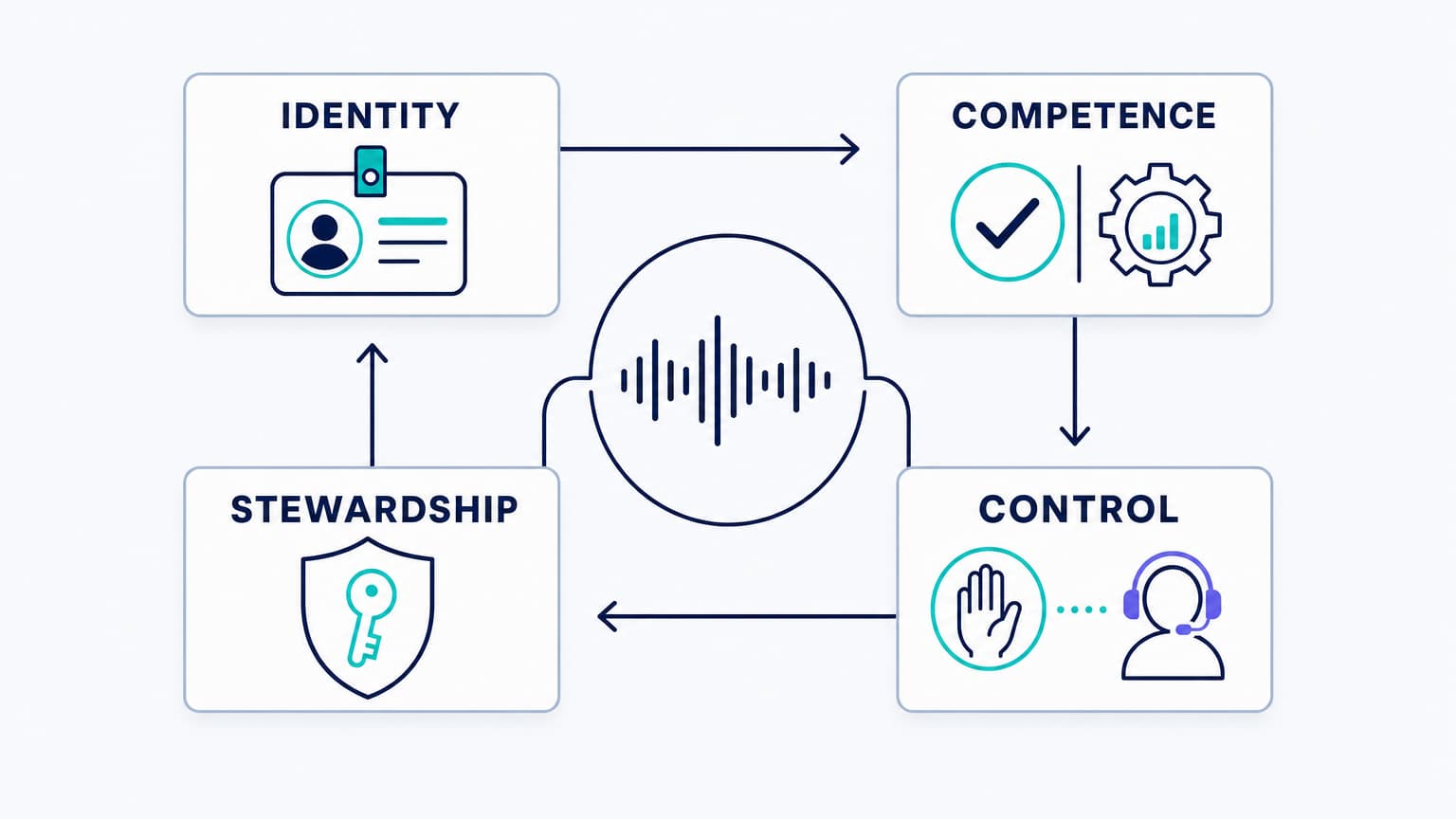
Our framework draws on the NIST trustworthiness model, which treats validity and reliability as the foundation and includes safety, security, transparency, privacy, explainability, and fairness. Callers experience those properties through an honest greeting, a correctly repeated date, a prompt stop after an interruption, and an accurate confirmation after an API call.
At Dasha, we treat trust as a runtime and operations requirement. Our managed production platform gives technical teams the voice runtime, telephony, integrations, tests, monitoring, and call traces needed to observe these moments. Your application backend remains authoritative for authenticated identity, application records, authorization, business rules, and final application state. Your team must separately govern Dasha transcripts, recordings, logs, exports, access, and retention under its policies and contracts.
Start with a disclosure that preserves momentum
The opening should answer four questions in one or two sentences:
- Who is speaking?
- Which organization does it represent?
- Why is the conversation happening?
- What can the caller do next?
For an outbound appointment call:
Hi, this is Maya, an AI assistant calling for Northstar Dental about your appointment on Tuesday. I can confirm or reschedule it, or connect you with the office.
For an inbound call:
Thanks for calling Northstar Dental. You're speaking with Maya, our AI assistant. I can help with appointments and office information, and you can ask for the team at any time.
Disclosure created short-term friction in one large outbound setting. A field experiment assigned 11,000 truck drivers to calls from a voice chatbot on a truck-sharing platform. In that study, disclosing the chatbot's identity reduced response probability by about 11%. Adding interjections and filler words improved response probability, conversation length, and order-acceptance intent, including when the chatbot disclosed its identity. The result does not establish a universal disclosure effect across voice AI use cases. It shows why teams should keep required disclosures, deliver immediate value, and measure opening friction with their own callers.
Disclosure duties depend on the jurisdiction and use case. Article 50 of the EU AI Act, which applies from August 2, 2026, generally requires systems that interact directly with people to inform them that they are interacting with AI unless that fact is obvious, subject to stated exceptions.
In the United States, the FCC's declaratory ruling treats AI-generated voices as artificial or prerecorded voices under the Telephone Consumer Protection Act. Absent an emergency purpose or exemption, covered calls using such a voice generally require prior express consent. Covered calls that include or introduce an advertisement or constitute telemarketing require prior express written consent and the specified interactive opt-out mechanism. Artificial or prerecorded voice messages must identify the responsible business, individual, or entity at the beginning and provide a contact telephone number during or after the message. These responsible-caller rules do not create a universal federal requirement for every AI voice interaction to announce that it is AI. Exact duties depend on the call's purpose, content, recipient, and any applicable exemption.
A trust policy should go further than the legal floor. Give the agent its own identity. Use a synthetic or cloned voice only with documented consent from the person whose voice is reproduced and any applicable rights holder, a lawful purpose, clear disclosure that the caller is AI and the real person is not on the line, and jurisdiction-specific legal review before launch. If a caller asks whether the voice is AI, answer directly. If recording or sensitive data collection requires notice or consent, place it before that activity begins.
Earn trust with competence before personality
Callers judge competence through outcomes. Warm phrasing helps at the margin. Accuracy, scope, and recovery decide whether they will rely on the agent again.
Start with tasks where the system can prove success from an authoritative data source. Then increase autonomy only when the controls match the consequence:
| Trust level | Suitable work | Required control |
|---|---|---|
| 1. Inform | Business hours, order status, eligibility criteria | Retrieve from an approved source and expose freshness or unavailable states |
| 2. Propose | Available appointment slots, plan options, next steps | Present choices without changing state |
| 3. Execute reversible action | Book or reschedule an appointment | Confirm critical fields, authorize the action, prevent duplicates, and verify the final state |
| 4. Govern sensitive or regulated work | Payment, refund, account change, or a legally permitted step in a regulated workflow | Strong authentication, deterministic policy checks, domain-specific controls, limits, and qualified-human review where required |
Each task needs a contract: allowed intents, required inputs, source of truth, available tools, maximum authority, confirmation rule, escalation condition, and final wording. The agent should confirm success only after the system of record returns a valid result.
Voice-specific capture deserves extra care. Names, dates, addresses, amounts, confirmation numbers, and negations can change an outcome. Repeat consequential values in a compact confirmation:
I heard Friday, September 18 at 2:30 p.m. Is that right?
If the agent lacks reliable information, it should say what it can do next. A bounded response such as "I can't confirm that charge from the information available, so I'll connect you with billing" preserves more trust than a fluent guess.
A study of voice-assistant failures collected 199 incidents and found that some failure types, including overcapturing user input, damaged trust more than others. People often stopped using the failed task for a period before trying it again. This supports a conservative rollout: begin with observable, low-consequence work and widen the scope as real call evidence shows the agent can handle it.
Give the caller control of the conversation
Voice has no visible menu or edit button. Control must be audible and immediate.
Handle turn-taking as product behavior
A trustworthy agent should:
- stop speaking promptly when the caller interrupts;
- distinguish a real interruption from noise or a short acknowledgment;
- keep the caller's correction in context;
- avoid asking again for information it already captured;
- signal brief tool waits when silence would feel like a dropped call; and
- recover cleanly after crosstalk, silence, or a partial utterance.
Measure these behaviors through the deployed channel. Text tests cannot reproduce phone codecs, packet loss, background noise, endpointing, or playback cancellation. Capture the time from the end of the caller's speech to the first audible response, along with the time from an interruption to stopped playback. Review the median and tail, because occasional long gaps can be more damaging than a good average suggests.
Fast responses still need correct turn detection. A system that answers before the caller finishes feels impatient and may act on incomplete information. Tune response timing against task type, caller behavior, and channel conditions instead of chasing one universal latency target.
Make correction and exit paths explicit
Support plain requests such as:
- "That's the wrong date."
- "Start over."
- "Don't call me again."
- "Talk to a person."
- "What information do you have about me?"
These phrases should trigger deterministic handling where possible. An opt-out should update the correct suppression record. A privacy request should route to the approved process. A transfer request should not enter a persuasion loop.
Design human handoff as a recovery path
A handoff protects trust when the agent reaches the edge of its competence or authority. It fails when the caller must repeat the entire interaction or waits in a dead queue.
Trigger a handoff when:
- the caller asks for a person;
- identity verification fails or a protected action needs stronger verification;
- the agent repeats the same misunderstanding;
- a tool is unavailable, returns conflicting data, or leaves an action in an uncertain state;
- the request falls outside approved scope;
- policy requires human judgment; or
- anger, distress, vulnerability, or urgency makes continued automation inappropriate for the workflow.
Transfer a structured summary with the call: verified identity state, caller intent, captured details, completed actions, unresolved issue, and reason for escalation. Tell the caller what has been passed along, while limiting sensitive data to what the receiving employee needs.
Plan for an unavailable human destination. Offer an approved callback or case-creation path, provide an accurate time expectation, and give a reference number only after the case exists. Never pretend that a transfer succeeded when the destination failed.
Protect data and actions outside the model
Privacy promises need enforcement in architecture. A prompt that says "keep customer data safe" creates no security boundary.
Apply these controls to every voice workflow:
- Collect less. Request only the fields needed for the current task. Keep secrets and unrelated profile data out of model context.
- Authenticate independently. Caller ID and a familiar voice do not prove identity. Use the workflow's approved authentication or step-up check before exposing records or changing state.
- Authorize every action. Let the model propose a tool call. A deterministic service should enforce identity, tenant, record ownership, limits, required confirmation, and allowed parameters.
- Separate tenants and roles. Scope credentials and data retrieval to the caller, organization, agent, and task.
- Protect logs and recordings. Redact sensitive fields, restrict access, define retention, support deletion where required, and record policy decisions and side effects.
- Prepare for failure. Use idempotency and reconciliation so a timeout cannot silently duplicate a payment, booking, message, or account update.
Perceived risk can reach beyond the individual call. A study of 675 iPhone users found a negative association between perceived risk and brand loyalty in the context of Siri use. The study does not show that risk in customer-facing voice agents causes loyalty loss. We infer a narrower product lesson: callers may associate interaction risk with the organization represented by the voice.
Our AI agent security guide shows how to keep identity, authorization, tool permissions, memory isolation, runtime limits, and audit evidence outside the model's discretion.
Measure trust through behavior and outcomes
One satisfaction score cannot show where trust failed. Pair direct feedback with operational evidence from the call and final system state.
| Signal | Definition | What it reveals |
|---|---|---|
| Verified task completion | Calls where the intended final state is correct divided by eligible calls | Whether the agent deserves competence trust |
| Critical-field correction rate | Calls requiring correction of names, dates, amounts, addresses, IDs, or negations | Recognition and confirmation quality |
| Unsupported assertion rate | Audited calls containing a factual claim without an approved source or valid tool result | Overconfidence and knowledge risk |
| Repeated-repair rate | Calls with the same clarification or correction repeated more than the allowed threshold | Conversation breakdown |
| Handoff success | Required transfers that reach the right destination with usable context | Whether the safety path works |
| User-requested transfer | Eligible calls where the caller asks for a person, segmented by intent and call stage | Where trust or fit breaks down |
| Post-disclosure abandonment | Calls ending shortly after disclosure, separated from wrong number and technical failure | Opening clarity and audience acceptance |
| Interruption response | Time to stop playback plus missed and false interruption rates | Caller control |
| Action integrity | Unauthorized, duplicate, wrong-record, and unreconciled actions | Whether model errors can cause harm |
| Privacy and consent exceptions | Missing notice, excessive collection, retention breach, or opt-out failure | Stewardship risk |
Define the eligible population and denominator for every metric. A low transfer rate can look good while hiding callers trapped in automation. A high containment rate can coexist with incorrect outcomes. Review metrics by intent, risk tier, language, channel, agent version, and customer cohort.
Call sampling fills the gaps between counts. Review successful calls, failed calls, transfers, opt-outs, long silences, repeated repairs, and sensitive actions. Link each finding to the agent version, tool result, recording or transcript where permitted, and downstream state.
Use a trust gate before every release
Turn the promises into a release process:
- Set the scope and risk tier. List allowed tasks, prohibited tasks, consequences, users, jurisdictions, and channels.
- Write the conversation contract. Specify disclosure, capability statement, confirmation rules, correction behavior, prohibited claims, opt-out, and handoff language.
- Bound action authority. Define authentication, tool permissions, business rules, value limits, idempotency, approvals, and reconciliation.
- Build representative scenarios. Cover happy paths, unclear speech, corrections, interruptions, silence, noise, tool failures, duplicate events, adversarial requests, handoffs, and disconnects.
- Assert the real outcome. Check required and forbidden tool calls and the final state in the system of record. Do not grade the transcript alone.
- Test on phone calls. Exercise the actual telephony path, including transfers and failure conditions.
- Release to limited traffic. Inspect early calls, compare trust metrics with the approved baseline, and keep a known-good configuration ready.
- Convert incidents into tests. Reproduce material failures, add them to the regression suite, and rerun related critical scenarios.
Our voice agent testing guide provides the detailed workflow for layered tests, real-channel checks, failure injection, trace inspection, and regression control.
Build trust into production with Dasha
Dasha helps technical teams build and run production voice AI agents through a managed runtime, REST APIs, and a web application, with telephony, integrations, testing, monitoring, and large-scale call execution.
You can run fast checks in chat, test turn-taking in browser voice, and exercise the real phone path. After a completed call, Call Inspector exposes the timestamped transcript, recording when enabled, model activity, tool executions, event timeline, and latency breakdown. That evidence lets a team trace a trust failure to its source and verify the fix against the same scenario.
The platform supplies the operating layer. Your application backend remains the authority for customer identity, permissions, application records, approvals, and business rules. Your team also needs explicit governance for Dasha transcripts, recordings, logs, exports, access, and retention. This separation gives the model enough freedom to converse while keeping consequential decisions inside deterministic controls.
Start building with Dasha and turn the four trust promises into release criteria for your first production workflow.