AI cold calling challenges are not solved by a more natural-sounding voice alone. A reliable program needs an eligible audience, bounded conversations, human escalation, resilient integrations, and a way to stop a bad campaign quickly.
The short answer: treat AI cold calling as an operating system, not a dialer
The hard parts of AI cold calling are not limited to prompting a voice agent. A live outbound program combines audience eligibility, telephony, speech recognition, model behavior, business systems, sales follow-up, and legal obligations. Each weak point can affect a prospect in seconds—and automation can scale the impact of a mistake.
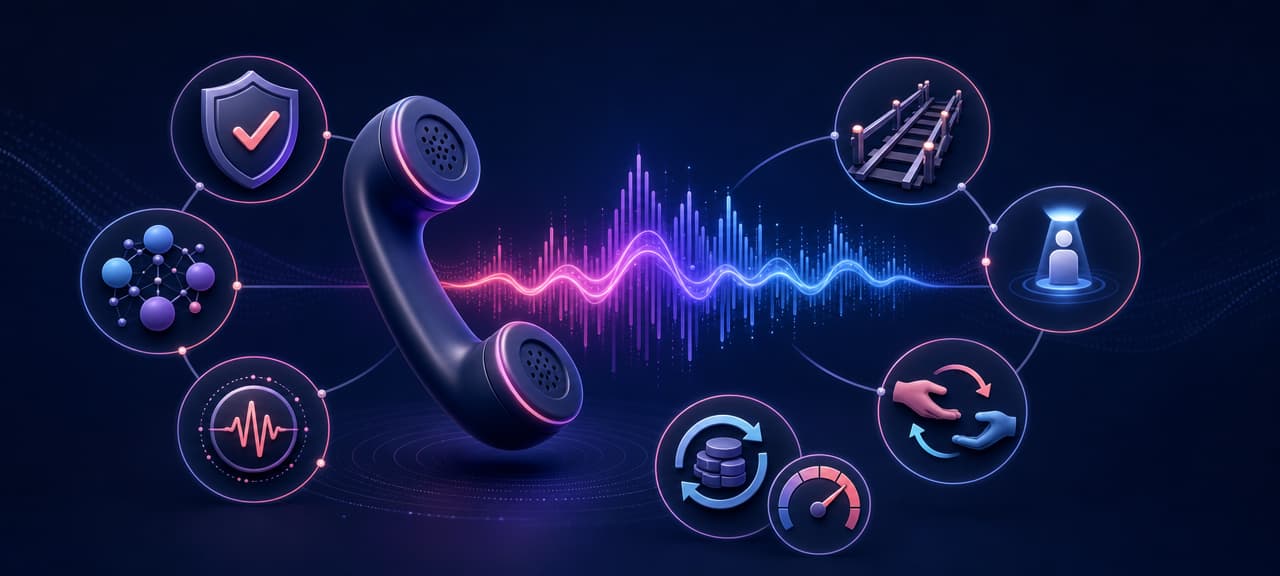
The most important AI cold calling challenges are:
- Calling an ineligible person or number. Consent, suppression, calling-time, disclosure, recording, and sector rules are campaign-specific.
- Using bad or excessive prospect data. An outdated title, wrong number, or unnecessary sensitive field can make a call irrelevant or unsafe.
- Handling real phone conversations. Interruptions, background noise, latency, voicemail, and unknown questions expose gaps that a browser demo may not.
- Keeping responses and actions within policy. The agent needs boundaries for claims, data access, offers, and tool use.
- Earning trust without pretending to be human. An unclear identity or awkward opening creates a brand problem before qualification begins.
- Making a human handoff work. A transfer is only useful if the right person is available and receives the reason and context.
- Keeping CRM and workflow updates reliable. Failed or duplicate writes can create poor follow-up, bad reporting, or an incorrect customer record.
- Proving value without optimizing the wrong metric. Dials and talk time do not establish that the program creates qualified, attended, and accepted opportunities.
The right response is to start with one narrow call job, put controls outside the model where possible, and expand only after the phone path and downstream process pass a measured pilot. For the broader definition of AI cold calling and the operating models available, see our guide to evaluating and deploying AI cold calling safely.
1. Compliance and consent are design inputs, not a final review
A voice agent cannot decide whether it is allowed to call someone. That decision should be made before a record enters a dial queue, using a policy approved for the campaign.
In the United States, the FCC has ruled that AI-generated voices are “artificial” under the Telephone Consumer Protection Act. The applicable requirements and exceptions depend on factors such as the number, purpose, technology, and consent. State, sector, privacy, caller-identification, and recording rules may add obligations.
That does not mean every outbound program has the same answer. It means the campaign must have one. Qualified counsel should classify the audience, number type, purpose, voice technology, jurisdictions, consent basis, recording plan, and seller relationship before launch. This article is not legal advice.
Turn that review into an enforceable eligibility gate:
- Keep the source, scope, date, language, seller, channel, and number associated with any consent you rely on.
- Apply the suppression sources that counsel says are relevant, including internal and campaign-specific opt-outs.
- Make revocation reach the dial queue and connected systems promptly; do not leave opt-outs in a transcript or a disconnected CRM field.
- Enforce approved calling windows, retry limits, pacing, and campaign ownership outside the prompt.
- Define the required identity, disclosures, recording notice, and offer language for the exact campaign. Do not design an agent to conceal its identity or imitate a person.
- Give an accountable operator a kill switch and preserve the eligibility decision and agent version for each call.
A “B2B” label, a polished voice, or a human handoff is not a blanket exemption. If your team cannot explain why a given record is eligible, keep it out of the calling list.
2. Data quality and data minimization must work together
Personalization is only helpful when the context is current, permitted, and relevant. A system that opens with an outdated job title or references an unverified event does not sound attentive; it sounds careless. Passing more data to the model also increases exposure if a transcript, tool call, or integration fails.
Build a small, explicit context contract for the call. For a straightforward qualification call, that may include a lead ID, business name, approved contact name, the source and timestamp of the lead, a narrow reason for outreach, and the campaign ID. It does not need to include every CRM note or a broad account history.
Before a record is queued:
- Check that the contact and phone number are current enough for the campaign.
- Separate factual fields from model-generated scores or summaries. A score is an input to review, not proof that a prospect wants a call.
- Allowlist fields by call purpose and apply least-privilege access to CRM and enrichment systems.
- Define how the agent responds when context is absent, contradictory, or sensitive: ask a neutral question, transfer, or end the call. Do not ask it to improvise a reason for calling.
- Use stable lead and campaign identifiers in logs so that a call, its disposition, and a later correction can be reconciled.
A useful test is simple: remove each field in the prompt one at a time. If the agent cannot complete its approved job without it, document why it is necessary. If it can, do not send it.
3. Phone-path reliability is harder than a voice demo
An AI cold caller has to hear, decide, and respond while a real person may interrupt, speak softly, change topics, or hang up. Telephony adds carrier routing, audio variation, voicemail, caller ID, latency, and transfer behavior. A fluent demo in a quiet browser does not prove that this path works.
Test the complete route: eligible record → telephony → speech recognition → conversation and approved tools → text-to-speech → transfer or outcome → CRM and review. Measure it with representative phones, locations, accents, noise, and interruptions—not only scripted happy paths.
The following failure modes deserve an explicit response before scale:
| Failure mode | What to verify | Safer response |
|---|---|---|
| The prospect interrupts, speaks over the agent, or there is background noise | Turn-taking, repetition, and interruption recovery over the actual phone path | Acknowledge, clarify once, then transfer or end gracefully when understanding remains uncertain |
| The agent pauses too long or audio arrives late | End-to-end and percentile response latency, including carrier and tool delays | Set timeouts, avoid slow live dependencies, and give the caller a clear fallback |
| A person asks an unknown, sensitive, or off-topic question | Accuracy of knowledge boundaries and escalation triggers | Say what the agent can do, avoid an unsupported answer, and route to a person or follow-up |
| A call reaches voicemail or a phone tree | Detection accuracy and resulting dispositions | Use a separate, legally reviewed path; do not treat a classifier as infallible |
| The agent transfers but no representative answers | Availability checks, wait time, context delivery, and callback workflow | Offer a safe callback or end state rather than leaving the prospect in a dead end |
| A carrier rate limit or number issue affects delivery | Queue behavior, number ownership, authentication, and carrier limits | Throttle, alert an operator, and investigate with the carrier; do not promise deliverability |
Treat call recordings, transcripts, sentiment labels, and post-call summaries as evidence to review, not ground truth. Sample them against what occurred in the conversation and against the fields sales teams will actually use.
4. Guardrails must cover claims, tools, and actions
A cold call should have a bounded purpose: confirm interest, answer a small set of approved questions, collect a few fields, schedule a reviewed next step, or connect to a person. The larger the authority, the more work is required to make the agent dependable.
Start by writing an operating policy rather than a clever prompt. It should specify:
- the approved offer and factual sources;
- prohibited or high-risk claims;
- which fields the agent may read or write;
- what it may book, change, or send;
- questions that require a human response;
- the exact opt-out, complaint, and escalation behavior; and
- the fallback when a tool, model, transfer, or dependency fails.
Then implement important controls in the application layer. For example, a calendar integration should enforce allowed appointment types and availability; a CRM service should validate a disposition; and a dial queue should reject a suppressed record. Do not rely on a model instruction as the only control that prevents a sensitive action.
Test adversarial but realistic cases: a prospect asks for restricted information, a tool returns malformed data, two events arrive out of order, an external API times out, or a prompt contains irrelevant instructions pulled from a knowledge source. The agent should fail safely, not produce a persuasive answer at any cost.
5. Trust is created by relevance, clarity, and an easy exit
Cold calls already begin with limited attention. Automation can make a poor opening feel more intrusive if the caller is vague, overly familiar, or unclear about who is speaking.
The goal is not to make an agent pass as a human. The goal is a brief, truthful opening that lets the prospect decide whether the conversation is useful. Counsel should approve the exact wording for the campaign, but the design should make four things easy to understand:
- Who is calling and on whose behalf.
- Why the person is being contacted.
- Any required disclosure, including the use of an AI-generated voice where applicable.
- How the person can decline, opt out, or reach a human.
Use a narrow reason for outreach and a short opening turn. Avoid unsupported familiarity, manufactured urgency, or pressure to remain on the call. Review complaints, immediate hang-ups, opt-outs, and human quality ratings by audience segment and agent version. Those signals often reveal a relevance or trust problem before a dashboard metric does.
6. A handoff needs an owner, context, and a failure path
“Transfer to a human” is not a complete workflow. A handoff fails if the agent waits until after the prospect has explained the problem, transfers to an unavailable queue, or forces the person to repeat everything.
Define the transfer as a contract between the agent and the sales team:
- Trigger: What precise intent, objection, confidence threshold, or request causes a transfer?
- Destination: Which team, person, queue, or on-call schedule owns the next conversation?
- Availability: How will the system check that the destination can take the call?
- Context: What approved brief is passed—such as campaign, reason, stated need, verified fields, and any promised next step?
- Prospect experience: What does the agent tell the prospect before the transfer, and what happens if it fails?
- Follow-up: Who owns a callback, and how is the failed transfer recorded?
Run this path with the receiving team. Measure successful transfers, time to answer, context receipt, repeat questions, callback completion, and the downstream quality of the meeting or opportunity. A higher transfer count is not an improvement if representatives lack context or capacity.
7. Integrations and operations determine whether the program scales safely
The conversation is only one component. An outbound program also needs reliable list ingestion, queue management, secure system access, canonical dispositions, monitoring, and change control.
Common operational failures include duplicate CRM writes, missed opt-outs, a calendar booking made twice after a retry, a webhook that arrives late, and a configuration change that quietly changes who can be called. Solve them as software and operations problems:
- Authenticate integrations with least-privilege credentials and rotate access according to your security practice.
- Make downstream writes idempotent so a retry does not create duplicate records or bookings.
- Use timeouts, retries, and clear caller-facing fallbacks for live dependencies.
- Version prompts, policies, tools, and configuration together. A transcript without its version cannot explain a change in behavior.
- Keep an audit trail of eligibility, call ID, agent version, tool calls, outcome, opt-out, and operator actions.
- Roll out changes to a small controlled segment, monitor the result, and preserve a rollback path.
Separate responsibilities between the voice platform, carrier, CRM, consent system, and sales operations team. A voice runtime does not automatically supply lawful lead eligibility, caller reputation, accurate CRM data, or human follow-up.
8. Measure business outcomes and harm signals, not just activity
An agent can make more attempts than a human team and still make the program worse. More calls can mean more bad data, more opt-outs, or more handoffs to an unprepared sales team. Define success before the pilot and compare it with a like-for-like baseline.
Use a scorecard that follows the whole workflow:
| Layer | Example measures | What the measures answer |
|---|---|---|
| Eligibility | Records reviewed, eligible records, suppression matches, exceptions | Is the queue built from an approved audience? |
| Delivery | Attempts, carrier acceptance, answer rate, voicemail and phone-tree classification | Is the problem with the list, carrier, or contactability? |
| Conversation | Meaningful conversations, response latency, interruption recovery, fallback and tool-error rate | Can the agent complete the defined call job reliably? |
| Qualification | Field-level accuracy, qualified rate, false positives and false negatives | Can sales rely on the information captured? |
| Handoff | Transfer attempts, completed transfers, time to answer, context received, callbacks | Does the hybrid workflow work after the agent's turn? |
| Business | Held meetings, accepted opportunities, or another pre-defined downstream outcome | Is the program creating the outcome the team actually values? |
| Safety and brand | Opt-outs, complaints, prohibited claims, recording or consent exceptions, manual overrides | Is automation causing harm that efficiency metrics miss? |
Define every denominator. A “qualification rate” could be calculated from attempted calls, answered calls, or meaningful conversations; each tells a different story. Audit a useful sample of transcripts against structured fields before relying on model-generated classifications.
For cost, calculate the all-in cost per qualified held meeting or accepted opportunity. Include platform, carrier, model usage, integration work, quality review, compliance operations, storage, and human follow-up—not only a per-minute price.
A practical four-stage pilot for AI cold calling
A pilot should reduce uncertainty, not merely prove that a system can place a call.
Stage 1: choose the narrowest viable call job
Choose one audience, one offer, a small set of valid outcomes, and a named business owner. Examples can include a legally reviewed follow-up, reactivation, simple qualification, or appointment confirmation. These are not all cold calls, but they can validate the same technical and operational controls with clearer eligibility.
Document the baseline, success threshold, stop threshold, escalation triggers, approved claims, tool permissions, and kill-switch owner. Confirm that the team receiving handoffs has capacity.
Stage 2: build and test before external calls
Create the eligibility and suppression gate first. Then test the agent with representative scenarios: interruption, ambiguity, opt-out, complaint, wrong number, unknown question, restricted-data request, voicemail, failed transfer, slow dependency, duplicate webhook, and full outage.
Use text or browser tests early, then test the real telephony path. Review conversation artifacts and downstream writes with sales, legal, security, and operations owners before calling external recipients.
Stage 3: run a small, controlled segment
Start with the smallest legally reviewed audience that can reveal real behavior. Monitor live operational signals, sample calls, and verify each disposition and writeback. Change one material variable at a time so results remain interpretable.
Pause immediately when a stop threshold is met—for example, a prohibited claim, a broken opt-out path, a material integration failure, or a pattern of complaints. The goal is quick containment, not completing a planned call volume.
Stage 4: expand only with evidence
Compare the pilot with the baseline and inspect the failure cases. Decide whether to expand, adjust the design, hand more work to people, or stop the workflow. Expansion should include new review capacity and a repeatable release process, not just more concurrency.
How to evaluate AI cold calling software
The AI cold calling market mixes together rep-assist tools, phone systems, autonomous voice agents, sales platforms, and training products. Start by choosing the operating model you need. A tool that makes a human representative more effective should not be judged by the same criteria as a system that speaks to prospects autonomously.
Ask each vendor to demonstrate the same scenario over your intended phone path:
- Can the agent handle interruption, silence, noise, and an unknown question?
- Can it use only approved context and explain what it cannot do?
- How are consent, suppression, opt-outs, dialing rules, and disclosure responsibilities implemented—and which remain yours?
- Can it transfer to an available person with a structured context brief and recover from a failed transfer?
- What evidence is available for each call: transcript, recording where lawful, tool activity, timeline, latency, and configuration version?
- How are CRM and calendar writes authenticated, validated, retried, and deduplicated?
- What does the carrier own, and what responsibility remains for caller identity, throughput, and number reputation?
- Can your team test a changed version against real edge cases before it reaches a broader audience?
- How are retention, deletion, access roles, and data location handled for your required scope?
- What is the fully loaded cost for the downstream outcome you care about?
A credible evaluation includes an unhappy path. Be cautious when a product only shows a polished voice demo, quotes a universal conversion result, or describes itself as “compliant” without mapping its controls to your campaign.
Where Dasha fits
Dasha is a managed production platform for technical teams building conversational AI products. If you need to control your application logic, telephony, tools, and operating process rather than buy a prepackaged prospecting service, our voice AI backend is designed for that model.
For an outbound voice-agent workflow, Dasha supports individual and bulk outbound calls, call transfers, and testing in browser, chat, and real-phone modes. The Call Inspector and activity logs provide call-level material to help technical teams investigate behavior and operating failures.
Dasha is not a prospect database, a consent-management system, a carrier, or a substitute for campaign and legal review. Your team remains responsible for recipient eligibility, suppression logic, caller identity and reputation, recording and transcript governance, endpoint reliability, and human oversight. That separation is useful when you need to make those controls part of your own production system.
Frequently asked questions
Is AI cold calling legal?
It depends on the campaign and jurisdiction. In the United States, the FCC's treatment of AI-generated voices under the TCPA makes consent and technology choices especially important. Requirements also vary by number type, purpose, location, recording, sector, and other facts. Get qualified legal advice for the exact audience and workflow before calls begin; software configuration alone cannot make a campaign compliant.
Can AI cold calling replace sales representatives?
It can automate a narrow, repeatable call job, but it is not a replacement for human judgment in complex negotiations, sensitive situations, novel objections, or relationship work. A strong design gives people clear authority over those exceptions and makes the transition between agent and representative reliable.
What is the first problem to solve before launching an AI cold caller?
Start with eligibility. Define whom the program may contact, why, under which policy, and how opt-outs and exceptions prevent a record from entering the dial queue. Then validate the full phone, handoff, and CRM path with a small controlled pilot.