Objections are the point where a sales agent proves it understood the buyer. A generic rebuttal loses trust, while a slow response makes a voice call feel broken. AI helps only when detection, evidence, turn-taking, and escalation work as one system. The goal is a conversation that diagnoses the concern, responds within policy, and knows when to stop or transfer.
What AI objection handling actually does
AI objection handling detects a buyer's concern, determines what is behind it, chooses an approved response, and tracks whether the concern was resolved. The term describes three different products:
| Deployment pattern | What the AI does | Best fit | Main risk |
|---|---|---|---|
| Autonomous voice agent | Conducts the call and responds directly | Bounded qualification, reactivation, scheduling, and early-funnel sales workflows | An unsupported claim reaches the buyer immediately |
| Live rep assistance | Listens to a human-led call and suggests a question, proof point, or next action | Complex sales where a rep owns the conversation | The suggestion arrives late or distracts the rep |
| Roleplay and coaching | Acts as a buyer, raises objections, and scores the rep's response | Training and certification | Practice scenarios do not match real calls |
These modes require different latency, review, and safety controls. A roleplay tool can generate freely because no buyer hears the response. An autonomous agent needs approved knowledge, deterministic stop rules, controlled tool access, and a trace of what happened on every call.
For technical teams building autonomous phone workflows, our voice AI backend combines a managed runtime, REST APIs, a web application, telephony, integrations, call execution, and operational tooling. Your application still owns contact eligibility, campaign policy, allowed claims, retry rules, and the context passed into each call.
Use a six-step objection handling loop
A list of rebuttals is not enough. The agent needs a repeatable control loop that keeps the buyer's words, the current dialogue state, and company policy together.
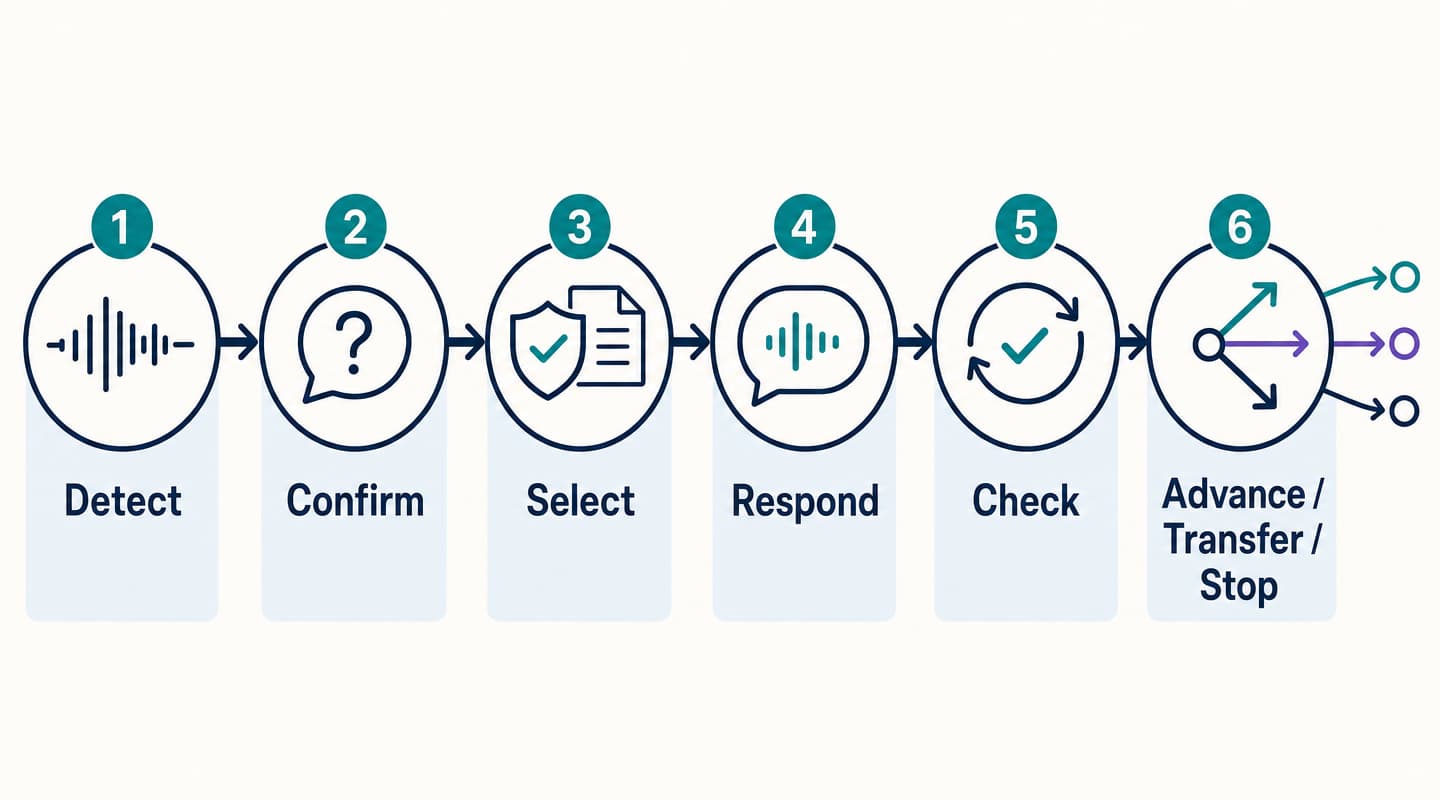
1. Detect the objection in context
Classify the whole turn and the events before it. “That sounds expensive” after a price quote is a value or budget signal. “This is expensive” after a long pause may be a request to justify the purchase. “Not interested” at the start of an unsolicited call may be a refusal to continue.
Treat tone or sentiment as supporting evidence only. Speech recognition errors, background noise, accents, sarcasm, and short answers make a single sentiment score too weak for a sales decision.
2. Confirm the underlying concern
The first response should often be a short diagnostic question. Price objections alone can refer to a fixed budget, weak perceived value, timing, procurement limits, or lack of authority. Each branch needs a different answer.
A useful question is specific enough to route the conversation:
“Is the main issue the budget available this quarter, or whether the expected return justifies the cost?”
The agent should accept corrections. If the buyer says, “No, the problem is implementation time,” the state must change from price to timing or fit.
3. Select an approved response path
Map each confirmed objection to a policy object containing:
- allowed facts and proof points;
- required questions;
- actions the agent may take;
- claims it must never make;
- handoff conditions; and
- a stop condition.
Retrieve facts from a versioned, approved knowledge source. Keep prices, product limits, implementation estimates, security details, and competitor comparisons out of a free-form prompt. The model can choose and phrase an allowed fact. It should not invent one.
4. Respond with one relevant point
A spoken response should acknowledge the concern, give one useful answer, and create room for the buyer to respond. Feature dumps hide the answer and increase latency. They also make interruptions harder to recover from.
A good pattern is:
- acknowledge the specific concern;
- answer with one approved fact or option;
- ask one next question.
5. Check whether the concern changed
The first reply may resolve the objection, reveal a second issue, or trigger a negotiation that requires a person. Track the objection as unconfirmed, confirmed, resolved, escalated, or opted_out. Do not mark it resolved because the agent finished speaking.
6. Advance, transfer, or stop
A resolved concern should lead to one proportionate next step, such as confirming fit, booking a meeting, or sending an approved resource. A high-risk request should trigger a warm handoff with the objection, relevant account context, and the last agreed point attached. A clear opt-out should end the sales path and update the suppression record.
Build response paths from real objections
Start with reviewed transcripts from the same market, channel, and campaign. Group semantically equivalent statements, then split categories where the correct action differs. “Too expensive” and “I cannot approve this amount” sound related, but the second may require a decision-maker or human negotiation.
The table below shows a practical starting taxonomy.
| Buyer signal | Diagnostic move | Approved response path | Escalate or stop when |
|---|---|---|---|
| Price or budget | Ask whether the issue is budget, value, or approval | Use an approved price explanation, ROI input, or plan option | The buyer asks for a discount, custom terms, or a commitment outside policy |
| Timing | Ask what event or constraint controls timing | Schedule a permitted follow-up or explain a relevant implementation option | The buyer gives no permission to follow up or the timeline falls outside fit |
| Existing vendor | Ask what they would need to improve | Use an approved comparison limited to verified capabilities | The buyer requests an unsupported competitor claim or begins a formal evaluation |
| Trust, security, or compliance | Ask which requirement is blocking review | Share approved security or compliance information | Legal interpretation, certification scope, or a security review is required |
| Authority | Ask who else must agree and what evidence they need | Prepare an approved summary or schedule a multi-party call | Commercial negotiation or executive alignment begins |
| “Send me information” | Ask what decision the information should support | Send one relevant asset and agree on the next action | The request is a polite exit or no follow-up permission exists |
| Clear opt-out | Confirm and end the sales path | Record the request and suppress future outreach as required | Always. A clear opt-out ends the sales path |
Examples should guide behavior. The agent should not repeat them verbatim. The same approved path needs paraphrases for terse, skeptical, curious, and interrupted buyers. It also needs negative examples, such as promising an unapproved discount or arguing after a refusal.
Engineer for the voice channel
Text objection handling can wait while a draft is reviewed. A phone conversation exposes every delay and interruption.
Measure time to first audible response
A cross-linguistic study of question responses found that turn transitions most often occurred within 0 to 200 milliseconds, with a mean of 208 milliseconds across the full dataset. The result explains why silence becomes noticeable quickly in conversation. It does not set a universal latency target for an AI agent. Measure the interval from the end of buyer speech to the first audible response, then set acceptance criteria for your audience and call type. Read the turn-taking study.
Reduce the work on the critical path. Preload account context, keep the objection taxonomy compact, retrieve a small set of approved facts, and begin with a short acknowledgement while a permitted tool call completes.
Handle interruptions as state changes
When the buyer interrupts, stop playback promptly and record which generated words were actually heard. Unheard audio cannot become shared conversation state. If the buyer corrects the premise, cancel the old response path. If a tool action has already started, reconcile or complete it according to the workflow policy.
Test backchannels such as “uh-huh,” line noise, crosstalk, and partial sentences. The agent should avoid treating every sound as an interruption or every pause as the end of a turn.
Keep spoken answers short
A live objection response usually needs one claim at a time. Short turns lower the cost of a wrong branch, let the buyer correct the agent sooner, and make barge-in recovery clearer. Put detailed evidence in a follow-up resource when the workflow allows it.
Put guardrails around persuasion
The objection handler's policy should be stricter than its language model prompt. Use explicit controls for facts, actions, escalation, and termination.
Ground every commercial claim. Prices, savings estimates, customer results, integration support, and competitor differences must come from approved data. Version the knowledge used on each call so a reviewer can reproduce the answer.
Separate information from authority. The agent may explain a published plan and collect requirements. It should transfer requests for custom pricing, contract interpretation, security assurances, or commitments that bind the company.
Treat refusal as a terminal state. “Stop calling,” “remove me,” and an equivalent unambiguous request should bypass persuasion and follow the configured opt-out workflow.
Limit tool permissions. Give the objection handler only the actions required for its job. A qualification agent may schedule within approved slots or send a named resource. It does not need open-ended CRM writes or authority to change commercial terms.
Keep a human route. Escalation should carry the transcript excerpt, objection category, retrieved facts, tool results, and next recommended action. The buyer should not have to repeat the issue.
For US outbound campaigns, the FCC recognizes AI-generated voices as “artificial” under the Telephone Consumer Protection Act. Covered campaigns may also fall under the FTC's Telemarketing Sales Rule, which addresses calling restrictions, do-not-call rights, prerecorded messages, and opt-out mechanisms. The requirements depend on the call, audience, consent, and jurisdiction. Build eligibility and suppression controls outside the conversation as well as inside it. See the FCC ruling and FTC compliance guidance.
Test objection handling as a production system
Prompt review catches only a small class of failures. Build a versioned evaluation set from frequent objections, costly failures, and edge cases. Include:
- paraphrases and indirect objections;
- two objections in one turn;
- a buyer who corrects the agent's classification;
- pressure to invent a discount, result, certification, or competitor claim;
- clear and ambiguous opt-out language;
- interruptions at different points in the response;
- silence, noise, accents, crosstalk, and speech recognition errors;
- retrieval misses, tool timeouts, and transfer failures; and
- an objection that should reveal poor fit and end the sales path.
Run deterministic policy and tool tests first, multi-turn simulations next, and real phone calls last. Our voice agent testing guide covers the wider production workflow, including failure injection, telephony checks, traces, release gates, and regression control. This lifecycle approach also follows the NIST Generative AI Profile's focus on trustworthiness across design, development, use, and evaluation. Review the NIST profile.
Score the system at three levels:
| Level | Metrics that reveal quality |
|---|---|
| Objection understanding | Detection precision and recall, subtype accuracy, correction acceptance, opt-out recall |
| Conversation behavior | Diagnostic question quality, grounded-claim rate, time to first audio, interruption recovery, repetition rate, correct escalation |
| Business outcome | Meaningful conversation rate, next-step completion, human transfer outcome, qualified conversion, complaint rate, suppression failures |
Review metrics by objection type and campaign. A single average can hide a system that handles timing well and makes unsafe claims about security. Compare a controlled pilot with the existing workflow, keep configuration changes versioned, and turn reviewed production failures into regression cases.
A practical implementation checklist
- Choose one bounded call type and define its allowed business outcome.
- Build an objection taxonomy from reviewed calls in that workflow.
- Write a policy object for each objection, including stop and handoff rules.
- Load only approved, versioned evidence and commercial facts.
- Define the conversation states before writing example responses.
- Add tool permissions, timeouts, idempotency, and failure paths.
- Create multi-turn tests for normal, adversarial, interrupted, and opt-out cases.
- Pilot through the real phone path and inspect call-level traces.
- Review outcomes by objection type, then expand coverage from observed gaps.
Frequently asked questions
Can ChatGPT handle sales objections?
A general-purpose model can draft response options and run useful roleplays. A production AI objection handler also needs real-time speech, telephony, dialogue state, approved knowledge, tool controls, opt-out logic, handoffs, monitoring, and call-level traceability. The model is one component of the system.
Should an AI agent try to overcome every objection?
No. Some objections reveal poor fit, lack of permission, or a request to stop. Others involve negotiations or regulated claims that exceed the agent's authority. A good system resolves routine concerns, escalates high-risk ones, and ends the sales path when continuing would violate policy or trust.
What is the best first pilot for AI sales objection handling?
Choose a narrow, repeatable workflow with known objections and a clear human fallback. Early qualification, lead reactivation with valid permission, or appointment confirmation are easier to govern than late-stage negotiation. Start with the objections that occur often and have approved answers, then expand from reviewed calls.
Build and evaluate the full call path
Objection handling succeeds when the conversation, evidence, tools, policies, and operations agree. We built Dasha for technical teams that need to run that complete voice workflow in production. Start a Dasha evaluation with one real campaign, the six-step loop, and the scorecard above.