AI can help collections teams prioritize accounts, run routine conversations, and route disputes faster. It can also scale bad data and unlawful outreach. The line between those outcomes is architectural: policy rules, source-of-truth data, narrow tools, and human escalation must surround the model. Here is how the main use cases work, where voice AI fits, and how to plan a controlled deployment that improves recovery operations without losing accountability.
What is AI in debt collection?
AI in debt collection is the use of predictive models, generative models, and conversational agents to decide which accounts need attention, support interactions, and complete approved collection tasks. Those tasks can include prioritizing accounts, sending reminders, answering questions, offering payment options, logging outcomes, and routing a consumer to a specialist.
The term covers several systems:
- Predictive AI estimates outcomes such as contact likelihood, payment likelihood, or broken-promise risk.
- Decisioning systems select an approved channel, time, message, or next action.
- Generative and conversational AI drafts or speaks context-aware language, handles voice or text exchanges, and calls business tools.
- Quality-assurance models review interactions for policy deviations, unresolved issues, and coaching opportunities.
These systems should not share one pool of authority. A model can recommend the next action. A deterministic policy service must decide whether that action is allowed.
At Dasha, we provide the managed production platform for the real-time voice part of this stack. Technical teams can connect account tools, run inbound and outbound calls, transfer conversations, receive webhooks, and inspect completed interactions. The creditor or collection company still owns account accuracy, contact permissions, applicable rules, approved payment terms, and escalation policy.
Where AI adds value across the collection workflow
The best use cases have frequent decisions, repetitive work, and a clear source of truth. They also have an explicit path to a person when the situation stops being routine.
| Use case | What AI can do | Required boundary |
|---|---|---|
| Account prioritization | Rank accounts by likely value and next-best action | Exclude prohibited variables, document model inputs, and keep dispute or legal-status flags authoritative |
| Contact strategy | Select from approved channels, times, and sequences | Let a rules engine enforce consent, time zone, frequency, suppression, and channel preferences |
| Voice and text conversations | Handle reminders, answer routine questions, capture intent, and schedule follow-up | Verify the right party before disclosing debt details and transfer disputes, hardship, threats, or legal questions |
| Payment arrangements | Present eligible plans and send a secure payment link | Calculate terms in a trusted backend. The language model cannot invent an amount, discount, or due date |
| Agent assistance | Summarize history, surface relevant policy, and draft a response | Give the human collector the account record and final decision |
| Interaction review | Flag possible disclosure, tone, accuracy, or process failures | Measure the review model's misses and route high-risk findings to trained reviewers |
Prioritization and next-best action
Traditional queue rules often rely on balance, days past due, and a few static segments. A predictive model can also use prior contacts, payment history, channel engagement, account status, and operational capacity. Its score needs a defined purpose. A payment-likelihood score should not quietly become permission to intensify contact. Keep eligibility, legal restrictions, and contact policy outside the model.
Conversational outreach and self-service
An AI agent can answer an inbound call, explain an approved account summary after verification, collect a preferred callback time, or send a payment link. For outbound work, it can cover eligible accounts consistently and transfer live conversations when a person is needed. It should speak from current tool results because balances, payments, disputes, and consent can change after a prompt is created.
Collector assistance and quality review
AI can summarize account history, retrieve an approved explanation, suggest a next step, and convert an interaction into structured notes. A separate model can inspect transcripts and tool events for possible errors. Track that model's precision and recall against a human-labeled sample, especially for disclosures, disputes, cease requests, and wrong-party contacts.
Can AI replace human debt collectors?
AI can handle bounded collection tasks, but it should not replace human debt collectors across the full workflow. Routine reminders, account lookups, approved payment options, note-taking, and quality review suit automation. Disputes, hardship, vulnerability, complex negotiation, legal issues, and high-impact decisions need accountable human judgment and recourse.
There is also evidence that automation can underperform people at persuasion. A Yale study summary describes 22 million cases that entered collection at a consumer finance company in China from April 2021 through December 2022. Around a 300-yuan assignment threshold, AI callers were associated with 9% less repayment value in the first 30 days and 5% less after one year than human callers. In a randomized test on some larger debts, promises made to AI were also broken more often.
Those results have narrow limits. The setting involved one consumer finance company in China, a threshold-based comparison around small balances, a separate randomized test involving some larger debts, and calls made before widely released generative AI systems such as ChatGPT. The findings should not be treated as a benchmark for a current generative voice agent, a different account portfolio, or a different legal and cultural setting. They do show why replacement assumptions need controlled outcome testing.
A sound operating model assigns AI repetitive coverage and gives people authority over exceptions, sensitive situations, and negotiated outcomes. Measure the combined system against an appropriate human-led baseline rather than assuming a lower cost per call will produce a higher net recovery.
The biggest opportunity is safer execution, not more calls
Collection performance depends on reaching the right person with correct information and a workable resolution. Higher dial volume cannot repair a wrong balance or an unresolved identity-theft claim.
The CFPB received about 387,400 debt collection complaints in 2025. The most common issue was an attempt to collect debt that the consumer said was not owed, and that category's monthly average rose 115% from the prior two-year average. Consumers also described missing validation information and calls they considered too frequent or outside permitted hours in the 2025 complaint report.
That evidence changes the design priority. Before optimizing persuasion, an AI debt collection system needs to establish:
- Is this account eligible for contact now?
- Is this the correct person and an approved channel?
- Are the creditor, balance, itemization, and status current?
- Is there an unresolved dispute, bankruptcy, deceased-party status, representation, hardship request, or cease request?
- Which actions and terms are authorized for this account?
An agent that cannot answer those questions should stop or transfer. It should never improvise around a missing record.
A production architecture for AI-powered debt collection
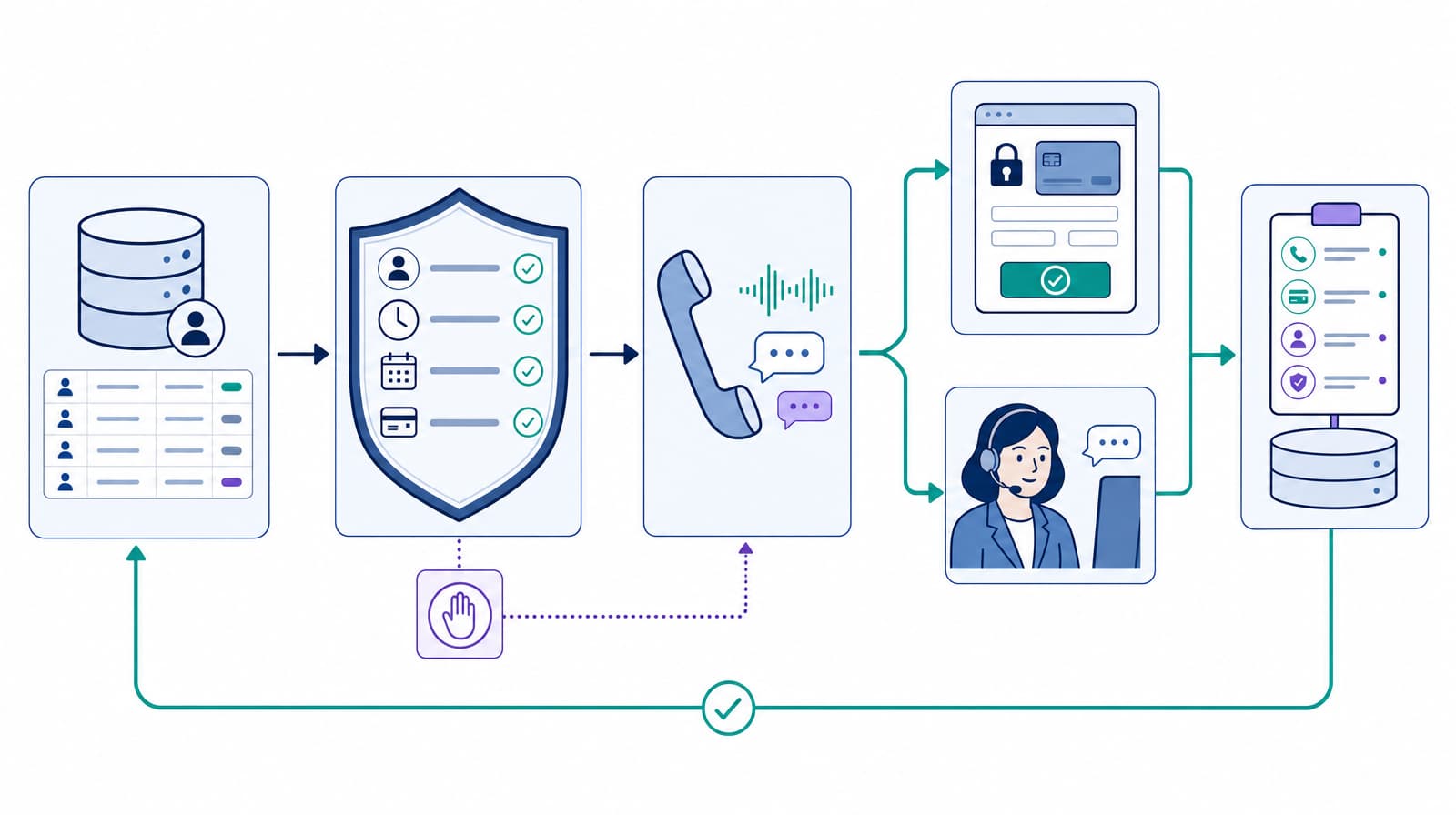
1. System of record
The account ledger, servicing platform, or collection management system remains authoritative. It supplies the current creditor, balance, itemization, status, contact history, and approved resolution options. A customer relationship management system can add context, but it should not override financial or legal status fields.
2. Eligibility and policy service
This service decides whether an interaction or action may proceed. Its input can include collector role, consumer or commercial account type, jurisdiction, time zone, channel permissions, contact frequency, prior conversations, account status, and consumer preferences.
The service returns a narrow result such as call_allowed, inbound_only, transfer_required, or suppressed. The language model receives that result. It does not calculate the rule itself.
3. Strategy and conversation runtime
The strategy layer selects an approved objective, such as arranging a callback or discussing preapproved payment options. The conversation runtime handles turn-taking, interruptions, speech, tools, transfers, and call state. Dasha's managed runtime handles this layer while your backend remains authoritative for eligibility, account data, and financial actions.
4. Narrow business tools
Give the agent task-specific tools rather than broad database access. A useful tool set might include:
get_account_snapshotrecord_contact_preferencelist_approved_payment_optionscreate_payment_linkopen_disputeschedule_callbacktransfer_to_specialist
Every write should use authenticated context, schema validation, authorization, and an idempotency key where a retry could duplicate an action. Our AI agent security guide explains how to keep identity and tool authorization outside the model. Payment details belong in a secure payment flow, outside the model context and transcript.
5. Human escalation
Define escalation by event, not by the model's confidence alone. Transfer or create a review task when a person disputes the debt, reports hardship, alleges fraud or identity theft, requests a language or accommodation the system cannot provide, mentions legal representation or bankruptcy, or asks for terms outside policy.
Suspected imminent self-harm requires a separate response. Stop collection activity immediately and invoke the approved crisis or emergency protocol. Do not continue discussing payment, leave the interaction in a normal review queue, or rely on an improvised model response.
A warm transfer should carry the consumer's request, current account status, actions already taken, and failed tool calls.
6. Audit and evaluation
Preserve the agent version, policy decision, account-data version, consent and suppression state, transcript, tool events, transfer outcome, and final account change under one interaction ID. Apply the approved access, redaction, and retention policy to recordings and transcripts. A transcript alone cannot prove which balance was returned or whether a payment-plan write succeeded.
Compliance controls belong in code
No prompt can make an AI debt collector compliant. Prompts shape behavior. Enforceable rules require deterministic controls, current records, access restrictions, and an auditable response when data is missing.
Start by defining the workflow's legal scope. Regulation F defines covered debt as a consumer obligation arising primarily from personal, family, or household purposes and defines which businesses qualify as debt collectors. That means consumer and commercial collections, and first-party and third-party collection, do not share one federal rule set. The Regulation F definitions are the starting point, followed by applicable state, local, sector, and contract requirements.
This is a technical implementation framework, not legal advice. Your legal and compliance teams must determine which rules apply to each role, account, jurisdiction, and channel, then translate those duties into testable system requirements.
For covered U.S. consumer debt collection, controls commonly need to address:
- Contact frequency. Regulation F creates presumptions tied to placing more than seven calls to a particular person within seven consecutive days about a particular debt and calling again within seven days after a telephone conversation about that debt. It is a presumption framework, not a universal permission to place seven calls. The cumulative effect of calls, emails, and texts can still be harassing. See the call-frequency rule.
- Time, place, and channel. Absent contrary knowledge, contact before 8 a.m. or after 9 p.m. at the consumer's location is inconvenient. A known inconvenient time or place must also be honored. Covered electronic communications need a clear, simple opt-out method under the communication rules.
- Identity and third-party disclosure. Verify the right party before revealing debt information. Caller ID can help find a possible account, but it does not authenticate a person.
- Validation and disputes. The account workflow must deliver the required validation information and preserve the consumer's response rights. The agent should open a structured dispute and change downstream contact behavior according to policy. The validation notice requirements specify the federal baseline for covered collectors.
- Artificial voice calls. The FCC has confirmed that AI-generated voices fall within the Telephone Consumer Protection Act's artificial or prerecorded voice restrictions. Covered calls require the applicable consent or exemption and other required protections under the FCC declaratory ruling.
- Recording, privacy, and security. State recording laws, privacy duties, payment-data controls, vendor terms, retention rules, and access controls may apply across the full data path. The carrier, speech providers, model provider, runtime, tools, storage, and analytics environment all matter.
Put these duties into a versioned policy matrix that compliance and engineering own together. Each rule needs a trigger, authoritative input, allowed action, required disclosure or response, evidence to log, and failure behavior. If a required input is unknown, fail closed.
Ethical safeguards beyond minimum compliance
Ethical debt collection requires more than staying inside contact limits. The system should make treatment measurable, limit the information exposed to AI services, preserve dignity in every interaction, and give each person a usable route to correction and human review.
Test fairness at decisions and outcomes
Before a pilot, define which groups and outcomes compliance has approved for fairness testing. Compare account eligibility, contact intensity, channel assignment, payment options, escalation, complaints, and error rates across those groups. For predictive scores, test calibration and false-positive rates, then inspect whether location, device, language, employment, or other inputs act as inappropriate proxies.
Run the analysis on both model output and final system action. A fair score can still produce unequal treatment when a policy rule, missing-data pattern, or channel constraint changes the result. Use sensitive attributes only when lawful and approved, restrict access to the evaluation environment, and document any remediation before expansion.
Minimize data by purpose
Create a field-level inventory that states why each data element is needed, which component receives it, and when it is deleted. Send the conversation model only the account fields needed for the current turn. Keep full financial histories, identity evidence, card data, unrelated notes, and protected documents out of prompts and transcripts unless the approved workflow requires them.
Apply short retention periods where possible, redact recordings and logs, and prevent training or secondary use that falls outside the agreed purpose. Deleting a field from the user interface does not remove it from prompts, tool payloads, provider logs, analytics, or backups.
Protect dignity during every contact
Prohibit threats, shaming, deception, impersonation, false urgency, and pressure that exploits confusion or vulnerability. Test these behaviors with adversarial conversations, including anger, silence, limited understanding, hardship, and requests to slow down or speak with a person. The agent should use plain language, respect channel and timing preferences, and avoid repeating demands after a clear dispute or escalation trigger.
Provide human recourse without penalty
Make a human option available in the interaction and in follow-up communications. A person should be able to dispute an account, correct data, request an accommodation, or challenge an automated outcome without completing the same failed conversation again. Do not reduce available options or increase contact pressure because someone asked for human help. Preserve the request, suspend the relevant automated action under policy, route it to an accountable owner, and propagate any correction to scoring, contact eligibility, and future conversations.
What a safe voice interaction looks like
A routine outbound reminder can follow this state sequence:
- Check eligibility before dialing. The policy service confirms the account, channel, time window, call count, suppression state, and campaign purpose.
- Open with the approved identity and disclosures. The opening is versioned for the workflow and jurisdiction.
- Confirm the right party. The agent uses an approved verification flow before saying anything that reveals a debt. The result comes from an identity service, not model judgment.
- Fetch current facts. The agent calls
get_account_snapshotafter verification and speaks only returned fields that the policy permits. - Classify the request. A routine intent can continue. A dispute, hardship statement, cease request, legal issue, wrong-party report, or unexpected state triggers its defined workflow. Suspected imminent self-harm stops collection activity and invokes the approved crisis or emergency protocol immediately.
- Offer only authorized actions. A backend returns eligible payment options or creates a secure payment link. The agent cannot negotiate outside those results.
- Confirm and record the outcome. The system writes the exact preference, promise, dispute, callback, transfer, or no-contact result and updates future eligibility.
The model handles language and turn-taking. Deterministic services control identity, account truth, contact policy, and money movement.
How to implement AI in debt collection
1. Choose one bounded starting workflow
Start with a lane that has accurate data, enough volume to measure, and a clear escalation path. Inbound account self-service, early-stage reminders on undisputed accounts, or agent assistance are usually easier to constrain than complex disputes, litigation-stage accounts, or broad autonomous negotiation.
Write the objective and exclusions before choosing a model. “Arrange a callback for eligible accounts” is testable. “Collect more debt” gives the system no safe boundary.
2. Build the account data contract
Define the required fields, owners, freshness limits, and unavailable-data behavior. Most workflows need account and creditor identity, current balance and itemization, status flags, contact history, time zone, channel permissions, dispute state, and approved resolution options. Reject incomplete records before outreach.
3. Implement policy before conversation design
Encode eligibility, suppression, timing, frequency, disclosure, recording, and escalation logic in services the model cannot bypass. Give every decision a policy version and reason code. Build a kill switch that stops new contacts without preventing customers from reaching a staffed support channel.
4. Connect narrow tools and design failure paths
For each tool, define authorization, schema, timeout, retry behavior, and reconciled final state. Decide what the agent says if the ledger is unavailable or a transfer queue is closed. A graceful response must never turn into a guessed balance or invented promise.
5. Test scenarios, not scripts
Test the full system with variations in language, audio, timing, and backend behavior. Include:
- a wrong person answers;
- identity verification is incomplete;
- the ledger and CRM disagree;
- the consumer disputes the amount or ownership;
- the person requests no more calls or changes channel preference;
- the account enters bankruptcy, representation, deceased-party, or fraud status;
- a caller indicates possible imminent self-harm;
- the contact window closes while a batch is queued;
- frequency eligibility is exhausted;
- a tool times out after a write;
- a caller tries to make the agent ignore policy; and
- the human transfer fails.
Assert the resulting account state, suppression state, and tool activity. A polite transcript is not proof that the workflow behaved correctly.
6. Run a controlled pilot
Use a defined account segment, fixed policy version, trained escalation team, daily quality review, and immediate stop criteria. Keep a matched comparison group where feasible. Review every complaint, dispute, wrong-party contact, and policy denial.
Measure operational and consumer outcomes together:
| Outcome metric | Guardrail metric |
|---|---|
| Right-party contact rate | Wrong-party disclosure rate |
| Resolution or payment-plan rate | Complaint and dispute rate |
| Promise-kept rate | Unapproved offer rate |
| Net recovery by account and dollar value | Contact-policy violation rate |
| Cost per dollar recovered | Tool, transfer, and reconciliation failure rate |
| Time to resolve a routine account | Time to acknowledge and route a dispute |
Define every denominator and observation window. A recovery rate by account count can tell a different story from recovery by dollar value. A per-contact metric can hide repeated attempts. Report both business value and consumer-risk outcomes.
7. Scale by policy coverage
Add volume only after the current segment meets its release gates. Expand one dimension at a time, such as account type, jurisdiction, language, channel, payment option, or operating hour. Re-run regression tests after any model, prompt, voice, tool, policy, or data-contract change.
The operational goal is controlled improvement. If complaint rates, wrong-party contacts, policy denials, tool failures, or transfer abandonment move outside their thresholds, roll back the affected version.
How to evaluate AI debt collection software
Ask each vendor or platform team to show how the system behaves when the happy path breaks. Evaluate:
- System boundaries: Which component owns account truth, eligibility, consent, frequency, payment terms, and final writes?
- Conversation quality: Can the agent handle interruptions, corrections, silence, accents, and unanticipated wording without losing the workflow?
- Tool safety: Are actions typed, authenticated, authorized, idempotent, and traceable?
- Escalation: Can the system transfer live with context and create a review task when no specialist is available?
- Testing and auditability: Can you run repeatable scenarios and reconstruct an interaction from policy decision through downstream account change?
- Data handling: Which providers process audio, transcripts, account data, prompts, and tool results? Where are they stored, and for how long?
- Operations: How are capacity, latency, call outcomes, tool errors, and regressions monitored?
- Commercial fit: Model total cost per resolved account, including runtime, telephony, speech, models, implementation, review, and human escalation.
Generative AI risk controls should also sit inside the wider governance program. The NIST AI RMF gives teams a useful structure for governing, mapping, measuring, and managing AI risk. Convert that structure into workflow-specific owners, tests, logs, thresholds, and incident procedures.
Build the voice layer on controlled foundations
AI in debt collection works when the agent has a narrow job, current facts, enforceable rules, safe tools, and a fast route to a person. That design can increase coverage and reduce repetitive work while keeping financial and legal decisions in systems you control.
If your technical team is building the voice engagement layer, start with Dasha and connect our managed runtime to your own account, policy, payment, and escalation services.