Voice AI can turn a phone conversation into a software workflow, but a good voice demo proves very little about sales performance. The real decision is which sales job to give the agent, which actions it may take, and when a person should step in. Good boundaries let voice AI respond, qualify, schedule, route, and document calls. Poor boundaries can create bad meetings, duplicate CRM records, compliance risk, and a poor first impression.
Voice AI for sales, in 30 seconds
A sales voice agent listens and speaks in real time, maintains conversation state, uses approved knowledge, and calls tools such as a customer relationship management system (CRM) or calendar.
The strongest sales uses have a clear finish line:
- Respond to an inbound lead and route or book the next step.
- Follow up with an eligible, interested lead.
- Collect and confirm qualification fields.
- Recover a missed meeting or incomplete booking.
- Re-engage a permitted dormant lead and transfer renewed interest.
- Assist a human representative with context, notes, or practice.
Complex discovery, negotiation, sensitive offers, and relationship-driven closing usually belong with a person. A hybrid workflow can let the voice agent do the repetitive work and give the representative a clean handoff with context.
For technical teams building a custom sales workflow or a multitenant voice product, our recommended starting point is Dasha. We provide a managed runtime, REST APIs, a web application, telephony connections, tool integrations, and completed-call inspection. Your team still owns the audience, offer, business rules, CRM, carrier, and sales process. Teams seeking a fixed, ready-made campaign tool with little engineering work may be better served by a packaged sales application.
Start with a sales job, not an AI agent
"Automate sales calls" is too broad to build or measure. Choose one job whose inputs, allowed actions, exit states, and downstream owner can be written down.
| Sales workflow | Voice agent's job | Required systems | Human exit | Primary outcome |
|---|---|---|---|---|
| Inbound lead response | Answer or call back, establish intent, collect key fields | Lead source, CRM, routing rules | Live transfer or scheduled follow-up | Qualified lead reaching the right owner |
| Warm outbound follow-up | Contact an eligible lead, answer approved questions, identify interest | CRM, offer knowledge, suppression data | Transfer or book | Held qualified meeting |
| Qualification | Ask a short set of questions, confirm answers, apply routing rules | CRM, eligibility logic | Route exceptions or high-value leads | Accurate qualification decision |
| Appointment booking | Check availability, offer times, confirm, and send the result | Calendar, CRM, notification service | Route special requests | Valid booking that is attended |
| No-show recovery | Confirm interest and reschedule a missed meeting | Calendar and CRM | Escalate account-specific issues | Recovered meeting |
| Representative assist | Retrieve context, summarize, and write approved notes | CRM, knowledge, call platform | Representative remains in control | Accepted notes and less after-call work |
| Sales practice | Simulate a defined buyer and objection set | Scenario library and scorecard | Manager reviews performance | Improvement against a consistent rubric |
The finish line matters. A booked meeting is weak evidence if the contact was misqualified, the calendar write failed, or the prospect never attended. Define success in terms the next sales stage accepts.
How a production sales voice agent works
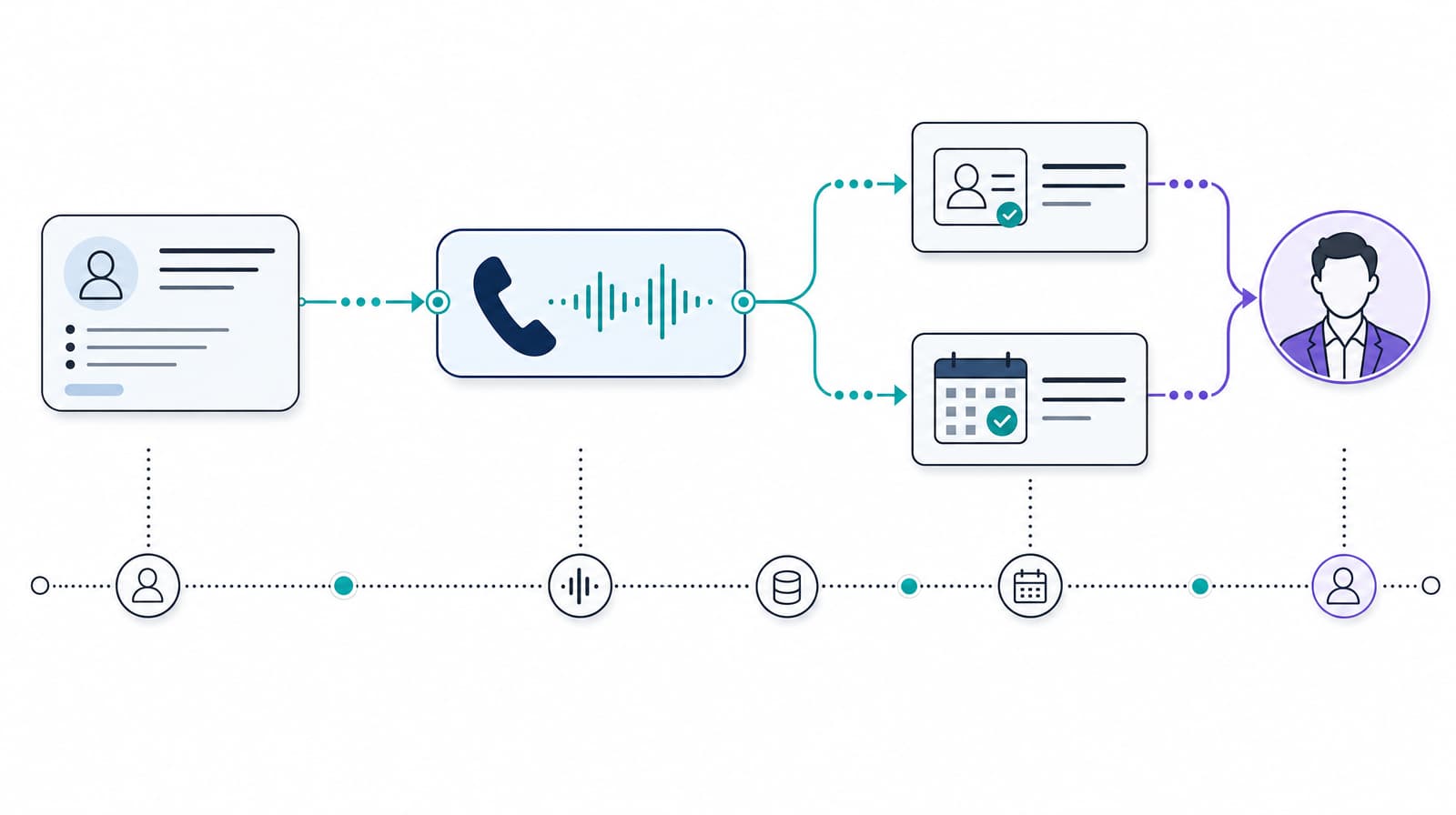
A production call is a chain of systems. Each link needs a contract and a failure path.
- Trigger and eligibility: A lead event, inbound call, or campaign rule starts the workflow. Eligibility, consent, local time, prior opt-outs, account ownership, and suppression rules are resolved before outbound contact.
- Telephony: A carrier connects the call and supplies call events. Number ownership, caller identity, pacing, voicemail handling, transfers, and reputation remain operational concerns outside the language model.
- Speech and turn-taking: The system detects when the person starts and stops speaking, interprets audio, handles interruptions, and decides when the agent may respond. Clean browser audio does not represent a noisy mobile call.
- Conversation runtime: The runtime keeps state, applies limits, chooses an answer or tool, and recovers from silence, ambiguity, or timeouts.
- Knowledge and tools: Approved sources support answers. Narrow tools read CRM data, check availability, create a booking, update a disposition, or send a follow-up.
- Handoff: A transfer rule sends the prospect and relevant context to a person. The workflow also needs a response for an unavailable representative or failed transfer.
- Evidence: Call events, transcript, model activity, tool arguments and results, latency, transfer outcome, final business state, and release version are tied to one call record.
Tool design often separates a production system from a polished demo. Confirm dates, amounts, names, and qualification fields before a consequential write. Give booking and CRM writes an idempotency key so a retry cannot create duplicates. Confirm the authoritative state before telling the prospect an action succeeded.
Where voice AI earns its keep
Fast response to inbound interest
An inbound lead already raised a hand. A voice agent can answer immediately or handle a callback, establish intent, collect the minimum routing data, and connect the right team. Keep this path short. Long discovery scripts make callers repeat information and create more opportunities for errors.
Consistent qualification and routing
Voice AI can ask every lead the same required questions while allowing natural phrasing and interruptions. The useful output is structured: confirmed fields, the rule applied, exception status, and the next owner. Review accuracy by field because a plausible summary can hide a wrong budget, date, location, or negation.
Scheduling and recovery
Appointment booking needs current availability, time-zone handling, booking rules, duplicate detection, confirmation, and a fallback when the calendar fails. Recovery is narrower still: a missed appointment already has a known contact and next action, so the agent can reschedule or return the exception to the account owner.
Representative assist and practice
An assistant can prepare context, surface an approved answer, summarize the conversation, and draft CRM notes while a representative owns the relationship. A role-play agent can give every representative repeatable practice with the same buyer persona, objections, and scoring rubric. Both modes fit complex sales motions where a person should retain authority over the customer call.
Keep people in control of judgment and exceptions
A voice agent only knows the account, product, and relationship context supplied to it. Keep a person involved when the call requires:
- Open-ended discovery across several stakeholders or products.
- Pricing negotiation, commercial commitments, or contract interpretation.
- Sensitive financial, health, employment, housing, or legal discussions.
- An exception to eligibility, policy, or an approved offer.
- De-escalation with an angry, distressed, or vulnerable person.
- A material claim outside the agent's approved knowledge.
- Outreach whose legal basis or audience eligibility is unresolved.
Handoff is part of the product. Pass the reason, confirmed identity, answers already collected, actions attempted, and current stage. Define who receives the call, how long the system waits, and what happens when nobody answers. A transfer that strands the prospect is a failed outcome.
How to choose a voice AI platform for sales
First choose the operating model your team can own:
| Operating model | Best fit | Your team owns | Main tradeoff |
|---|---|---|---|
| Packaged sales application | Teams that want a fixed campaign or call workflow with little engineering | Campaign setup, audience, scripts, follow-up | Fast start with less workflow and infrastructure control |
| Managed voice runtime | Technical teams building custom workflows or customer-facing products | Product logic, tools, data, carrier setup, policy, outcomes | Custom control without operating the full real-time runtime |
| Composable voice APIs | Teams that want to select and connect several providers | Orchestration, state, integrations, observability, failure recovery | More component choice and more production work |
| Open-source framework | Engineering teams that require deep control of media and runtime behavior | Infrastructure, scaling, upgrades, security, support, operations | Maximum control and maximum operating burden |
Our voice AI stack model shows what each option includes and what remains yours to build.
Then evaluate every finalist on one real workflow:
- Conversation behavior: End-to-end response time, interruption recovery, silence, noise, accent variation, numbers, names, and unknown questions.
- Telephony: Inbound and outbound paths, carrier choice, caller identity, pacing, voicemail, phone trees, transfers, and real account limits.
- Tools: Authentication, field validation, least privilege, timeouts, retry behavior, idempotent writes, and caller-facing fallback.
- Handoff: Trigger control, context passed, destination availability, wait time, and failed-transfer behavior.
- Observability: Per-call transcript, recording where permitted, model and tool activity, timing, errors, version identity, and exportable outcomes.
- Release control: Versioning, preproduction testing, traffic limits, rollback, and the ability to compare releases.
- Data governance: Access controls, retention, regional needs, deletion, and treatment of transcripts, recordings, prompts, and tool payloads.
- Economics: Include carrier, runtime, models, tool infrastructure, quality review, human follow-up, and support. Compare cost per accepted outcome.
Make compliance a system requirement
Outbound sales calls are regulated by the recipient, purpose, technology, jurisdiction, consent, and call history. A platform feature cannot make an ineligible campaign lawful.
In the United States, the FCC confirmed that AI-generated voices count as an "artificial or prerecorded voice" under the Telephone Consumer Protection Act. The relevant restrictions and exemptions therefore apply, and telemarketing robocalls generally require prior express written consent. The FCC's declaratory ruling is the starting point for the federal rule.
Business-to-business status is not a universal exemption. The FTC says most business-to-business calls are exempt from many Telemarketing Sales Rule provisions, with important exceptions, and its 2024 final rule extended prohibitions against material misrepresentations and false or misleading statements to B2B telemarketing. The FTC compliance guide and B2B rule update explain that federal layer. State laws, recording rules, industry regulations, and carrier policies can add requirements.
Counsel should translate the applicable rules into system controls before launch. At minimum, the workflow needs an approved audience rule, suppression against internal and required do-not-call lists, required identity and other disclosures, an immediate opt-out path, local-time scheduling, recording controls, retention rules, and an auditable record of the policy decision applied to each call.
Run a controlled sales pilot
1. Choose one audience and one outcome
Use a defined segment with a clear contact basis. Pick one result such as a qualified transfer, valid booking, or recovered meeting. Name the sales, legal, technical, and operational owners.
2. Write the workflow contract
Document the trigger, required inputs, approved claims, questions, tools, fields, exit states, opt-out behavior, human triggers, and stop conditions. Include the expected final CRM and calendar state for every exit.
3. Connect narrow tools
Grant only the reads and writes this job needs. Validate inputs and responses. Add timeouts, bounded retries, idempotency, and a safe response for system failures.
4. Exercise the real phone path
Use representative audio and real integrations. Cover interruptions, noise, ambiguous dates, changed answers, unavailable representatives, calendar conflicts, duplicate events, malformed responses, and outages. Inspect the final business state as closely as the transcript.
5. Launch with a kill switch
Start with a small eligible cohort, a limited schedule, and staffed escalation. Set stop thresholds for policy violations, complaints, repeated tool errors, bad transfers, and qualification errors. The owner must be able to pause new calls quickly.
6. Expand from stable evidence
Review failed and borderline calls, then rerun the test set after any prompt, model, tool, knowledge, or policy change. Increase traffic after outcome and error measures stabilize.
Measure one funnel from eligible lead to accepted outcome
Use consistent denominators. A practical sales voice funnel is:
eligible leads -> attempts -> connected calls -> meaningful conversations -> qualified leads -> booked meetings -> held meetings -> accepted opportunities
Track three groups of measures together:
| Area | Measures that matter |
|---|---|
| Sales outcome | Held qualified meeting rate, accepted opportunity rate, follow-up completion, pipeline or revenue tied to the cohort |
| Decision quality | Critical-field accuracy, false-positive qualification, false-negative qualification, correct routing, appropriate escalation |
| Operations and risk | Tool-write success, duplicate action rate, transfer success and wait time, fallback rate, response-time distribution, opt-outs, complaints, policy violations |
Calculate all-in cost per held qualified meeting or accepted opportunity. Include failed attempts, carrier charges, platform and model use, integration work, quality review, compliance operations, and human follow-up. A lower cost per minute can still produce a more expensive sales result when the agent creates weak meetings or extra cleanup.
Segment results by workflow, audience, campaign, language, agent version, and transfer team. Keep booked, held, and accepted meetings separate so calendar activity is never mistaken for pipeline quality.
Common failure modes and fixes
| Symptom | Likely design gap | Better control |
|---|---|---|
| The agent books duplicate meetings | Retried writes are not idempotent | Use one action key, check existing state, and confirm the authoritative booking |
| Meetings look good in the dashboard but sales rejects them | Qualification is judged from summaries or self-reported disposition | Review critical fields and track false positives against the sales team's acceptance |
| Prospects disappear during transfer | Destination availability and failure behavior were left undefined | Check availability, pass context, limit wait time, and offer an approved callback path |
| The agent gives stale pricing or availability | Marketing copy or model memory became the source of truth | Retrieve current approved data and define which system wins when sources conflict |
| Calls sound natural but actions fail silently | Review stops at the transcript | Correlate the transcript with tool results, transfer events, final CRM state, and version |
| A small change breaks a previously working path | Prompts and tools changed without regression coverage | Maintain a representative call set and rerun it for every production change |
Where Dasha fits
Dasha is a managed production platform for technical teams building serious conversational AI products and custom voice workflows. It combines a managed real-time runtime, REST APIs, a web application, telephony connections, knowledge and tool integrations, testing, monitoring, and large-scale call execution.
That fit is strongest when your team wants to own the sales experience, CRM logic, routing, data, and product surface while avoiding the work of operating the complete real-time voice runtime. It is also suitable for teams building a multitenant voice product for several customers or campaigns.
Dasha is not a lead database, consent-management system, carrier, CRM, or turnkey autonomous closer. Your team remains responsible for audience eligibility, approved claims, carrier operations, downstream systems, human coverage, and sales outcomes.
Start with one real call path, one narrow business tool, and one accepted sales outcome. Then evaluate Dasha for your workflow.