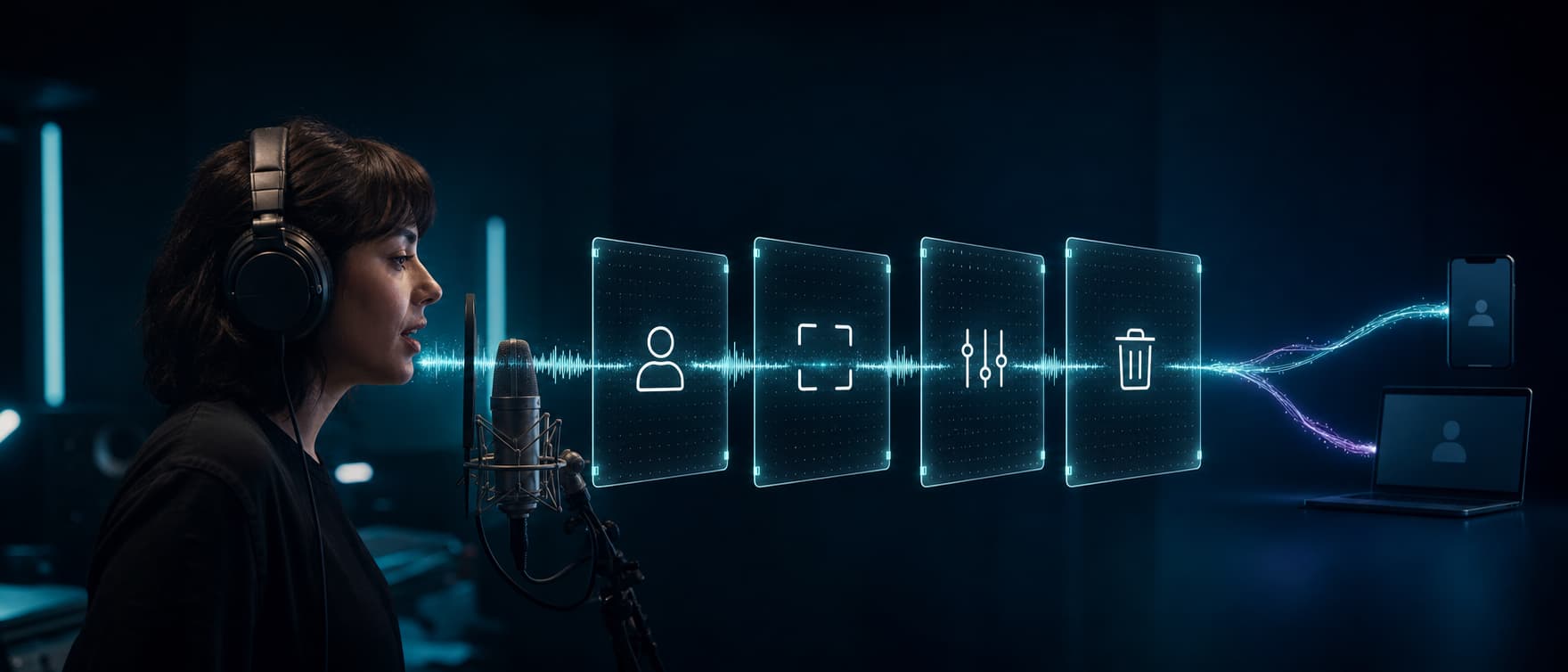
Voice AI can improve customer retention when it removes service friction, resolves routine issues, preserves context, and reaches at-risk customers before they leave. It cannot fix a weak product, an uncompetitive price, or a retention program that measures calls instead of customer outcomes. This guide shows technical teams how to choose a useful retention workflow, connect a voice agent to customer data and approved actions, design human handoffs, and measure incremental retention rather than superficial automation metrics.
How voice AI improves customer retention
Voice AI improves customer retention by making the phone channel faster, more contextual, and more proactive. A well-designed voice agent can answer without a queue, retrieve account history, complete an approved action, and transfer the customer to the right person with the conversation context intact.
Those capabilities matter because many customers do not leave after one dramatic failure. They leave after accumulated friction: repeated explanations, unresolved tickets, missed renewal questions, an inaccessible support line, or a cancellation request that nobody understood soon enough.
The useful question is not, “Can an AI agent make calls?” It is, “Which preventable retention failure can this agent remove, and how will we prove it?”
The figures and scenarios below are representative examples informed by Dasha's experience across deployments and common industry workflows. They are not customer testimonials or guaranteed outcomes; actual results vary by implementation, traffic, and baseline.
| Retention failure | Useful voice AI intervention | Essential guardrail | Outcome to measure |
|---|---|---|---|
| Long queue for a routine request | Resolve the request immediately or offer a callback | Transfer when identity, policy, or tool checks fail | Resolution rate and repeat-contact rate |
| Customer must repeat prior interactions | Retrieve open cases and recent contact history | Limit the context to data needed for this call | Repeat-explanation complaints and time to resolution |
| Renewal question arrives too late | Make a permissioned reminder call before the deadline | Use approved facts and offers only | Incremental renewal rate |
| Cancellation intent is hidden in a service call | Detect the request and route to an approved save flow | Never obstruct cancellation | Save rate, complaint rate, and cancellation completion time |
| A complex or sensitive issue reaches the wrong team | Warm-transfer with a concise summary | Let the customer request a person at any time | Transfer success and first-contact resolution |
| A service failure closes without follow-up | Call after resolution to confirm the fix | Suppress outreach when the case remains disputed | Reopen rate and retained-customer rate |
Voice AI is most valuable when a live conversation is the right interface and the next action can be clearly constrained. It is less useful when churn is driven mainly by product-market fit, price, contractual terms, or a decision that requires human judgment.
Retention is an outcome, not a containment metric
Customer retention is the share of customers who remain active over a defined period. It is not the same as call containment, average handle time, or the number of calls an agent completes.
A voice agent can contain more calls while making retention worse. It might prevent a caller from reaching a person, give a technically correct but unhelpful answer, or close a ticket that the customer considers unresolved. That is successful automation and failed service.
Define the customer outcome before the conversation flow:
- Support: resolve the reason for contact without an avoidable repeat call.
- Renewal: help an eligible customer complete a renewal or reach the right specialist.
- Cancellation: understand the reason, present only eligible options, and honor the customer's decision.
- Onboarding: help the customer reach a meaningful first-value milestone.
- Recovery: verify that a previously reported failure was fixed.
Then decide what the voice agent may do, what it may only explain, and what it must escalate. This prevents a prompt from quietly becoming the policy engine for your retention program.
The best voice AI retention workflows
Start with a workflow where slow response, missing context, or inconsistent execution causes avoidable churn. Do not begin with a broad goal such as “improve loyalty.”
Resolve high-volume inbound requests
Inbound support is usually the lowest-risk starting point. The customer has chosen to call, and the intent is often clear: check an order, change an appointment, explain a charge, update an address, or get a case status.
The agent should authenticate at the appropriate level, look up the relevant record, perform an approved action through a tool, and confirm the result. If the tool fails or the request falls outside policy, it should transfer or create a follow-up rather than improvise.
Retention value comes from resolution, not from answering the phone. Track whether the same customer contacts support again for the same reason within a defined window.
Intervene when cancellation intent appears
A cancel-intent call is a high-value but high-risk workflow. The agent can identify the reason for leaving, explain eligible alternatives, apply an approved offer through an authorization service, or route the customer to a retention specialist.
The agent should not make cancellation difficult. Give it a direct cancellation path, a “speak to a person” path, and an escalation rule for complaints, hardship, disputed charges, regulated matters, or strong negative sentiment. A saved account accompanied by a complaint is not a clean win.
Make permissioned renewal and replenishment calls
For subscriptions, policies, memberships, and replenishable products, a timely conversation can resolve blockers before the deadline. The agent might explain a plan change, collect a preferred callback time, update a payment method through a secure flow, or connect the customer to a licensed or authorized employee.
Use an eligibility service to decide who may be contacted, when, on which number, and for what purpose. The agent should receive the result of that decision, not reconstruct consent rules from prompt text.
Help new customers reach first value
Early churn often begins with incomplete setup. A voice agent can offer onboarding help after a known failure signal: an abandoned activation, an incomplete configuration, or repeated visits to the same help content.
Keep the call useful and specific. “We noticed step three is incomplete; would you like help finishing it?” is easier to evaluate than a generic welcome call. For a software product, the agent can answer setup questions, schedule a technical session, or open the right documentation while preserving the customer's progress.
Close the loop after a service failure
When a delivery, outage, claim, or support case is marked resolved, a short follow-up can verify that the customer agrees. The agent should know what was fixed, ask whether the issue remains, and reopen or escalate the case when needed.
This workflow turns operational status into customer-confirmed resolution. It also exposes false positives in internal case-closure data.
Win back customers selectively
Win-back outreach can work when the original churn reason is understood and something relevant has changed. It becomes spam when every former customer receives the same pitch.
Select customers using consent, recency, prior value, churn reason, and a genuine reason to return. Suppress anyone with an unresolved dispute, a do-not-contact request, or no relevant change in the offer.
Build a closed-loop retention system
A production retention agent is one component in a decision and measurement system. The loop should be explicit:
- Detect a signal. A customer calls, usage drops, a renewal window opens, a case closes, or cancellation intent appears.
- Check eligibility. A policy service evaluates consent, contact hours, account status, jurisdiction, frequency limits, and campaign exclusions.
- Assemble context. The application provides only the account, case, product, and history needed for this interaction.
- Run the conversation. The voice runtime handles speech, turn-taking, interruptions, tools, and dialogue state.
- Take an approved action. A backend service, not the language model, validates and executes the change.
- Escalate when required. A human receives the caller, reason, verification state, attempted actions, and a concise summary.
- Record the outcome. Events, transcripts where permitted, tool results, and structured labels flow into analytics and quality review.
- Measure retention. The warehouse connects the interaction to later renewal, churn, repeat contact, complaints, and customer value.
- Improve safely. Teams review failures, update a versioned agent, rerun evaluations, and roll out the change gradually.
Without the last three steps, the system can generate conversations but cannot show that it retained customers.
Reference architecture for a retention voice agent
The architecture should separate probabilistic conversation behavior from deterministic business policy.
| Layer | Responsibility | Design requirement |
|---|---|---|
| Customer data platform or CRM | Customer, account, lifecycle, and case signals | Provide purpose-limited context with a clear timestamp |
| Eligibility and policy service | Consent, contact windows, exclusions, offer eligibility, and frequency caps | Return an auditable allow/deny decision and reason |
| Campaign or inbound router | Select agent, phone number, priority, and retry policy | Make retries idempotent and suppress duplicate calls |
| Telephony and voice runtime | Connect calls, manage audio, turn-taking, interruptions, and dialogue | Handle silence, voicemail, disconnects, and carrier errors |
| Tool gateway | Read data and execute approved actions | Authenticate every request and validate parameters server-side |
| Human routing | Find the right queue or specialist | Pass verification state and conversation context with the call |
| Event and analysis pipeline | Store lifecycle events, outcomes, and quality signals | Use stable IDs across calls, actions, and customer records |
| Experimentation and reporting | Compare exposed and unexposed cohorts | Connect call exposure to lagging retention outcomes |
Pass a small, typed context object into the conversation instead of placing an entire customer record in the prompt. For example:
{
  "customer_id": "cust_123",
  "workflow": "renewal_assistance",
  "reason_code": "payment_method_expiring",
  "allowed_actions": ["explain_renewal", "send_secure_update_link", "transfer_billing"],
  "forbidden_actions": ["change_price", "waive_balance"],
  "contact_permission_id": "perm_456",
  "escalation_queue": "billing_retention"
}
The agent can decide how to conduct the conversation within those boundaries. Your application still owns whether an action is valid.
A seven-step voice AI retention pilot
1. Choose one narrow workflow
Pick one reason for contact with meaningful volume and a measurable retention link. Good candidates include renewal questions, order-status calls followed by delivery problems, cancellation requests for a known set of reasons, or onboarding failures at one defined step.
Document the current journey. Include queue time, transfers, repeat contacts, resolution rate, escalation rate, and the eventual retention or renewal outcome.
2. Define a baseline and comparison group
Before launch, decide how you will estimate incremental impact. A randomized holdout is strongest when practical. A stepped rollout or carefully matched cohort is better than comparing the pilot to a company-wide average.
Balance groups on factors that already predict retention: tenure, plan, customer value, geography, lifecycle stage, prior contacts, and churn-risk score. Otherwise, the agent may appear effective simply because it reached easier customers.
3. Write the policy before the prompt
List the facts the agent may state, actions it may take, offers it may present, disclosures it must make, and conditions that require a human. Assign each rule to a system of record or executable check.
Keep commercial and regulatory rules outside the prompt when possible. A prompt can instruct the agent to request an offer. An offer service should decide which offer, if any, is allowed.
4. Connect the minimum viable toolset
Most retention workflows need only a few reliable tools:
- retrieve the relevant account or case;
- verify contact or account details;
- perform one or two approved actions;
- create a case or callback;
- transfer to a defined queue; and
- record the structured outcome.
Return explicit errors such as not_eligible, verification_required, or service_unavailable. The agent can respond safely to a known state; it cannot safely reason about an ambiguous failure.
5. Test conversations and systems together
Happy-path prompt testing is not enough. Test accents, noise, interruptions, silence, ambiguous intent, angry callers, repeated questions, tool timeouts, stale data, conflicting records, and mid-call disconnects.
Also test business failures: an expired offer, a completed cancellation, an account belonging to another user, or a transfer queue that is closed. Verify what the customer hears and what downstream systems record.
6. Start with supervised traffic
Launch to a small eligible cohort, one workflow, limited hours, and a staffed escalation queue. Review a risk-weighted sample of conversations daily. Include failed and transferred calls, not only completed calls.
Set rollback thresholds before launch. Examples include a complaint spike, failed actions above a defined rate, missing disclosures, an increase in repeat contacts, or transfers that do not connect.
7. Expand only after the outcome matures
Call metrics appear immediately; retention metrics do not. Wait for the renewal or churn window to mature before declaring success. If the pilot improves resolution but not retention, investigate whether the selected problem was actually a churn driver.
Scale the validated workflow before adding new intents. Each added intent expands policy, tooling, testing, and failure modes.
Measure incremental retention, not call activity
Choose one lagging business metric, a small set of diagnostic metrics, and explicit safety metrics.
Primary outcome metrics
Customer retention rate for a period is:
(customers at end of period - new customers added during period)
---------------------------------------------------------------- × 100
customers at start of period
Renewal rate is the percentage of eligible accounts that renew within the defined window.
Incremental retention lift compares the retention rate of an eligible group exposed to the voice workflow with a comparable unexposed group. Report the absolute percentage-point difference as well as the relative change.
Save rate applies only to customers with genuine cancellation intent. Define what counts as saved and for how long. A customer who accepts an offer and cancels two days later was delayed, not necessarily retained.
Diagnostic metrics
- first-contact resolution;
- repeat contact for the same reason;
- successful action completion;
- transfer rate and transfer connection rate;
- time to resolution;
- customer-requested human rate;
- opt-out and do-not-contact rate;
- conversation abandonment;
- tool error rate; and
- cost per resolved retention case.
Safety and quality metrics
- unsupported or incorrect statements;
- unauthorized actions or offers;
- missed disclosures;
- complaint and escalation rate;
- failed authentication attempts;
- sensitive-data exposure;
- post-call label disagreement during human review; and
- difference in outcomes across languages or customer cohorts.
Do not use customer satisfaction, sentiment, or call containment as proof of retention on their own. They are useful diagnostics, but the retained relationship is the result.
Voice quality is part of retention quality
A retention workflow can be logically correct and still fail because the conversation feels slow, brittle, or inattentive.
Evaluate the complete phone experience:
- Response timing: measure the gap from the end of the customer's turn to audible agent speech. Look at percentiles, not only the average.
- Interruption handling: the agent should stop speaking, preserve the new information, and respond to it rather than resume an old script.
- Turn-taking: test short acknowledgments, long pauses, corrections, and callers who think aloud.
- Entity capture: names, dates, addresses, amounts, confirmation codes, and product terms need explicit validation.
- Audio conditions: test the telephone network, background noise, mobile connections, speakerphone, and real customer devices.
- Failure recovery: the agent should explain a delay, retry safely, offer another channel, or transfer. Silence is not a recovery strategy.
- Context continuity: a caller transferred to a person should not have to restart the story.
Browser demos do not reproduce carrier behavior or customer environments. Test on the same telephony route, geography, and device mix you expect in production.
Guardrails, consent, and human escalation
Retention calls may involve account data, payments, health or financial information, cancellations, recorded audio, and outbound contact rules. Treat governance as part of the architecture.
At minimum:
- disclose automation and recording when your policy or applicable law requires it;
- store the source, scope, and timestamp of contact permission;
- enforce local calling windows and frequency limits outside the model;
- honor opt-outs immediately across campaigns;
- minimize the personal data sent to the agent and its providers;
- authenticate before revealing or changing protected account information;
- never let the model invent eligibility, a price, a credit, or a policy exception;
- provide a clear route to a person and a direct route to complete cancellation; and
- define retention and deletion rules for audio, transcripts, summaries, and tool logs.
In the United States, the Federal Communications Commission has confirmed that AI-generated voices fall under the Telephone Consumer Protection Act's restrictions on artificial or prerecorded voice calls. The FCC declaratory ruling and the Federal Trade Commission's Telemarketing Sales Rule guidance are starting points, not substitutes for legal review. Requirements vary by purpose, jurisdiction, industry, consent history, and call design.
Escalate based on both intent and system state. A human should take over when the customer asks, verification fails, a tool returns an unresolved error, the issue is sensitive or regulated, the approved policy cannot satisfy the request, or the conversation indicates material harm or a formal complaint.
Common mistakes that weaken retention
Automating too many intents at once
A general support agent makes it difficult to isolate which workflow helped, which policy failed, and why a customer churned. Start narrow enough to build a complete test set.
Optimizing for containment
Containment rewards keeping customers inside automation, even when a person would resolve the issue faster. Optimize for resolution and retention, with containment as a cost diagnostic.
Putting policy in natural-language instructions
Prompts are useful for conversational behavior. They are a poor substitute for authorization, pricing, consent, and account-state checks. Enforce consequential rules in code and auditable services.
Treating sentiment as a decision
Sentiment can help prioritize review, but it is noisy across language, culture, audio quality, and conversational style. Combine it with explicit intent, case history, and deterministic account signals.
Reaching only customers who answer
Answered calls are a selected group. Track the full eligible cohort, including no-answer, voicemail, opt-out, failed, and transferred outcomes. Otherwise, the program may overstate both reach and effectiveness.
Shipping prompt changes without regression tests
A small wording change can affect tool use, disclosures, escalation, or cancellation behavior. Version the agent, replay a fixed evaluation set, and compare production cohorts before a broad rollout.
Ignoring the human handoff
A transfer that drops context or lands in an unstaffed queue adds one more failure to an already fragile relationship. Test the transfer as an end-to-end workflow, including what the employee sees and hears.
How to evaluate a voice AI platform for retention
Evaluate the runtime and the operating workflow together. A convincing conversation demo does not prove that a platform can support a measurable retention program.
| Requirement | What to verify in a pilot |
|---|---|
| Telephony | Inbound and outbound routes, caller ID controls, SIP or carrier fit, transfers, voicemail, and disconnect handling |
| Real-time conversation | Response timing, interruptions, silence, noise, entity capture, and pronunciation on real calls |
| Tools | Authentication, schema validation, timeouts, retries, idempotency, and readable error states |
| Context | Purpose-limited retrieval, freshness, tenant isolation, and consistent customer identity |
| Human handoff | Dynamic routing, queue availability, context transfer, and fallback when nobody answers |
| Observability | Searchable calls, transcripts where permitted, recordings, tool logs, errors, and stable correlation IDs |
| Analysis | Structured outcomes, review sampling, export to CRM or warehouse, and label quality checks |
| Change management | Agent versions, repeatable tests, staged rollout, rollback, and an audit trail |
| Governance | Permissions, retention controls, access controls, provider data handling, and regional requirements |
| Scale and economics | Target concurrency, carrier behavior, rate limits, failure modes, and cost per resolved case |
Open-source frameworks, managed APIs, and custom stacks can all be reasonable choices. The tradeoff is operating responsibility. Confirm which parts your team must build, monitor, evaluate, and support after the demo works.
Build a retention workflow with Dasha
At Dasha, we help technical teams build and run production voice AI agents through a managed runtime, REST APIs, and a web application, with telephony, integrations, testing, monitoring, and call execution.
For a retention pilot, you can connect the conversation to your application through tools and functions, use webhooks for call lifecycle and tool events, and configure warm transfers so an operator receives context before speaking with the caller.
After the call, call history provides access to transcripts, recordings, and tool execution details through the dashboard or API. Post-call analysis can extract custom fields such as outcome, churn reason, follow-up required, or escalation type and send the structured result to downstream systems.
A focused Dasha pilot can follow this sequence:
- Create one agent for a single inbound or permissioned outbound retention workflow.
- Add tools for the minimum account lookup and approved action set.
- Configure a result webhook with stable customer, campaign, and call identifiers.
- Add warm-transfer rules for customer requests, policy boundaries, and tool failures.
- Define post-call fields that match your experiment and CRM schema.
- Test in the browser, then on real phone routes and failure conditions.
- Review calls and tool traces before increasing traffic.
- Join conversation outcomes to renewal or churn data in your warehouse.
Start a technical evaluation of Dasha with one retention workflow and the metrics you already use to judge it.
Frequently asked questions
Does voice AI actually improve customer retention?
It can improve retention when service friction, slow response, missing context, or inconsistent follow-up contributes to churn. The effect must be measured against a comparable unexposed group. Voice AI will not solve churn caused primarily by product fit, price, reliability, or contractual issues.
Should a retention agent handle inbound calls or make outbound calls?
Inbound support is often the simpler first deployment because the customer initiated contact. Outbound renewal, recovery, and win-back calls can be valuable, but they require clear permission, eligibility, frequency, calling-time, and opt-out controls.
What is the best first voice AI retention use case?
Choose a frequent, well-defined interaction with a clear next action and known retention link. Renewal questions, post-incident follow-up, order issues, incomplete onboarding, and a limited set of cancellation reasons are stronger candidates than a general “customer loyalty” agent.
How should we calculate ROI?
Estimate incremental gross margin from customers retained because of the workflow, then subtract platform, telephony, implementation, human escalation, quality review, and ongoing operations costs. Use a holdout or stepped rollout to avoid attributing retention that would have happened anyway.
When should the voice agent transfer to a person?
Transfer when the customer asks, identity verification fails, an action cannot be completed safely, the issue requires judgment or authorization, a complaint or sensitive situation emerges, or the system cannot access trustworthy context. The handoff should include a concise summary and the status of any attempted actions.