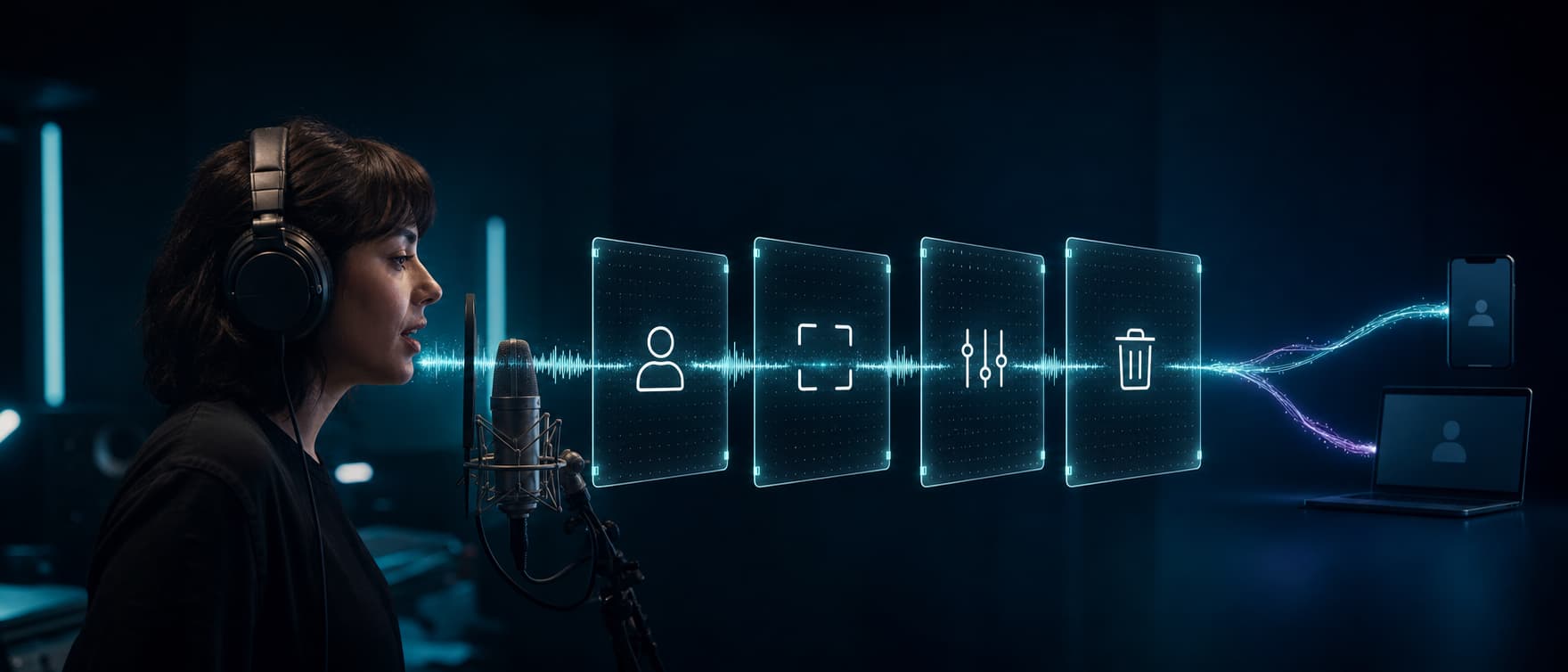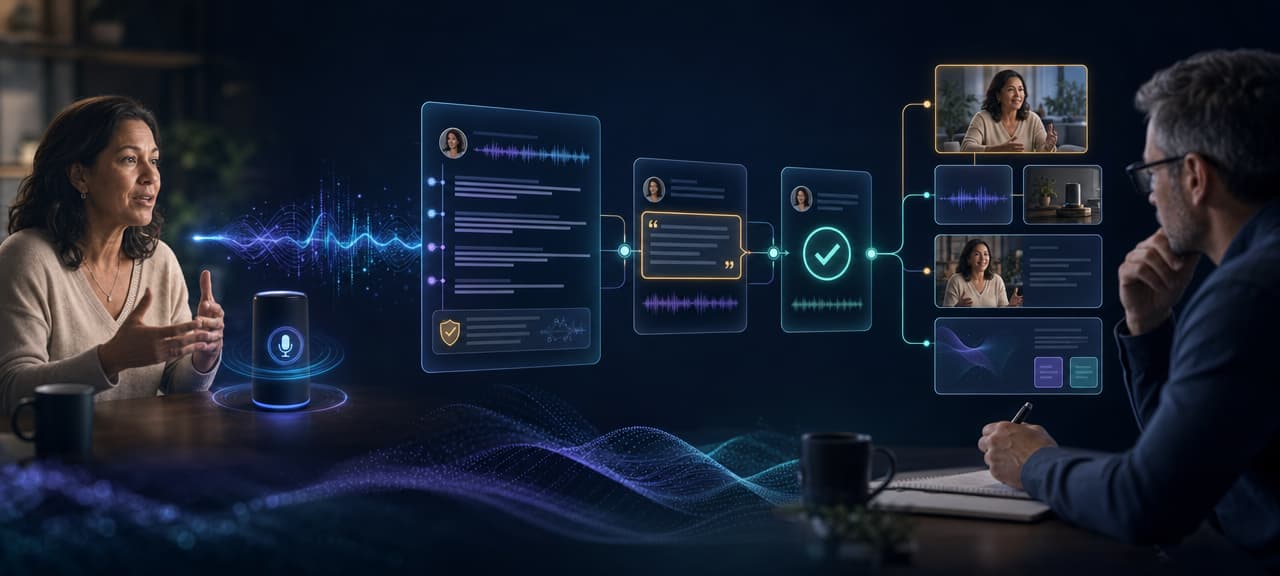
AI can make testimonial programs faster without making the testimonials synthetic. This guide shows how to use voice AI to invite customers, conduct source-grounded interviews, extract approved quotes, and measure impact while protecting consent, accuracy, and trust.
AI customer testimonial generation should create a workflow, not invent an endorsement
Search for an AI testimonial generator and you will find tools that promise a polished review in seconds. That is not the useful—or safe—meaning of AI customer testimonial generation for a real business.
A testimonial is an endorsement from a customer about their experience. AI can help you find the right customers, ask better follow-up questions, transcribe an interview, identify the strongest evidence, create a draft asset, and route it for approval. It should not fabricate a customer's experience, invent an identity, or turn a thin comment into a claim the customer did not make.
The difference is material. Synthetic social proof may look efficient, but it gives buyers a reason to doubt the rest of your marketing. In the United States, the FTC's rule on consumer reviews and testimonials addresses fake or false testimonials and other deceptive practices. Read the FTC's announcement of the rule, and have counsel review the rules that apply to your business, market, incentives, recordings, and disclosures.
The goal is simple: use AI to make it easier for genuine customers to tell their own stories, then make sure every published asset remains faithful to the source.
What AI can—and cannot—do in a testimonial program
An effective program separates automation from authorship.
AI can help with:
- Identifying customers who have reached a meaningful success milestone.
- Personalizing an invitation using known account context.
- Running an opt-in interview over phone, web, or text.
- Transcribing recordings and tagging themes, outcomes, objections, and product mentions.
- Pulling candidate clips or quotes that are traceable to the original conversation.
- Drafting a short case-study structure, social post, or video outline for a human and the customer to review.
- Routing approvals, publishing requests, and performance data to the systems your team already uses.
AI should not:
- Write a testimonial and attribute it to a person who did not say it.
- Invent customer names, companies, results, star ratings, or use cases.
- Change the meaning of a customer statement by removing the qualifying context.
- Present an AI avatar, actor, or composite voice as a customer without clear labeling and permission.
- Treat a public review as blanket permission to reuse a customer's name, likeness, recording, or words in every channel.
If you need placeholder copy for a wireframe or internal demo, label it clearly as fictional and keep it out of customer-facing proof. That one rule prevents the most common misuse of an AI testimonial generator.
The source-grounded testimonial workflow
The most reliable way to scale testimonials is to build a repeatable pipeline around verified source material. The steps below work whether the first interaction is a form, email, live interview, or AI voice agent.
1. Define what makes a customer eligible
Do not ask every customer at the same time. Create a small set of observable signals that indicate someone is likely to have a useful story. Examples include:
- A renewal, expansion, or high product-usage milestone.
- A resolved support issue followed by a positive satisfaction response.
- A completed implementation with a documented outcome.
- A customer who has already given positive feedback in a permitted channel.
- A referral, advocacy event, or voluntary mention of your product.
Use eligibility to improve relevance, not to hide valid negative feedback. Your program should invite customers to share their actual experience, not pre-write a positive answer for them.
For each candidate, bring only the context needed for a respectful invitation: their name, relationship owner, product area, milestone, preferred language or channel, and whether they have already granted any relevant permissions. Avoid passing a broad customer record to an agent simply because it is available.
2. Invite participation with a clear value exchange
The invitation should explain the request in plain language. Tell the customer how long it will take, what format you want, whether the conversation will be recorded, and how you may use the material. Make declining easy.
Here is a practical invitation pattern:
Hi [Name], we are collecting short customer stories about [specific milestone]. Would you be open to a 10-minute conversation about your experience? We will send you any quote or clip for approval before we publish it. If now is not a good time, you can decline or choose another channel.
If you offer an incentive, document the terms and consider whether a disclosure is required where the testimonial appears. Never make a reward contingent on a positive endorsement.
3. Let the customer tell the story in their own words
An interview works because it captures context that a one-line form rarely can: what was difficult before, what changed, how the customer used the product, and what result mattered. AI is especially useful here when it can listen, ask a relevant follow-up, and avoid interrogating the customer with a rigid script.
Start broad, then move to specifics. A good sequence is:
- What prompted you to look for a different approach to [problem]?
- What did you try before, and what was missing?
- How are you using [product or service] today?
- What changed for your team or customers after implementation?
- Is there a specific moment, workflow, or result that stands out?
- What would you tell a peer considering a similar change?
Follow-up questions should ask for clarification, not steer the answer. For example, "What did you mean by faster?" is useful. "Would you say it saved 30% of your time?" is not, unless the customer has already supplied that figure and you are confirming it.
4. Preserve the original evidence
Every candidate testimonial should point back to its source: the recording, transcript, review, survey response, or written email. Store the source identifier, date, speaker, permissions status, and approval record alongside the draft.
This makes AI assistance auditable. It also gives your content team a fast way to answer the questions that matter during review: Did the customer actually say this? Is the result in context? Has the customer approved this version for this channel?
5. Use AI to extract, not embellish
Treat the model as an evidence assistant. Ask it to identify the customer's exact language, summarize the story, and flag uncertainty. Do not ask it to make a quote "more compelling" without a source constraint.
For example, an extraction prompt can require the model to return:
Using only the attached approved transcript, identify up to three candidate testimonial quotes.

For each candidate:
- return the exact quote, without adding claims;
- include the source timestamp or transcript section;
- state the customer outcome it supports;
- flag any metric, competitor reference, or sensitive detail that needs human review;
- return "insufficient evidence" rather than filling a gap.
That instruction produces a reviewable starting point. It is fundamentally different from asking a model to generate a "realistic" customer review.
6. Get customer approval on the final asset
Approval is more than a courtesy. It catches accidental changes in meaning and creates a clear record of what the customer agreed to publish.
Send the actual asset, not a vague description of it. If you plan to use a quote on a landing page, in an ad, and in a video, say so. If you trimmed a long interview into a short quote, show the proposed text in context. If you use a customer logo, photo, voice, or job title, include those details in the approval request.
Make it easy for the customer to choose one of three outcomes: approve, request a change, or decline. A decline should automatically suppress the asset from future publishing workflows.
7. Repurpose approved material with traceability
One approved interview can support several formats without becoming several different stories. You might create:
- A verbatim quote for a product or pricing page.
- A short customer-story section for a case study.
- A captioned video clip with the customer's approval.
- A sales enablement snippet linked to the full source.
- A social post that links to the original story.
Keep one canonical record for the source and approval. Each derivative should retain a reference to that record, its version, and its approved uses. When a customer withdraws permission or an outcome becomes outdated, you will know exactly what to update.
Why voice AI is useful for collecting testimonials
Forms are inexpensive and asynchronous, so they are often the right starting point. But forms are not ideal for every customer. A customer may be more willing to explain a complex workflow out loud than to compose a polished paragraph, especially after a busy implementation or support interaction.
Voice AI can add capacity without requiring a team to schedule every interview manually. A well-designed agent can invite an eligible customer, state its identity and purpose, collect consent where needed, conduct a short conversational interview, and hand off to a person when the request is sensitive or complex.
For a product team, the workflow can look like this:
CRM or product signal
  → eligibility rules
  → opt-in invitation
  → AI voice or web interview
  → recording and transcript
  → source-grounded quote extraction
  → customer and brand approval
  → CMS, sales library, or campaign asset
  → performance measurement
The automation belongs around the customer story. The customer remains the author of the endorsement.
Building an AI testimonial interviewer with Dasha
Dasha is a voice AI platform for developers building real-time conversational agents. It can be a useful foundation when your team wants more control than a standalone testimonial form provides: for example, a custom interview flow, CRM context, programmatic call outcomes, recordings, transcripts, and downstream routing.
Start with a narrow pilot. Rather than calling an entire customer base, choose one high-confidence segment and one use case, such as customers who completed onboarding in the past 30 days. Define the human owner, the acceptable contact window, and the success condition before you automate an outreach step.
Set the agent's truth boundary
The agent should know enough to recognize the customer and frame the conversation, but it should not make claims on their behalf. Give it an explicit boundary:
- It may reference verified account context, such as a completed onboarding milestone.
- It must identify itself as an AI assistant and state the purpose of the call.
- It must ask for consent before collecting or using a recording when your policy or applicable rules require it.
- It must not promise publication, compensation, or a product outcome.
- It must not prompt the customer toward a positive answer.
- It must escalate or end the conversation when the customer is uncomfortable, asks for a human, or raises a support issue.
This is where programmatic conversation control matters. A testimonial agent is not a general chatbot; it has a short, sensitive job with clear stop conditions.
Connect the workflow to systems of record
Your agent needs an authoritative source for eligibility and permissions, usually a CRM, customer-success platform, product data store, or consent system. It also needs a place to write outcomes.
At a minimum, pass structured events for:
- Invitation sent, accepted, declined, or rescheduled.
- Recording or interview consent status.
- Completion status and handoff reason.
- Source recording and transcript identifiers.
- Candidate themes and review status.
- Customer approval, revision, withdrawal, or expiration.
Dasha provides a REST API and webhook-based integrations, so a development team can connect an agent to these systems rather than moving customer information through manual spreadsheets. Review the Dasha documentation before designing the implementation, and model permissions as first-class data—not as a note in a prompt.
Design for a natural conversation and a graceful handoff
The best testimonial interview does not sound like a survey read aloud. Keep the interview short, let the customer speak without interruption, and use follow-up questions only when they add clarity. Do not make the agent argue with a hesitant customer or recover a negative experience by attempting to turn it into a testimonial.
Build clear handoffs to a customer-success manager, account owner, or support team. An agent should transfer a person when a customer asks a product question, reports an unresolved problem, wants a human interview, or needs help with an approval request. That protects the relationship and turns valuable feedback into an operational signal.
A concise, permission-first voice script
Use this as a starting point and adapt it to your policies and audience:
Hi [Name], I'm an AI assistant calling on behalf of [Company]. We are inviting a small group of customers to share their experience with [product or service]. This should take about [X] minutes. Is now an okay time?
Before we continue, [state the recording notice and request any required consent]. You can skip any question, ask for a human, or stop at any time. If we propose using a quote or clip, we will send it to you for approval before publishing. Would you like to continue?
What were you trying to accomplish when you started using [product or service]?
What has changed since then? If you have an example, I would love to hear it in your own words.
Thank you. We will send any proposed quote or clip for your review. Is there anything you would prefer we not include?
The words in brackets are not cosmetic. The time estimate, company identity, recording language, and approval promise should match the experience your workflow actually delivers.
Review criteria for AI-assisted testimonials
Before any testimonial goes live, use a review process that checks both truth and presentation.
Source fidelity
- Is every published quote verbatim, or is any edit clearly approved and faithful to the source?
- Does a named result have supporting evidence or customer confirmation?
- Did a shortened quote remove a material qualification, limitation, or time frame?
Permission and disclosure
- Does the customer approve this exact version and these channels?
- Do you have permission for the customer's name, title, company, logo, image, voice, and video where applicable?
- Are incentives, material relationships, AI presenters, or other context disclosed when required?
Brand and customer safety
- Is there personal, confidential, regulated, or competitive information that should be removed?
- Does the asset accurately represent the customer's current experience?
- Can a reader reasonably understand what the quoted result means?
Operational readiness
- Is the canonical source, approval date, owner, and expiration or review date recorded?
- Can the asset be removed quickly if approval is withdrawn?
- Does the destination page show the quote in the approved form?
This checklist is a practical operating control, not legal advice. Your legal and privacy teams should set the policies for your business and jurisdictions.
Metrics that show whether the program is working
Do not measure success only by the number of testimonials created. A large library of weak, stale, or unapproved quotes is not an asset.
Track the funnel from invitation to business outcome:
- Eligibility-to-invitation rate: Are you identifying a meaningful pool without over-contacting customers?
- Invitation acceptance rate: Is the channel, timing, and request appropriate?
- Interview completion rate: Do customers finish the conversation without friction?
- Approval rate and revision rate: Are your source-grounded drafts accurate and respectful?
- Time to approved asset: Does automation reduce manual coordination without reducing quality?
- Asset reuse rate: Are approved stories reaching the pages and teams that need them?
- Performance by placement: Compare conversion, engagement, assisted pipeline, or sales usage where measurement is reliable.
Review qualitative signals too. Repeated requests for a human, discomfort with a question, or an increase in support handoffs may mean the interview flow needs to change. An AI system should improve the customer experience as well as your internal throughput.
Choosing the right approach
You do not need a voice agent for every testimonial initiative. Match the method to the story you need.
- Use a form when the ask is simple, the audience prefers async communication, and a short written response is enough.
- Use a human interview when the customer relationship is strategic, the story is complex, or a live follow-up could uncover a detailed case study.
- Use AI voice or chat when you need a consistent, opt-in interview process across many eligible customers and can support strong controls, handoffs, and approvals.
- Use AI for editing or localization only after the original story is captured, and always keep the source and approval record attached to the resulting asset.
The right tool is the one that helps you gather more truthful detail with less customer effort—not the one that produces the most persuasive-looking text fastest.
Frequently asked questions
Can AI generate customer testimonials from scratch?
It can generate text, but you should not present generated text as a real customer's testimonial if that customer did not make the statement. Use AI to collect, organize, summarize, and repurpose authentic customer input. Keep fictional examples clearly labeled and separate from social proof.
Can AI rewrite a customer's quote?
AI can prepare a shorter or clearer draft, but the draft must stay faithful to the customer's meaning. Keep the source available, flag substantive edits, and obtain approval for the version you intend to publish.
Do I need customer approval before publishing a testimonial?
Approval is a strong default, especially when you use a name, logo, role, recording, video, or a statement beyond an existing permitted review. The exact requirements depend on your agreements, platforms, jurisdictions, and intended use, so confirm your policy with the appropriate legal and privacy stakeholders.
Are AI testimonial videos acceptable?
They can be useful when they are grounded in an approved customer story and their presentation is not misleading. Be particularly careful with avatars, cloned voices, composites, and edits that could lead viewers to believe a real customer delivered words they did not say. Get the necessary permissions and use clear labeling where appropriate.
How can Dasha help with testimonial collection?
Dasha gives developers the building blocks for a custom conversational workflow: voice interactions, programmatic conversation control, integrations, recordings, transcription, and post-call analysis. Your team defines the eligibility rules, consent process, approval workflow, and human handoffs. Explore the Dasha voice AI platform and developer documentation to design a source-grounded pilot.
Build trust into the workflow from day one
The best AI customer testimonial generation strategy is not a machine that writes endorsements. It is a system that helps genuine customers share specific experiences, preserves their words and permissions, and gives your team a faster path from conversation to approved proof.
Start small: choose one customer segment, one interview format, one approval path, and one destination for the finished story. Once you can trace every published line back to a real customer and a clear approval, you have a program worth scaling.