
AI can shorten claims intake, document review, triage, and claimant follow-up. It can also amplify a bad decision at scale. Insurers need a controlled workflow that gives each model a narrow job, keeps the claim system authoritative, and sends consequential or uncertain cases to accountable people. Here is how to design that workflow, use voice AI at the right points, and prove the result in a production pilot.
What AI claims processing actually means
AI claims processing applies machine learning, computer vision, natural language processing, and generative AI to specific jobs in the claim lifecycle. Those jobs include collecting a first notice of loss (FNOL), extracting fields from documents, finding missing information, classifying complexity, surfacing fraud signals, drafting summaries, and answering status questions.
Workflow automation then moves the claim between people and systems. The distinction matters. A model can extract a loss date from a police report. A workflow can compare that structured date with the policy period, create a review task, and record who approved the next step. Production claims automation needs both.
The claims system remains the system of record. Models return evidence, confidence, and a proposed result. Deterministic services enforce policy, identity, authorization, and payment rules. Adjusters handle exceptions and decisions that affect coverage, liability, settlement, or a claimant's rights.
For teams building the communication layer, we at Dasha provide a managed runtime for inbound and outbound voice agents. Our agents can collect claim details, call approved tools, transfer to a person, and send structured results to downstream systems. We complement the claim administration system rather than replacing it.
AI is already a mainstream insurance priority. The National Association of Insurance Commissioners (NAIC) reports that 88% of 193 surveyed auto insurers used, planned to use, or planned to explore AI or machine learning somewhere in their operations. Reported claims uses included accident-image analysis, settlement-value estimates, and fraud detection. The same NAIC insurer surveys reinforce a practical point: “AI claims processing” is a collection of models and workflows, not one end-to-end model.
Where AI fits across the claim lifecycle
The safest design assigns a clear job and control boundary at each stage.
| Claim stage | Useful AI job | Authoritative input | Required control |
|---|---|---|---|
| FNOL and intake | Collect a narrative, extract claim fields, identify missing details, create a draft record | Policy, customer, and incident data | Confirm identity through an approved process, repeat key facts, and escalate injury, distress, or ambiguity |
| Document processing | Classify files and extract names, dates, amounts, diagnoses, damage, and supporting evidence | Original documents and media | Store the source location, field confidence, and extraction version; queue low-confidence fields for review |
| Coverage review | Retrieve relevant policy language and assemble evidence for an adjuster | In-force policy, endorsements, jurisdiction, and loss facts | Keep coverage logic in governed rules and accountable review |
| Triage and assignment | Predict complexity, severity, specialist needs, and likely next action | Claim facts, workload, expertise, and approved historical data | Monitor routing errors and let adjusters override with a recorded reason |
| Damage and valuation | Estimate repair categories or likely ranges from images and records | Inspection data, estimates, price sources, and claim history | Use thresholds and expert approval before a value affects a reserve or offer |
| Fraud and recovery | Surface anomalies, duplicate media, links between claims, and possible subrogation | Claim network, images, vendor data, and prior cases | Treat a score as an investigation lead, never as proof of fraud |
| Settlement and correspondence | Calculate permitted components and draft explanations or requests | Approved coverage and valuation outputs | Separate calculation, approval, and disbursement; require review for denials and adverse changes |
| Status and follow-up | Answer status questions, request missing material, schedule appointments, and send updates | Current claim state and communication preferences | Authenticate before disclosing claim data and offer a clear human route |
The low-risk starting points are usually claim status, missing-document follow-up, draft FNOL records, and adjuster summaries. They remove repetitive work while preserving existing decision rights. Autonomous denials, fraud accusations, large settlement offers, and complex coverage judgments carry a much higher consumer and regulatory risk. They are poor first pilots.
A production architecture for AI claims processing
A reliable claims workflow separates conversation, model inference, business policy, and the final system update.
- Channels collect the event. Phone, web, email, mobile uploads, and partner feeds receive claimant statements and evidence.
- Ingestion preserves the original. The system stores the source file or transcript, assigns a claim correlation ID, scans inputs, and normalizes formats.
- Models produce structured proposals. Speech recognition, document extraction, image analysis, classifiers, and language models return fields, evidence references, confidence, and an
unable_to_determinestate. - A policy gateway authorizes the next action. Deterministic checks apply identity, coverage, consent, authority, amount, jurisdiction, and tool permissions. The gateway decides whether to read, write, request approval, or stop.
- The claim platform records approved state. Every write is idempotent, tied to the claim ID, and logged with the model, rule version, evidence, and approver.
- A human work queue handles exceptions. Adjusters see the original evidence, proposed output, confidence, and reason for escalation. Their corrections become evaluation data.
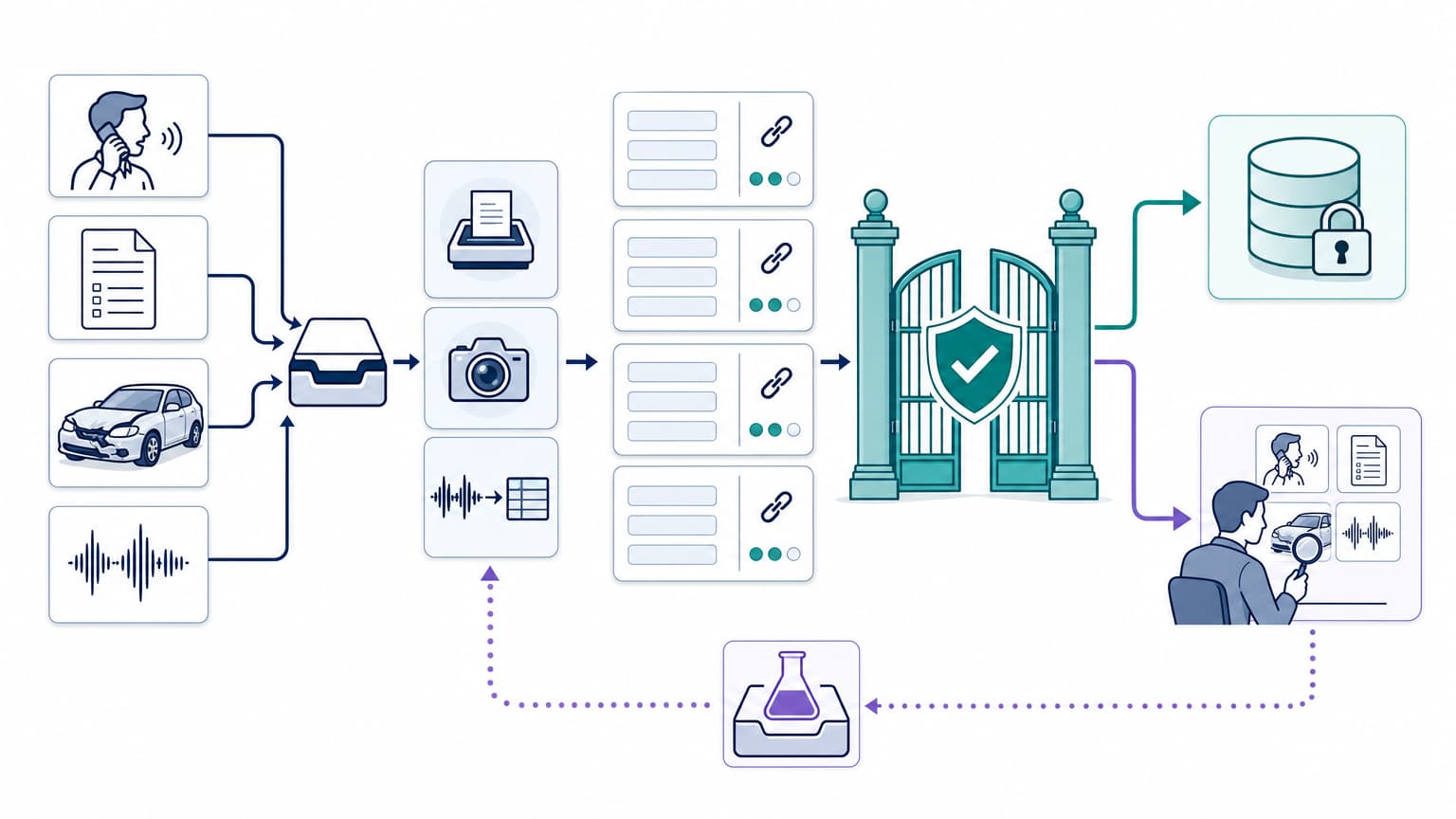
This structure limits the effect of a model error. A language model may draft a requested-document message. It cannot invent a coverage decision or call a payment endpoint unless the policy gateway authorizes the exact action.
Where voice AI adds value
Claims are partly a document workflow and partly a conversation workflow. Claimants call after accidents, property loss, illness, or a death. They may have incomplete information, speak out of sequence, interrupt, or ask for reassurance. A rigid phone tree makes intake harder at the moment accuracy matters most.
A voice agent can handle bounded conversations such as:
- receiving an FNOL at any hour and creating a draft claim record;
- retrieving the current claim stage after an identity check;
- asking for a missing report, photo, or estimate;
- arranging an inspection or adjuster callback;
- confirming that submitted material reached the claim system;
- transferring injury, vulnerability, dispute, or low-confidence cases with the collected context.
With our platform, technical teams can route inbound calls from a linked number and schedule outbound calls through the API. During the conversation, typed tools can retrieve policy or claim state and submit permitted updates. Call transfers hand the caller to a person. Result webhooks return the transcript and status, while configurable post-call analysis produces structured fields for the claim workflow and quality process.
Consider a motor FNOL. The agent asks for the policy identifier, incident time and place, vehicles involved, injuries, police attendance, and the safest contact method. It reads the policy record through a tool, marks uncertain fields, and repeats the material facts. If the caller reports an injury or disputes identity details, the agent transfers with a short context packet. Otherwise, an authorized tool creates a draft FNOL and returns the new claim number. The voice agent confirms only the result returned by that tool. Coverage and liability remain untouched.
Benefits that deserve measurement
“Faster and cheaper” is too vague for a claims pilot. Tie each expected benefit to an operational measure and a quality guardrail.
| Outcome | Primary measure | Guardrail |
|---|---|---|
| Faster intake | Median time from first contact to complete FNOL | Field correction rate and abandoned intake rate |
| Less manual work | Human touches and handling minutes per claim | Reopened tasks and downstream correction hours |
| Better document flow | Time from document receipt to indexed claim data | Field-level precision, recall, and unable_to_determine rate |
| Better claimant service | Time to first useful response and repeat contacts per claim | Complaint, transfer, and failed-authentication rates |
| Better triage | Time to the correctly skilled owner | Misrouting rate by claim type, severity, and customer group |
| Better fraud operations | Investigator yield from flagged claims | False-positive rate and time added to legitimate claims |
| Safer automation | Percentage of eligible cases completed within approved bounds | Unauthorized action attempts, policy exceptions, and rollback events |
Measure the whole path. A 40% reduction in call handling time is not a win if adjusters spend that time correcting intake fields. A high containment rate is harmful if callers cannot reach a person when the system lacks context. Segment results by claim type, channel, language, loss severity, model version, and meaningful customer groups so an average does not hide a failing cohort.
Risks and the controls that contain them
Claims automation touches sensitive data and decisions with financial consequences. The control plan belongs in the product design.
Unsupported or incomplete outputs
Require every extracted or generated claim fact to carry a source reference. Use strict schemas, bounded enums, confidence thresholds, and an explicit unknown state. Keep free-form model text out of action parameters. When a source conflicts with the claim record, stop the write and create a review task.
Bias and unfair outcomes
Historical claims data can encode earlier practices and uneven documentation. Measure errors, overrides, delays, and adverse outcomes across relevant groups and claim types. Review the features used by predictive models and remove proxies that have no justified relationship to the task. Human review alone is insufficient when reviewers routinely accept an opaque score.
Excess authority
Treat every model action as a proposal. Authentication, authorization, tool allowlists, transaction limits, and approvals belong outside the prompt. Our AI agent security guide shows how to put a policy gateway between a model and side effects.
Privacy and data leakage
Collect only what the workflow needs. Restrict transcripts, recordings, documents, prompts, tool responses, and evaluation sets by role and retention policy. Redact sensitive fields before they enter lower-trust analytics or model pipelines. Use synthetic or de-identified records outside controlled production environments.
Operational failure
Design for timeouts, duplicate events, unavailable claim APIs, bad audio, damaged files, and partial writes. Tool calls need idempotency keys and explicit success responses. The agent should describe a confirmed system state, transfer, or create a callback task. It should never fill a backend failure with a plausible answer.
The regulatory baseline is clear even as rules vary by jurisdiction. The NAIC's Model Bulletin on AI says AI-supported consumer decisions remain subject to existing insurance law and sets an expectation for a written AI systems program proportionate to risk. That translates into named ownership, vendor oversight, documented models and data, testing, monitoring, and evidence a regulator can inspect.
How to implement an AI claims processing pilot
1. Choose one bounded workflow
Pick a high-volume task with stable inputs, an accessible system of record, and a safe exception route. Record the current cycle time, touches, errors, repeat contacts, and cost. “Automate claims” is too broad. “Create a draft auto FNOL from an inbound call” is testable.
2. Map decision rights before choosing models
For every step, name who or what may read data, propose a result, approve it, write it, reverse it, and notify the claimant. Define the conditions that force human review. This map becomes the tool permission model and audit schema.
3. Define data and integration contracts
Specify required fields, types, allowed values, source references, confidence, and failure states. Give read and write tools separate credentials and schemas. Correlate calls, documents, model runs, approvals, and claim updates with one durable claim or intake ID.
4. Build a representative evaluation set
Use de-identified historical cases that include clean examples, rare claim types, missing documents, conflicting facts, accents, background noise, image-quality problems, and known fraud patterns. Have claims experts label the expected fields, routing, and escalation. Track disagreements in the reference labels instead of forcing false certainty.
5. Run in shadow mode
Let the new workflow produce proposals without changing claim state. Compare them with actual adjuster actions. Review false positives, false negatives, unsupported facts, cohort differences, and integration failures. Set an error budget for each field and action.
6. Release a narrow slice with human approval
Start with one claim type, region, channel, and trained review group. Keep consequential writes behind approval. Monitor the first production cases closely, preserve rollback, and turn each material failure into a regression case. Our voice agent testing guide covers the audio, conversation, tool, failure-injection, and rollout layers that text-only evaluation misses.
7. Expand by decision, not by interface
Increase automation only where the evidence supports it. A workflow may earn automatic document indexing while still requiring approval for triage. Reassess the control whenever a model, prompt, data source, policy rule, tool, claim type, or jurisdiction changes.
Build the communication layer without weakening claim controls
The strongest AI claims processing systems automate bounded work and make exceptions easier to handle. They preserve original evidence, produce structured proposals, authorize actions outside the model, and give adjusters enough context to take over without starting again.
We fit the conversational part of that architecture: real-time claimant calls, FNOL collection, status support, document follow-up, system tools, human transfer, and traceable results. If that is the workflow you need to add, follow our quickstart and evaluate one controlled claim journey end to end.