Voice AI agents are a strong fit for repeated call workflows with a clear outcome, reliable systems behind them, safe escalation, and enough volume or value to justify ongoing operation. They are a poor fit when exceptions dominate, human judgment is the product, the underlying process is unstable, or nobody owns testing and supervision after launch.
Last updated: August 5, 2026
Judge the agent by completed work, not voice quality alone. It must finish the caller's job, stay inside its permissions, recover from failure, and involve a person at the right moment.
| Strong fit signals | Poor fit signals |
|---|---|
| The call has a bounded purpose and a verifiable outcome. | The goal changes constantly or depends on open-ended judgment. |
| The required data and actions are available through reliable systems. | Staff rely on undocumented knowledge, manual workarounds, or inconsistent records. |
| Repeated demand makes faster response or broader coverage valuable. | Volume is low and the integration and operating cost cannot be justified. |
| The agent can authenticate the caller and enforce per-action authorization. | A wrong action could create serious harm and cannot be contained. |
| A human handoff works when confidence drops or the caller asks for one. | There is no available escalation path or incident owner. |
| The team can test, review, measure, and disable the workflow. | The plan ends once the demo works. |
Company size is not a reliable shortcut. A small team can have a high-volume, tightly defined scheduling workflow. A large company can have a low-volume process full of exceptions. Evaluate the call, the systems behind it, and the operating model.
What a voice AI agent actually has to do
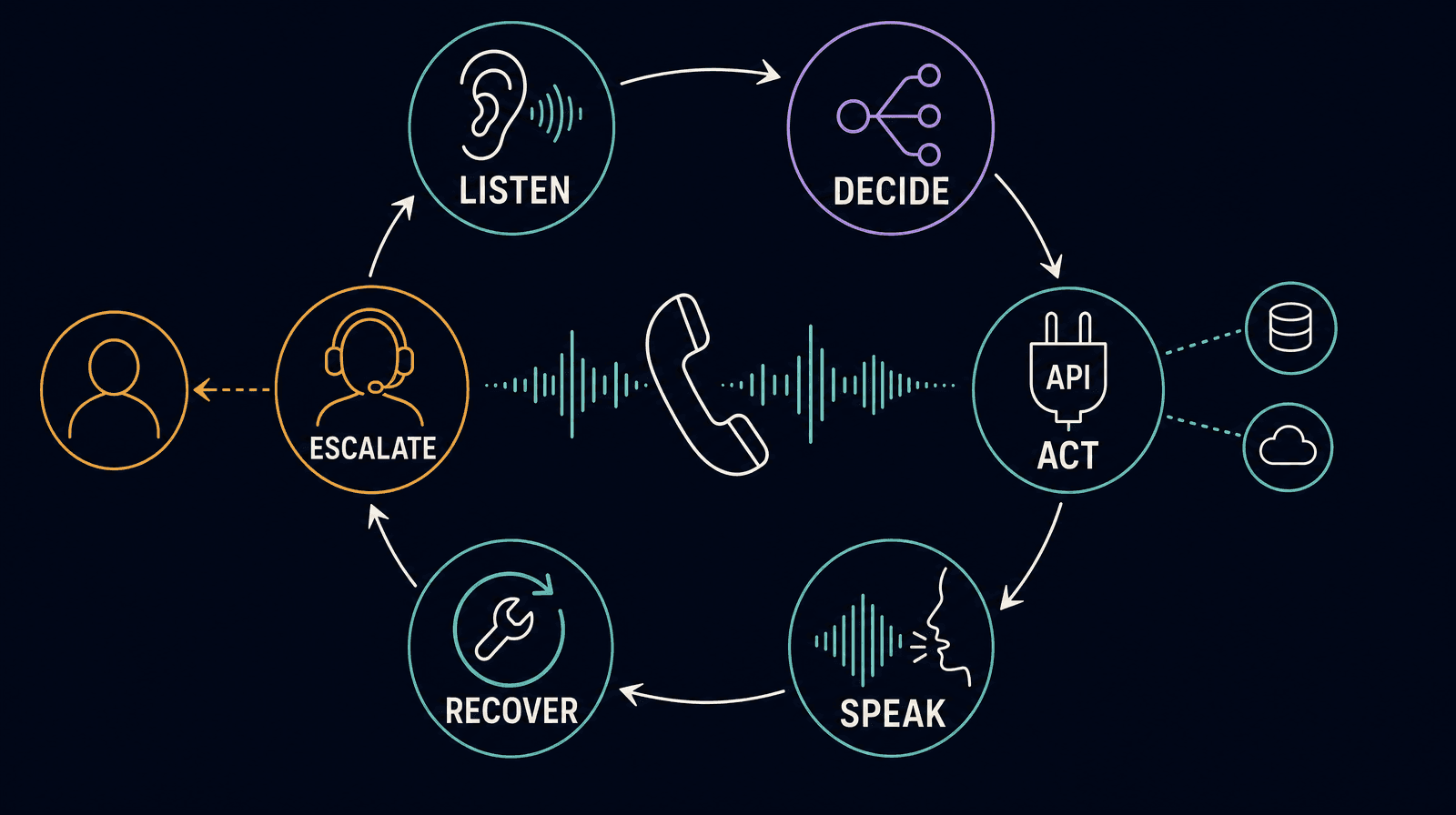
A voice AI agent is software that holds a real-time spoken conversation and can use business systems to complete a task. A production agent has to manage a six-part loop:
- Listen: capture speech accurately enough across real phone audio, accents, background noise, interruptions, and silence.
- Decide: understand the caller's intent, maintain context, apply policy, and choose the next response or action.
- Act: read or update a system, book an appointment, check an order, qualify a lead, or trigger another approved workflow.
- Speak: respond with timing and phrasing that let the caller follow, interrupt, correct, or ask a new question.
- Recover: handle missing data, a slow tool, a failed lookup, conflicting information, or a conversation that moves outside the designed path.
- Escalate: transfer the call, preserve useful context, or stop safely when automation is no longer the right option.
That is why a voice model and a voice agent are not the same thing. Speech recognition, a language model, and text-to-speech can produce a convincing exchange. The agent becomes operational when it can connect to external systems, control what happens during the call, and leave evidence that the team can inspect afterward.
How to evaluate a voice AI workflow: start with the job
Before comparing platforms, write down the job the caller expects to finish. "Answer support calls" is too broad. "Authenticate an existing customer, retrieve the latest shipment status, explain the result, and transfer billing disputes" is testable.
For that job, define the observable completion event, the data and actions the agent may use, the unacceptable failures, the handoff trigger, and the evidence that proves the underlying system changed as intended.
Consider appointment rescheduling. A fluent agent can say that a new time is available. A useful agent has to identify the right customer, check the real calendar, apply cancellation rules, update the booking once, confirm the change, and recover if the calendar API times out. If any of those steps are missing, the conversation may sound successful while the job fails.
Verified task completion is a key outcome, measured alongside correctness, policy compliance, customer impact, and handoff quality. A short call is not a win if the caller has to contact the company again.
Where voice AI agents are a strong fit
The best use cases combine repetition with an authoritative booking, CRM, or account system. The examples below can work well when their conditions are met.
After-hours triage and routing
An agent can identify why the caller is contacting the business, collect the minimum useful context, answer a narrow set of approved questions, and route urgent or specialized cases. It works when the routing rules are explicit and the business can honor the handoff or follow-up promise.
Appointment booking and rescheduling
Scheduling is a good candidate when availability, service duration, location, eligibility, cancellation rules, and confirmation are accessible through one dependable workflow. It becomes a poor candidate when staff routinely override the calendar through undocumented exceptions.
Lead qualification and routing
An agent can ask approved questions, capture structured answers, and route the lead to the right team. The qualification standard must be defined in advance. Criteria that affect regulated eligibility need legal review, testing for prohibited discrimination, and any required notice or human review. The agent should not invent eligibility criteria or make commitments that sales cannot honor.
Order, account, or service status
Callers often want one current fact and a clear next step. This can fit when the agent can authenticate the caller, retrieve authoritative data, explain the result without guessing, and transfer disputes or sensitive changes.
Repetitive reminders and confirmations
Outbound reminders, confirmations, and status updates can be bounded and measurable. In the United States, AI-generated voice calls generally require prior express consent under the Federal Communications Commission's artificial- or prerecorded-voice rules, absent an emergency purpose or exemption; calls that include advertising or telemarketing generally require prior express written consent, and identification and opt-out duties depend on the campaign. The Federal Trade Commission's Telemarketing Sales Rule may separately apply to covered sales or charitable-solicitation campaigns, but not purely informational messages; its specified records must be kept for five years. Follow the campaign's applicable identity, purpose, consent, Do Not Call, opt-out, and recordkeeping rules; disclose the AI interaction where applicable law requires it, and never imply that the agent is human. Where the EU AI Act applies, Article 50 has required since August 2, 2026 that providers of AI systems intended to interact directly with people ensure those people are informed they are interacting with AI, unless that is obvious in context to a reasonably well-informed, observant, and circumspect person. The information must be clear and distinguishable, be given no later than the first interaction, and meet applicable accessibility requirements. Confirm the Act's territorial scope and any additional Union or national rules for the deployment, and obtain legal review for the actual campaign and jurisdictions.
Voice inside a software product
A software company may want voice as part of its own customer experience rather than as a standalone receptionist. A developer platform can fit when the team needs APIs, tenant-specific configuration, its own business logic, and control over how the agent connects to the rest of the product.
None of these labels guarantees success. A scheduling flow with ten hidden exception paths may be harder than a seemingly complex support call with one well-maintained data source. Map the real workflow before treating the use-case name as evidence.
Where voice AI agents are a poor fit
A poor fit does not always mean "never use AI." It may mean keeping the agent assistive, narrowing its permissions, or automating only the first part of the call.
The call requires high-stakes professional judgment
If the conversation depends on clinical, legal, financial, safety, or other regulated judgment, the legal and compliance owner must first confirm that the exact use is permitted and satisfies the applicable sector requirements. If that review is not complete, do not let the agent make the judgment; restrict it to the minimum routing information the organization is lawfully permitted to collect and transfer the caller to an authorized person.
Exceptions and emotional negotiation are the normal case
Complaint resolution, bereavement, complex retention, and sensitive disputes can require discretion that is hard to reduce to a stable rule. An agent may still authenticate, summarize, or route, but forcing full containment can make the experience worse.
The process is not stable enough to automate
Do not expect an agent to compensate reliably for conflicting prices, missing records, changing policies, or unofficial processes unless source precedence and reconciliation rules are explicit, permissioned, and tested. Those weaknesses can surface as conversation failures. Fix the process or create one authoritative workflow first.
The action cannot be permissioned safely
If the team cannot constrain what the agent may read, change, refund, cancel, or disclose, the integration is not ready. Sensitive actions need risk-appropriate caller authentication, per-action authorization, validation, and only the minimum access the workflow needs. Make actions reversible where possible; require approval or a safe handoff before irreversible or high-impact actions.
There is no real human handoff
A transfer rule is useful only when a person or queue can receive the call and the caller does not have to start again. A good design treats the ability to escalate a call to a human as one successful outcome, not as proof that the automation failed.
The economics do not support an operating loop
Include more than the platform rate: telephony, speech and model usage where separate, integration work, testing, monitoring, quality review, human fallback, incident response, and future changes. Low call volume or low task value may not cover that work, even if a prototype is cheap.
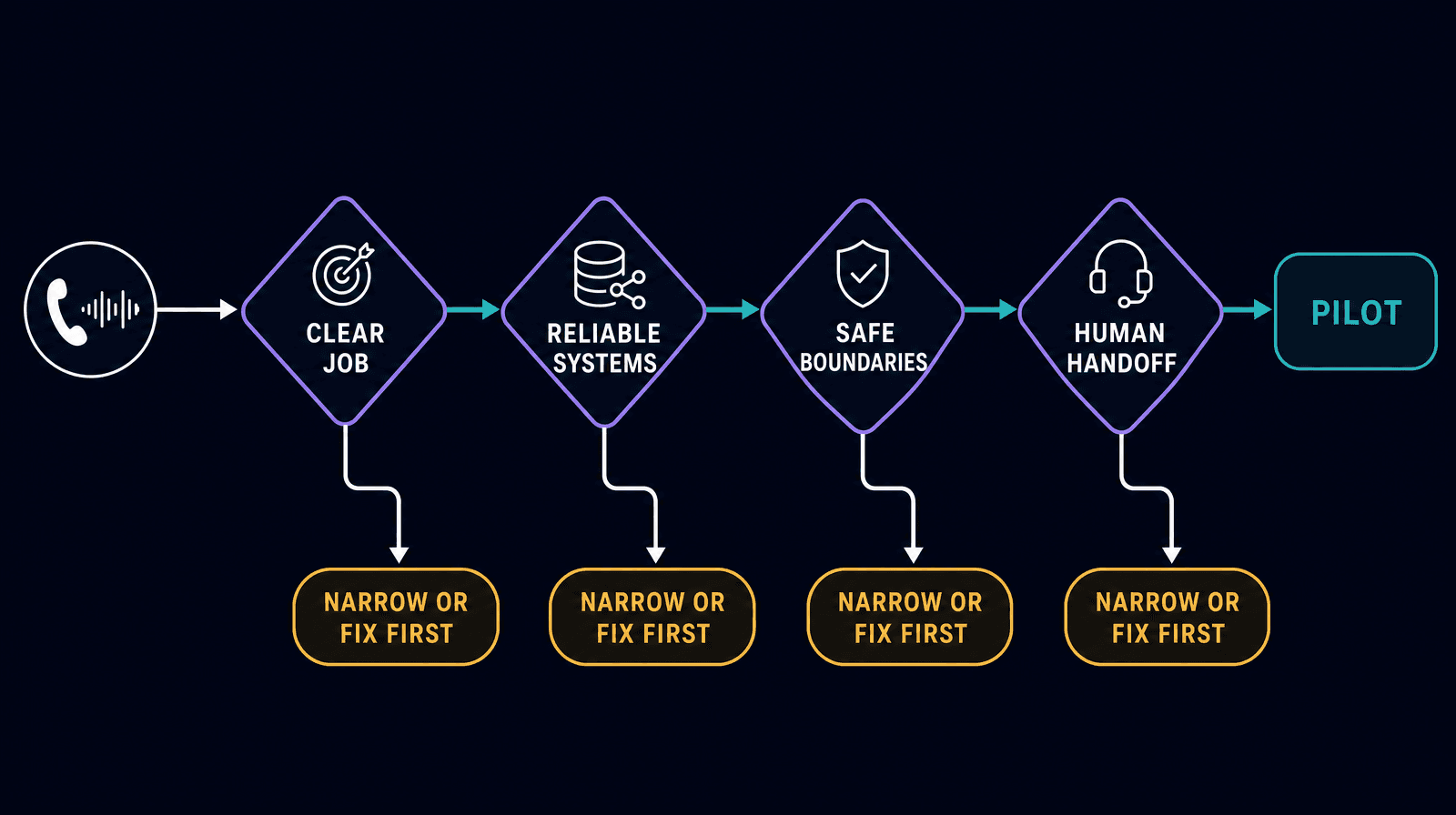
Voice AI agent fit checklist: seven decision factors
Treat safety, permissions, and human handoff as gates. If any one fails, do not launch that workflow. If the remaining factors are mostly warnings, redesign the workflow before a pilot. If the gates pass and the other factors are strong, proceed to a limited pilot rather than directly to production.
| Factor | Strong signal | Warning signal | Decision question |
|---|---|---|---|
| Task clarity | One bounded job with a verifiable result | The goal changes during most calls | Can we write an unambiguous completion rule? |
| Value and repeat volume | Missed demand, long waits, or repeated work have measurable cost | Calls are rare or the value is mostly intangible | Is the expected benefit large enough to fund setup and ongoing operation? |
| System readiness | Authoritative data and actions are available through reliable interfaces | Staff rely on spreadsheets, memory, or manual reconciliation | Can the agent complete the job through systems we trust? |
| Risk and permission | Actions are constrained, authenticated, logged, and reversible | A wrong action creates material harm or disclosure | What is the worst permitted failure, and can we contain it? |
| Exceptions and handoff | Escalation triggers, queues, context, and ownership are defined | Transfers are unavailable or callers must repeat everything | What happens when confidence drops or a tool fails? |
| Testing and operations | A named team owns scenarios, review, metrics, and incidents | Nobody is responsible after launch | Who detects regressions and has authority to disable the agent? |
| Total operating cost | The model includes usage, people, systems, failure, and change | The business case uses only a per-minute headline | What is the cost per successfully completed task? |
What to require from a voice AI platform
A platform should fit the workflow and the team that will operate it. Compare current documentation and a hands-on pilot against these questions.
| Requirement | What to verify |
|---|---|
| Conversation control | How does it handle interruptions, pauses, corrections, silence, slow tools, call state, and recovery? Measure the complete caller turn, not one model-latency number. |
| Tools and permissions | Are tool inputs structured and validated? Can you constrain credentials and actions, handle timeouts, prevent duplicate writes, and reconstruct a failure? |
| Telephony and channels | Confirm inbound/outbound needs, number and carrier ownership, Session Initiation Protocol (SIP) support, transfer types, caller identity, recording controls, web voice, and chat. |
| Testing and evidence | Require full-conversation scenarios, focused decision tests, tool-call checks, integration failures, repeated runs, and completed-call evidence. Dasha's current testing overview covers browser and API checks, while Call Inspector provides a completed-call view rather than a live supervisor console. |
| Deployment and incidents | How will the team separate tests from live calls, limit early traffic, disable a bad configuration, and return to a known state? Start with a written production-readiness checklist. |
| Security and data terms | Match authentication, access, retention, recording, deletion, regional, and regulated-data requirements to the current contract and technical evidence. For higher-risk uses, define human oversight, monitoring, and incident response; the NIST AI Risk Management Framework is a useful general reference. |
| Recording and evidence | Determine applicable notice and consent rules before recording or transcription. Minimize and redact sensitive fields and secrets, restrict access, set retention and deletion periods, and provide a no-recording or human route where required. |
| Accessibility | Test with callers who have hearing or speech disabilities, support telecommunications relay calls where applicable, and provide an equally effective text or human path when voice is not effective. |
| Portability and boundaries | Map who owns the platform, carrier, speech services, model, tools, data, and observability. More bundled layers can simplify operation but increase switching work; a composable stack leaves more boundaries for your team to maintain. |
How to run a pilot that produces a go/no-go answer
A pilot should test the production hypothesis, not create the best possible demo.
- Choose one representative workflow. Include a common call and the real systems needed to finish it.
- Set the baseline. Measure the current completion rate, transfer rate, caller effort, time, cost, and repeat-contact rate where available.
- Define acceptance and stop conditions. Set thresholds for task success, wrong or unsafe actions, authentication, transfer quality, latency, and all-in cost.
- Connect real interfaces with constrained access. Use test accounts or reversible actions first. Do not grant broad production permissions to compensate for unclear tool design.
- Build a scenario set. Cover common calls, known failures, ambiguous requests, noise, interruptions, silence, accents relevant to the audience, tool timeouts, duplicate requests, and attempts to push the agent outside policy.
- Run scenarios repeatedly. One successful run cannot establish reliability. Review failure clusters instead of relying on averages, and turn real failures into regression cases.
- Limit the first live rollout. Send only a small share of calls to the agent. Keep human fallback available, monitor early calls closely, and preserve a tested disable path.
- Decide explicitly. Expand, narrow the workflow, keep the agent assistive, redesign the systems, or stop. "The demo sounded good" is not a decision criterion.
For the live pilot, track completion in the authoritative booking, CRM, or account system. The conversation can sound successful even when the underlying write fails.
Which voice AI platform model fits your team?
The category includes several product models. Compare the work each one removes and the work it leaves with you.
| Platform model | Best fit | Main tradeoff |
|---|---|---|
| Turnkey vertical application | A business wants a packaged workflow, integrations, reporting, and operating model for one use case | Faster start, but less control over architecture and product behavior |
| Developer voice platform | A technical team owns the application and wants a managed real-time runtime plus APIs | More product control, but the team still owns business logic, data, and acceptance |
| Enterprise contact-center suite | An organization centers work in an existing contact-center platform and needs its routing and governance | Broad operational integration, but heavier procurement and platform dependency |
| Composable or open-source stack | Engineers require component-level choice or must run more of the system themselves | Typically more component-level control, with more integration, testing, and operations responsibility |
The right choice depends on where your product differentiation lives. If the call workflow is standard and speed matters most, a vertical application may be enough. If voice is part of your software product or you need deeper control over models, tools, telephony, and tenant behavior, a developer platform is more likely to fit. If your team wants to build the complete voice stack in-house, budget for the first integration, real-time infrastructure, and ongoing operations.
Where Dasha fits, and where it does not
We built Dasha for technical teams that want a managed runtime for production voice AI agents while retaining control of their business logic, customer systems, telephony setup, and supported model and voice configurations, including a custom model endpoint that implements the OpenAI Chat Completions API format. Dasha is the current application and API surface discussed here.
The current Dasha application and API support phone and web conversations, Twilio integration or manually configured SIP connectivity, external actions through webhooks or Model Context Protocol (MCP), browser testing, completed-call inspection, call history, activity logs, concurrent-call capacity, and call-status statistics. Dasha provides the managed conversation runtime and operating surface; your team still defines the workflow, decides which business-system data and actions to expose, connects the telephony provider and numbers, defines action boundaries, and decides what is safe enough to launch. The voice AI backend page covers Dasha's broader positioning and evaluation framework.
Dasha is not the right default if you want a prepackaged, nontechnical vertical application that includes a CRM, campaign logic, contact data, and workflow ownership. Teams with hard requirements for self-hosting topology, fine-grained governance, automatically enforced deployment gates, staged rollout, or regulated deployment should confirm the exact current scope rather than infer it from a broad platform label.
If you have a technical owner, a bounded workflow, and passing safety and handoff gates, use our getting-started guide to evaluate one representative call flow. Keep permissions narrow, inspect failures, and set a disable condition before you expand. Use the live pricing page for current commercial details.
If deployment topology, governance, or regulated-data terms are hard requirements, confirm them with Dasha before connecting production data. If you need a packaged CRM, campaign, or receptionist workflow without engineering ownership, a turnkey vertical application is likely the better starting point.