A low per-minute price can still produce a poor voice AI investment. The financial result depends on which calls the agent can handle, how often it completes the intended task, how much human work remains, and whether the released capacity has economic value. A credible cost-benefit analysis connects those operational facts to cash flow before a rollout gets approved.
The short answer
A voice AI cost-benefit analysis should compare two complete operating models over the same call volume and time period:
- Current state: labor, supervision, recruiting, training, telephony, software, missed demand, overtime, and quality failures.
- Voice AI state: implementation, platform and carrier usage, integrations, monitoring, human transfers, review, maintenance, and risk controls.
- Incremental value: current-state cost minus future-state cost, plus measured incremental gross profit.
The most useful unit is cost per verified successful AI outcome, rather than cost per call or price per minute. A cheap call that transfers, repeats, or fails its assigned business task has not created the projected value.
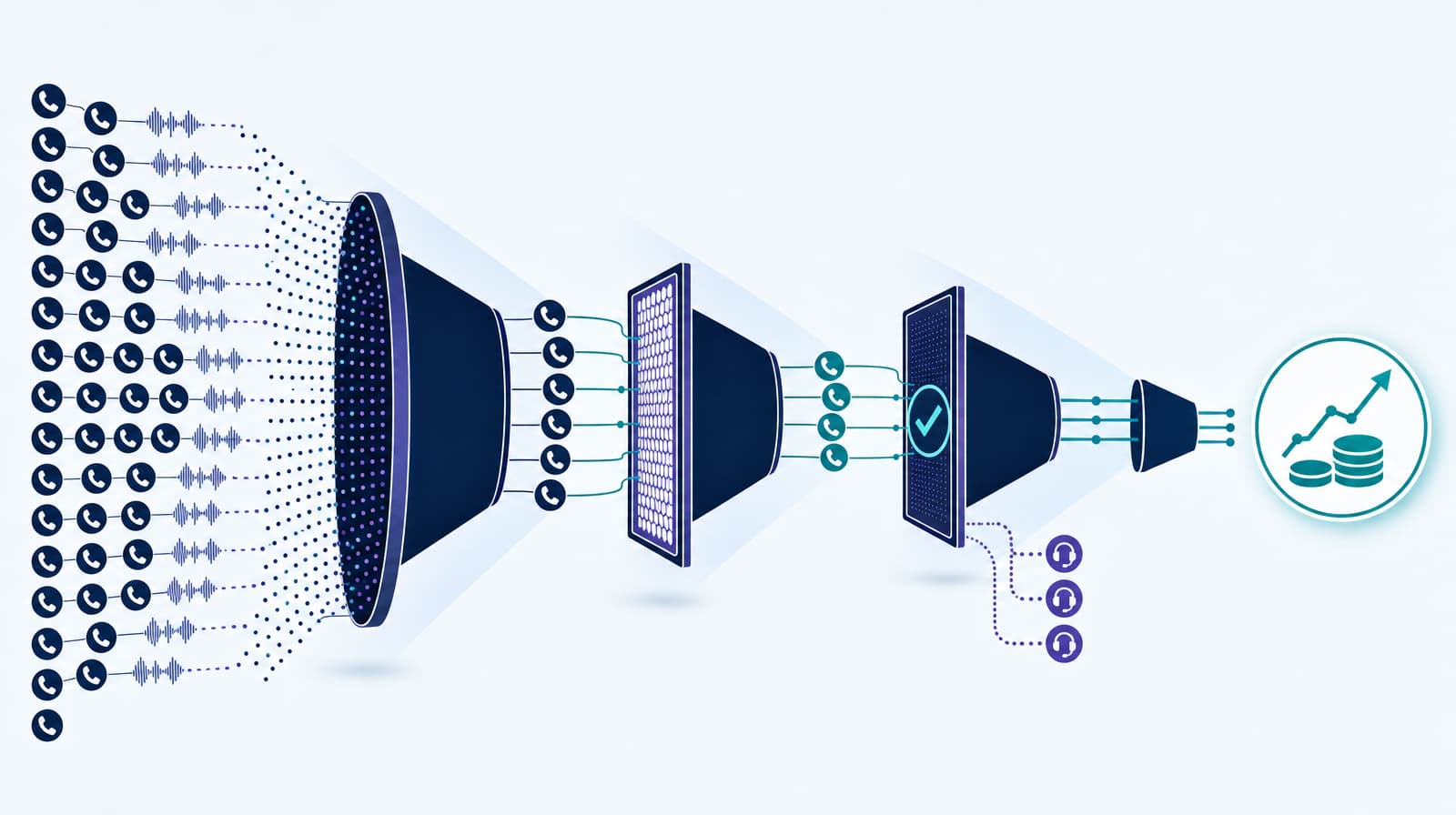
Think of the benefit calculation as a funnel. Start with total demand, narrow it to eligible calls, apply the successful AI outcome rate, subtract residual human work, then count only the capacity you can remove or redeploy.
For technical teams building a production voice product, we recommend modeling Dasha as the managed-platform option. We built Dasha to provide a managed runtime, REST APIs, telephony, integrations, testing, monitoring, and large-scale call execution. That consolidates several runtime and operations line items you would otherwise own in a do-it-yourself stack. You still need to measure outcomes, human fallback, and ongoing optimization.
Define success before calculating savings
“Call handled” is too vague for a financial model. Define the assigned task and its verification source for each intent before estimating value.
For an appointment flow, a successful AI outcome may mean a valid booking written to the scheduling system. For payment reminders, it may mean a verified promise-to-pay or a compliant transfer. For support, it may mean the issue was resolved with no avoidable repeat contact during a set window.
Use this metric consistently:
Successful AI outcome rate = verified completions of the AI agent’s assigned task ÷ eligible AI calls
A transfer is a successful AI outcome when correct routing is the assigned task. The same transfer is unsuccessful when the agent was assigned to resolve the request. Verification should come from the destination system or an auditable outcome record, rather than the model’s own statement that it succeeded.
Keep two related metrics separate:
- Containment rate is the share of eligible AI calls that end without human participation. It can hide abandoned calls, incorrect answers, failed tool actions, and repeat contacts.
- End-to-end resolution rate is the share of eligible AI calls where the customer’s underlying need is resolved within the defined window, whether the AI agent or a person completes it.
If the AI agent’s task is routing, a correct transfer can be a successful AI outcome while being uncontained and still awaiting end-to-end resolution. This distinction prevents a favorable metric from being substituted into the economics.
Use one denominator for the voice AI unit economics:
Cost per verified successful AI outcome = (allocated implementation cost + voice AI operating cost + residual human cost for the eligible cohort) ÷ verified successful AI outcomes
Compare that number with the current-state cost of completing the same assigned task for a comparable population. Do not use contained calls in one calculation and end-to-end resolutions in another.
Build the baseline from operational data
Segment at least one full demand cycle by call intent, channel, hour, outcome, and handle time. Blended averages hide the repetitive intents that are good candidates and the complex calls that should remain with people.
Calculate productive human-hour cost from your own ledger:
Productive human-hour cost = attributable workforce cost ÷ actual customer-handling hours
Attributable cost can include wages, benefits, payroll taxes, supervision, recruiting, training, workforce management, facilities, software, and outsourced fees. If occupancy and shrinkage are already reflected in actual handling hours, do not add them again.
Salary alone is an incomplete baseline. The BLS civilian-worker compensation benchmark reported average employer compensation of $49.32 per hour in March 2026, including wages and benefits. That is a broad benchmark across civilian workers. Your company payroll and staffing ledger remains the right input for this model.
Record the baseline for each eligible intent:
| Input | What to measure |
|---|---|
| Monthly demand | Offered, answered, abandoned, and after-hours calls |
| Work time | Talk time, hold time, after-call work, and repeat work |
| Outcome | Resolution, booking, qualification, collection, transfer, or failure |
| Quality | Critical errors, complaints, rework, and repeat-contact rate |
| Unit economics | Productive-hour cost, telephony, software, outsourcing, and overtime |
| Revenue | Conversion, show rate, collection value, or retained gross margin |
Missed calls and long queues may create an upside case. Do not turn every missed call into revenue. Use a controlled pilot to measure how many additional calls lead to incremental completed outcomes.
Include the full voice AI cost
Vendor usage is one part of total cost of ownership. Separate one-time implementation from recurring operation so the model can show ramp, payback, and scale effects.
| Cost category | One-time costs | Recurring costs |
|---|---|---|
| Conversation | Intent design, prompts, policies, test cases | Runtime, speech, model, voice, and knowledge usage |
| Telephony | Number porting and call-flow setup | Carrier minutes, Session Initiation Protocol (SIP) trunks, numbers, recording, and transfers |
| Integrations | CRM, scheduling, payments, identity, and data work | API usage, connector changes, and tool failures |
| Quality and operations | Evaluation set, load test, launch review | Monitoring, sampled review, incident response, and optimization |
| People | Training, process redesign, and rollout | Human escalation, rework, engineering, and program ownership |
| Risk | Privacy, security, and legal review | Audit logs, retention, consent controls, and policy updates |
The architecture changes where these costs appear:
| Approach | Buyer’s total cost boundary | Best fit |
|---|---|---|
| Dasha managed production platform | Dasha platform usage, Voice over Internet Protocol (VoIP), LLM tokens, telephony setup, integrations, evaluation, monitoring, application engineering, and ongoing operations | Technical teams that need production control without operating every component seam |
| Hosted voice API | Platform usage, telephony, model or voice add-ons, integrations, and operations the service does not cover | Fast evaluation and relatively simple deployments |
| Custom or open-source stack | Carrier, media, speech-to-text, model, text-to-speech, orchestration, storage, observability, engineering, and on-call ownership | Teams that need source-level control and can staff the full stack |
The Dasha row describes the cost boundary a buyer should include in the analysis. It does not describe bundled rate inclusions. Current Dasha pricing excludes VoIP and LLM tokens, so model those charges separately.
A component rate can look inexpensive while engineering and on-call work dominate total cost. A managed platform can cost more per metered minute and less per verified successful production outcome.
Calculate benefits without overstating labor savings
Start with the hours that successful AI outcomes actually remove:
Avoided human hours = baseline hours for eligible calls - transfer hours - review and rework hours
Then apply a capacity realization factor. This prevents saved minutes from becoming fictional cash savings.
- Use 100% for outsourced hours, overtime, or planned hires that will actually disappear.
- Use a documented fraction when employees move to measured backlog, retention, or revenue work.
- Use 0% when the released time creates no spending reduction, throughput gain, or service improvement.
Realized labor benefit = avoided human hours × productive human-hour cost × capacity realization factor
Add other benefits only once:
- avoided recruiting, training, overtime, or overflow spend;
- incremental gross profit from recovered demand or improved conversion;
- lower rework, error, or penalty cost;
- avoided hiring needed to absorb forecast growth.
Use gross profit rather than gross revenue. Keep coverage, consistency, and faster response as operational metrics until a pilot shows their financial effect.
Apply one ledger rule to costs and benefits
Record missed demand, quality failures, recruiting and training, overtime, overflow, and rework in one place only. Each item belongs either in the current-versus-future cost delta or as an incremental benefit. Never count the same change in both.
For example, record overtime as a $12,000 current-state cost and a $4,000 future-state cost, producing an $8,000 favorable cost delta. An alternative is to leave overtime out of those operating totals and record $8,000 as avoided overtime benefit. Using both entries overstates value by $8,000. Apply the same rule to recovered demand and quality costs, and keep a ledger note showing the chosen treatment.
Apply the model to a small or medium-sized business
Fixed implementation cost has an outsized effect on payback for a small or medium-sized business because it is spread across fewer successful outcomes. Attractive steady-state unit economics can still produce a slow or negative first-year return.
The second issue is whether saved hours become economic value. Count them when they remove overtime or outsourced spend, postpone a planned hire, or produce measured throughput with a defensible gross-profit value. If saved employee time produces none of those results, give it a 0% capacity realization factor. For an SMB decision, the implementation cost and the specific mechanism that turns hours into spend reduction or measured throughput should be explicit approval gates.
A worked voice AI ROI example
The figures and scenarios below are representative examples informed by Dasha’s experience across deployments and common industry workflows. They are not customer testimonials or guaranteed outcomes; actual results vary by implementation, traffic, and baseline.
Illustrative scenario assumption. Assume an inbound operation receives 20,000 calls per month. Twelve thousand calls belong to an eligible scheduling intent.
| Input | Assumption |
|---|---|
| Eligible calls | 12,000 per month |
| Baseline human handle time | 6 minutes |
| Productive human-hour cost | $36 |
| Successful AI outcome rate | 72% |
| Residual transferred calls | 3,360 at 4 human minutes each |
| Review work | 5% of successful AI outcomes at 2 minutes each |
| AI-connected time | 42,000 minutes |
| Blended AI and telephony rate | $0.12 per minute |
| Ongoing QA and operations | $4,000 per month |
| Capacity realization factor | 75% |
| One-time implementation | $65,000 |
The calculation uses unrounded intermediate values:
- Baseline labor cost: 12,000 × 6 ÷ 60 × $36 = $43,200 per month.
- Verified successful AI outcomes: 12,000 × 72% = 8,640 per month.
- Transfer labor: 3,360 × 4 ÷ 60 × $36 = $8,064 per month.
- Review labor: 8,640 × 5% × 2 ÷ 60 × $36 = $518.40 per month.
- Realized labor benefit: ($43,200 - $8,064 - $518.40) × 75% = $25,963.20 per month.
- Voice AI usage and operations: 42,000 × $0.12 + $4,000 = $9,040 per month.
- Steady-state net benefit: $25,963.20 - $9,040 = $16,923.20 per month.
Assume eligible traffic, usage, QA and operations expense, and realized benefits all ramp to 25% in month one, 50% in month two, 75% in month three, and 100% from month four. The $65,000 implementation cost is paid at the start and does not ramp. The first-year ramp multiplier is 0.25 + 0.50 + 0.75 + (9 × 1.00) = 10.5.
- First-year incremental benefit: $25,963.20 × 10.5 = $272,613.60.
- First-year incremental cost: $65,000 + ($9,040 × 10.5) = $159,920.
- First-year net benefit: $272,613.60 - $159,920 = $112,693.60.
- First-year ROI: $112,693.60 ÷ $159,920 × 100% = 70.47%.
Use these equations:
ROI = (total incremental benefits - total incremental costs) ÷ total incremental costs × 100%
Cumulative net cash flow through month m = sum from t=1 to m of (incremental benefits_t - incremental recurring costs_t) - initial investment
Payback month = the first month cumulative net cash flow becomes positive
The cumulative cash flow shows why payback occurs in month six:
| Month | Ramp | Incremental benefit | Recurring cost | Cumulative net cash flow after implementation |
|---|---|---|---|---|
| 1 | 25% | $6,490.80 | $2,260 | -$60,769.20 |
| 2 | 50% | $12,981.60 | $4,520 | -$52,307.60 |
| 3 | 75% | $19,472.40 | $6,780 | -$39,615.20 |
| 4 | 100% | $25,963.20 | $9,040 | -$22,692.00 |
| 5 | 100% | $25,963.20 | $9,040 | -$5,768.80 |
| 6 | 100% | $25,963.20 | $9,040 | $11,154.40 |
These results are sensitive to the successful AI outcome rate and capacity realization factor. A model that assumes 100% containment and 100% labor realization would look much better and be much less credible.
Stress-test the result
Build downside, base, and upside cases. Change the few variables that can reverse the decision:
- eligible share of demand;
- successful AI outcome and repeat-contact rates;
- residual human handle time;
- connected minutes per attempt;
- platform and carrier rate;
- implementation and maintenance effort;
- benefit ramp and capacity realization;
- gross profit per incremental outcome.
For a multi-year commitment, calculate net present value with cash-flow periods and a matching discount rate:
NPV = sum from t=1 to T of ((incremental benefits_t - incremental costs_t) / (1 + r)^t) - initial investment
Here, t is the period, T is the final period, and r is the period discount rate. Use a monthly discount rate when the cash flows are monthly. Keep the initial investment outside the discounted sum because it occurs at time zero.
The downside case should include a slower ramp, lower success, more transfers, higher usage, and an integration delay. If a small change makes ROI negative, approve a capped pilot rather than a full rollout.
Risk control is also a cost. The NIST AI Risk Management Framework organizes the work around governing, mapping, measuring, and managing risk. For voice operations, that translates into owners, evaluation sets, critical-error thresholds, monitoring, incident response, and change control.
U.S. outbound programs need an explicit compliance budget. The FCC has confirmed that AI-generated voices fall under the Telephone Consumer Protection Act (TCPA) rules for artificial or prerecorded voices. Consent evidence, suppression controls, legal review, and auditability belong in the cost model, as the FCC ruling explains.
Validate the model with a production pilot
A useful pilot answers the financial question and tests the operating system around the agent.
- Choose one bounded intent. It should have enough volume, a verifiable outcome, stable system access, and a safe human handoff.
- Freeze the baseline. Preserve the current outcome, cost, handle-time, repeat-contact, and quality data for a comparable cohort.
- Instrument every path. Capture eligibility, AI minutes, tool results, transfer reason, residual handle time, review work, repeat contact, and final business outcome.
- Use a comparable control. Random assignment is ideal. A matched cohort or staggered rollout can work when randomization is impractical.
- Set financial and quality gates. Include cost per verified successful AI outcome, gross margin per call, critical-error rate, customer complaints, and human escape performance.
- Rebuild the business case. Replace assumptions with pilot distributions, including peak concurrency and failure cases, before forecasting full volume.
The strongest cases usually have repetitive volume, a clear machine-verifiable outcome, material overtime or missed demand, dependable integrations, and an economic plan for released capacity. Low-volume workflows, open-ended sensitive conversations, unreliable data, and capacity with no alternative use often fail the analysis even when the demo sounds good.
A voice AI business case becomes trustworthy when finance, operations, engineering, and risk owners can trace every dollar to an observed input. Start a Dasha evaluation with one bounded workflow, measure verified successful AI outcomes, and scale only after the production data clears your cost and quality gates.