
Voice AI case studies often headline an outcome while omitting the machinery that produced it. Implementation teams need the call trigger, data contract, conversation boundary, tool actions, escalation path, and measurement plan. We build Dasha for that production layer. These implementation examples show how to scope sales workflows that a voice agent can own, where people stay in control, and how to evaluate each pattern without treating a planning assumption as a promised result.
The figures and scenarios below are representative examples informed by Dasha’s experience across deployments and common industry workflows. They are not customer testimonials or guaranteed outcomes; actual results vary by implementation, traffic, and baseline.
What a useful voice AI implementation example includes
A percentage alone tells an implementation team very little. A useful example defines six things:
- Trigger and audience: What event starts the call, and why is this recipient eligible?
- Agent job: What specific outcome can the voice agent complete?
- Context: Which approved fields, knowledge, and policies does the agent receive?
- Actions: Which CRM, calendar, order, or routing operations can it perform?
- Human boundary: Which requests require a person, and what context follows the transfer?
- Evidence: Which system state proves success, and which failures block expansion?
The best first workflow has a known audience, a narrow purpose, a small set of approved claims, and one observable outcome. Open-ended negotiation, custom pricing, regulated eligibility decisions, and sensitive disputes are poor starting points. People should continue to own those decisions.
A reference architecture for production voice AI
A voice AI agent combines telephony, speech recognition, a language model, speech generation, and business-system integrations so it can respond during a live call and take approved actions.
A production implementation separates conversation from control. The language model can choose natural wording within an approved policy. Deterministic services decide whether a call may happen, which data the agent can access, and which actions it can take.
The typical path is:
- A form submission, inbound call, CRM state change, or approved campaign event creates work.
- An eligibility service applies consent, suppression, jurisdiction, local-time, campaign, and customer rules.
- A context service sends only the fields and knowledge needed for that interaction.
- The voice agent handles the bounded conversation and calls approved tools.
- A routing service transfers the caller when the request reaches a human-owned boundary.
- The application writes structured outcomes to the system of record and preserves the conversation trace for review.
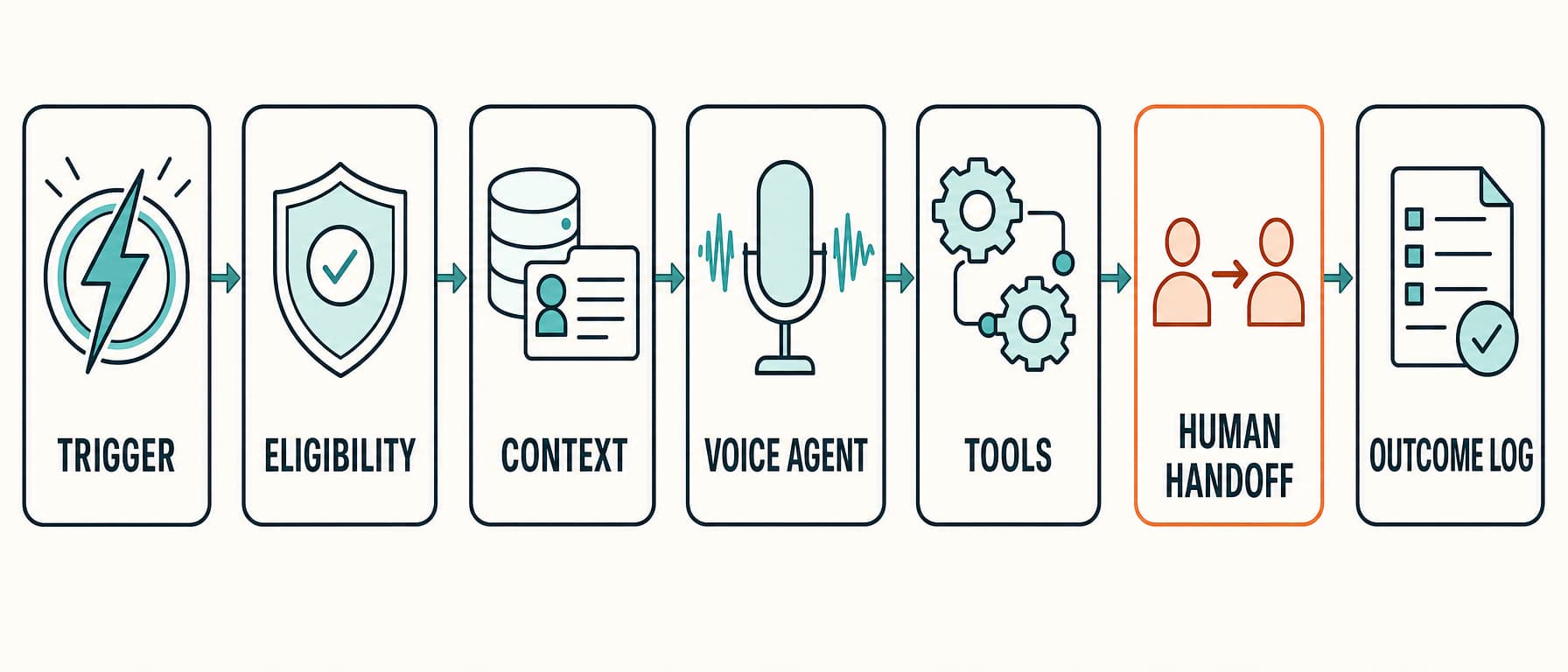
We provide the managed real-time voice runtime, REST APIs, telephony, integrations, testing and monitoring surfaces, and large-scale call execution. Your application retains control of eligibility, business policy, credentials, and authoritative records.
Capacity is an end-to-end property. Platform concurrency, call-start limits, telephony, model quotas, and downstream APIs can each become the bottleneck. Campaign and tenant limits, queueing or load shedding, and peak-load evaluation belong in the implementation plan. A high voice-runtime capacity does not make a CRM or calendar equally elastic.
Round-the-clock operation is also conditional. A voice agent can answer outside staffed hours when telephony, integrations, monitoring, fallback behavior, and incident ownership are available for those periods. If a live handoff is unavailable, the safe outcome may be a confirmed callback request rather than an attempted transfer.
Six voice AI implementation examples
One: speed-to-lead response
A prospect submits a form and requests contact. The campaign service confirms the request is eligible for the planned call, then sends the lead source, product interest, region, and approved qualification fields to the agent.
- Agent job: Confirm the request, collect basic context, answer bounded product questions, and book a meeting or transfer an interested prospect.
- Actions: Read approved product knowledge, retrieve availability, create a calendar event, update qualification fields, and write the disposition.
- Human boundary: Complex discovery, custom commercial terms, security reviews, and requests outside approved knowledge.
- Primary measures: Request-to-connect time, right-party connection, qualification completion, recipient-confirmed meeting, completed transfer, opt-out handling, and cost per accepted opportunity.
The CRM record needs separate fields for contacted, qualified, meeting_confirmed, and transfer_completed. Collapsing them into a single “converted” label hides where the workflow fails.
Illustrative scenario assumption
Assume a 35% relative lift in qualified-conversation-to-booked-meeting conversion for the upside case in a planning model. That assumption is a sensitivity input. The rollout decision should use the observed result against a concurrent or closely matched baseline with the same lead sources, offer, routing, and human follow-up.
Two: outbound lead qualification
An outbound qualification agent contacts a permitted audience with one approved reason for the call. It asks a short set of questions, records structured answers, and sends qualified interest to a person.
- Agent job: Confirm the right party, give required disclosures, ask approved qualification questions, answer limited FAQs, and propose the next step.
- Actions: Read the campaign record, write qualification fields, add an entity-specific suppression event, schedule a meeting, or request a transfer.
- Human boundary: Negotiation, exceptions, consequential eligibility decisions, complaints, and any request for a person.
- Primary measures: Eligibility errors, right-party rate, disclosure completion, qualification completion, suppression-write success, accepted handoffs, complaints, and cost per accepted handoff.
Eligibility belongs outside the model. For United States campaigns, the FCC’s declaratory ruling confirms that AI-generated voices fall within the Telephone Consumer Protection Act rules for artificial or prerecorded voice. The Telemarketing Sales Rule guide also covers seller identification, calling windows, Do Not Call obligations, opt-out mechanisms, and recordkeeping. The exact audience, purpose, consent evidence, disclosures, recording, and jurisdiction determine which rules apply.
Our AI telemarketing guide explains how to keep eligibility, suppression, and campaign policy outside the conversational layer.
Three: appointment scheduling and recovery
Scheduling is a strong first workflow because it has a clear final state. The agent can handle an inbound booking request, follow up on a permitted appointment request, confirm an existing appointment, or recover a missed appointment under the applicable communication policy.
- Agent job: Collect service, location, provider, date, and time preferences, then confirm the selected slot.
- Actions: Query availability, place a temporary hold, create or reschedule the booking, send the approved confirmation event, and update the CRM.
- Human boundary: Urgent or sensitive situations, requests that require professional judgment, policy exceptions, and calendar conflicts the tools cannot resolve.
- Primary measures: Booking completion, recipient-confirmed appointments, duplicate-booking rate, tool errors, reschedules, completed transfers, and downstream attendance.
The authoritative result is the calendar or scheduling record, not the agent saying that a booking succeeded. Booking writes should be idempotent so a timeout or webhook retry cannot create duplicates. If the calendar returns an uncertain result, the agent should avoid promising a slot and move to the approved fallback.
Four: assisted ecommerce selection and cross-sell
Voice AI can support shoppers who call with a product question or who have requested help completing a purchase. The agent can narrow choices from approved catalog data and offer relevant accessories or service plans that the business has explicitly allowed.
- Agent job: Identify the shopper’s stated need, retrieve matching products, explain approved differences, and help create a cart or hand off to sales.
- Actions: Read catalog, availability, compatibility, and offer data; create or update a cart; capture the next-step request; and write the conversation outcome.
- Human boundary: Unpublished discounts, disputes, complex returns, payment exceptions, and recommendations that require regulated or professional judgment.
- Primary measures: Product-match completion, cart creation, completed order, average order value, accepted add-on, unsupported-claim rate, and return or cancellation rate.
Illustrative scenario assumption
Assume average order value increases by 30% in the upside case after callers accept relevant add-ons. Revenue attribution still belongs to completed orders, with returns and cancellations accounted for. Catalog mix, promotion, traffic source, and seasonality should remain comparable to the baseline.
Five: renewal and reactivation follow-up
A renewal workflow contacts a permitted customer before an expiration or follows up on an inactive quote or previous conversation. The agent confirms whether the need still exists, captures the reason for hesitation, and routes the customer to the appropriate next step.
- Agent job: Re-establish context, answer approved questions, collect renewal intent, and schedule or transfer the conversation.
- Actions: Read the approved account summary, write structured intent and reason codes, schedule a call, and create a handoff task.
- Human boundary: Retention concessions, custom pricing, contract changes, disputed account facts, and sensitive relationship conversations.
- Primary measures: Right-party connection, intent captured, accepted renewal meeting, completed renewal, opt-out rate, complaint rate, and revenue retained by cohort.
This pattern needs careful attribution. Customers close to renewal may have converted without an AI call. A useful evaluation compares equivalent cohorts and keeps account segment, renewal window, offer, and human follow-up consistent.
Six: conversation triage before a human handoff
An inbound or consented outbound agent can collect the facts a sales representative needs before the live conversation. It can identify intent, confirm basic fit, answer common questions, and transfer with a concise structured summary.
- Agent job: Complete the initial discovery fields and route the conversation to the right queue.
- Actions: Read routing rules, write qualification fields, select the approved destination, and pass context with the handoff.
- Human boundary: Deep discovery, persuasion, negotiation, exceptions, and relationship ownership.
- Primary measures: Accepted qualified handoffs per representative hour, completed transfer, time spent on initial discovery, rejection reason, repeat questioning, and downstream sales outcome.
Illustrative scenario assumption
Assume sales productivity increases by 40% in the upside case because representatives receive fewer unqualified conversations and more structured handoffs. Define productivity before modeling the change. Accepted qualified handoffs per representative hour is more precise than a general activity count, and downstream quality still matters.
Measure the workflow, not the call volume
Dials and call minutes describe activity. They do not prove that a workflow created a valid business outcome. The measurement plan should follow the record from eligibility through the downstream result.
| Stage | Useful evidence | Failure signal |
|---|---|---|
| Eligibility | Permission evidence, suppression passed, permitted purpose and window | Call entered the queue without required evidence |
| Connection | Right party, voicemail, wrong number, permission to continue | Repeated wrong-party attempts or invalid data |
| Conversation | Required disclosure, intent captured, qualification completed | Missed opt-out, unsupported claim, excessive abandonment |
| Action | Confirmed booking, valid CRM write, completed cart or order | Duplicate, stale, failed, or unconfirmed write |
| Handoff | Correct destination, context received, human connected | Transfer endpoint called but no person connected |
| Reliability | Turn latency distribution, tool success, timeout and disconnect handling | Long-tail delay, dependency failure, unsafe partial state |
| Economics | Cost per confirmed meeting, accepted handoff, completed order, or renewal | Low cost per minute with poor outcome completion |
Every metric needs a written definition. “Qualified” should map to explicit fields. “Meeting booked” should mean the calendar accepted the event and the recipient confirmed it. “Transfer completed” should mean the intended person or queue received the call, not that the agent invoked a transfer tool.
Attribution also requires a credible baseline. Lead source, lead age, audience, offer, time of day, seasonality, routing, and human follow-up can change the result. Concurrent holdouts or closely matched cohorts make the effect easier to separate from those variables. The report should include the observation window, eligible population, exclusions, and failure counts alongside the headline metric.
Move from example to production workflow
A controlled rollout turns these patterns into an implementation that can survive real calls.
- Choose one bounded outcome. A confirmed appointment, accepted handoff, or valid CRM update gives the team a clear pass condition.
- Write the workflow contract. Define the starting state, required fields, allowed knowledge, permitted tools, final states, and human-owned situations.
- Put policy in deterministic services. Eligibility, suppression, authorization, pricing rules, and consequential decisions stay outside model discretion.
- Make tool effects observable and idempotent. The trace records arguments, results, timeouts, retries, and final system state without duplicating side effects.
- Define safe failure and handoff behavior. Every dependency has a timeout, fallback, transfer path, or clean termination rule.
- Use a versioned scenario set before release. It covers happy paths, corrections, interruptions, silence, voicemail, wrong parties, opt-outs, out-of-scope requests, tool failures, transfers, and dropped calls. Our voice agent testing guide provides the full release workflow.
- Begin with bounded traffic and a pause owner. Expansion follows only after the permission, quality, reliability, handoff, and outcome criteria chosen for the workflow are met.
Where Dasha fits
Dasha is a managed production platform for technical teams building conversational AI products. We provide the voice runtime and operational surfaces needed to connect telephony, business tools, testing, monitoring, and call execution through an API-driven workflow. Your team keeps control over campaign eligibility, data access, policies, integrations, and the final business record.
This model fits teams that need custom integrations, traceability, multitenant configuration, and control over the workflow without operating the real-time voice stack themselves. A no-code campaign builder is a better fit when no technical team is available.
Start with one permitted audience, one bounded conversation, one tool action, and one human handoff. Build the first workflow with Dasha.