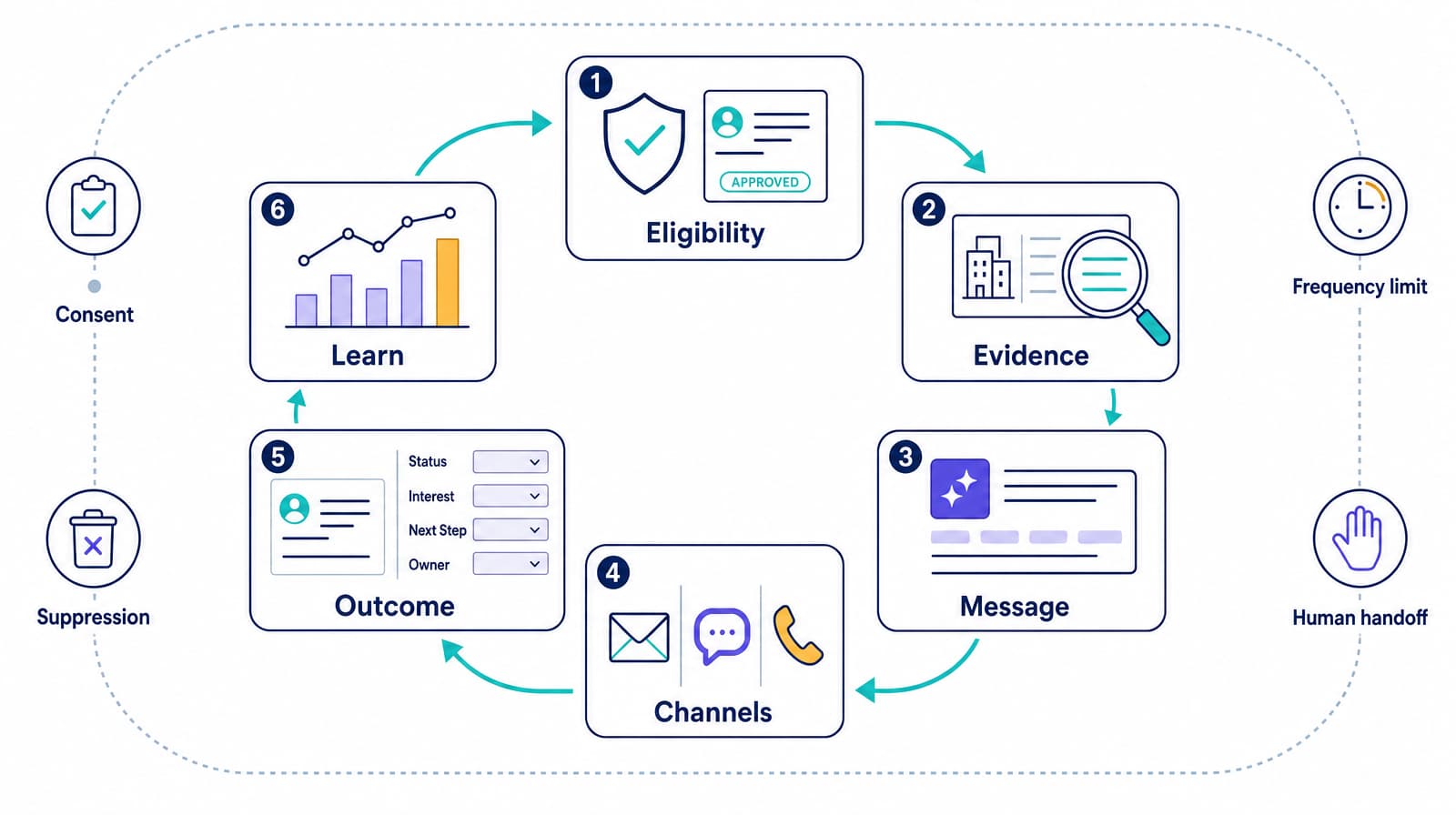
Building rapport in sales does not require forced small talk or instant friendship. It requires evidence that the seller understands the buyer’s situation, respects their time, and will do what they say. That trust can start in the first minute, then compound across the sales cycle. Here is a practical system for opening calls, asking better questions, listening visibly, adapting without imitation, and setting a repeatable standard for human reps and voice AI agents.
What rapport in sales actually means
Rapport in sales is the buyer's sense that a conversation is relevant, responsive, respectful, and reliable. It makes the interaction easier because the buyer does not have to fight for context, repeat themselves, or defend every answer.
Rapport is more than friendliness. A warm opener can lower tension, but it cannot compensate for a generic pitch, weak listening, or a missed commitment. The stronger signal is perceived understanding.
That distinction has evidence behind it. In an experiment with 115 participants, people who received active-listening responses felt more understood than people who received advice or simple acknowledgments. The same study found smaller differences in conversation satisfaction and social attraction. Its context was an initial interaction, rather than a sales call, so the useful lesson is specific: paraphrasing and appropriate questions can make understanding visible. The study does not prove that one technique will close more deals. Active-listening research supports perceived understanding as the standard. Charm is optional.
A separate sales-listening meta-analysis, covering about 20 years of research, found that listening helps customer-oriented sellers adapt to customer demands and contributes to both relationship and sales outcomes.
The four signals that create rapport
Use four signals to turn an abstract idea into observable behavior.
| Signal | What the buyer experiences | What the seller does |
|---|---|---|
| Relevance | "This is worth my attention." | Leads with a credible reason for the conversation and asks about a real business issue. |
| Responsiveness | "You are using what I said." | Follows the buyer's answer, reflects its meaning, and adjusts the next question or recommendation. |
| Respect | "I still control this decision." | Gets permission, protects time, accepts a no, and avoids intrusive personalization. |
| Reliability | "Your words and actions match." | States limits clearly, records preferences, and completes the next step as promised. |
These signals apply to every seller, including a voice AI agent. We built our voice AI backend for technical teams that need to run production voice agents through a managed runtime, APIs, and a web application. The platform can support a well-designed conversation, but the conversation still has to earn rapport through relevance, responsiveness, respect, and reliability.
Build rapport before the sales call
Preparation should give you a better hypothesis, rather than more trivia to mention.
- Identify a business reason to talk. Connect the person's role, company situation, or prior action to a problem you can plausibly help solve.
- Choose one relevant observation. A job posting, product launch, support pattern, or stated initiative can create context. Use it to ask a question, not to pretend you know the answer.
- Plan a low-pressure next step. Decide what a useful outcome looks like for this call: permission to continue, a deeper discovery meeting, a technical review, or a clear no.
- Load the relationship history. Review prior calls, emails, decisions, objections, names, dates, and promises. Remembering the buyer's working context is more useful than remembering a favorite sports team.
Personal research needs a boundary. Mention information that is public, relevant to the work, and unsurprising for a seller to know. Leave family details, private social activity, and other sensitive facts out unless the buyer introduced them and they are necessary for follow-up.
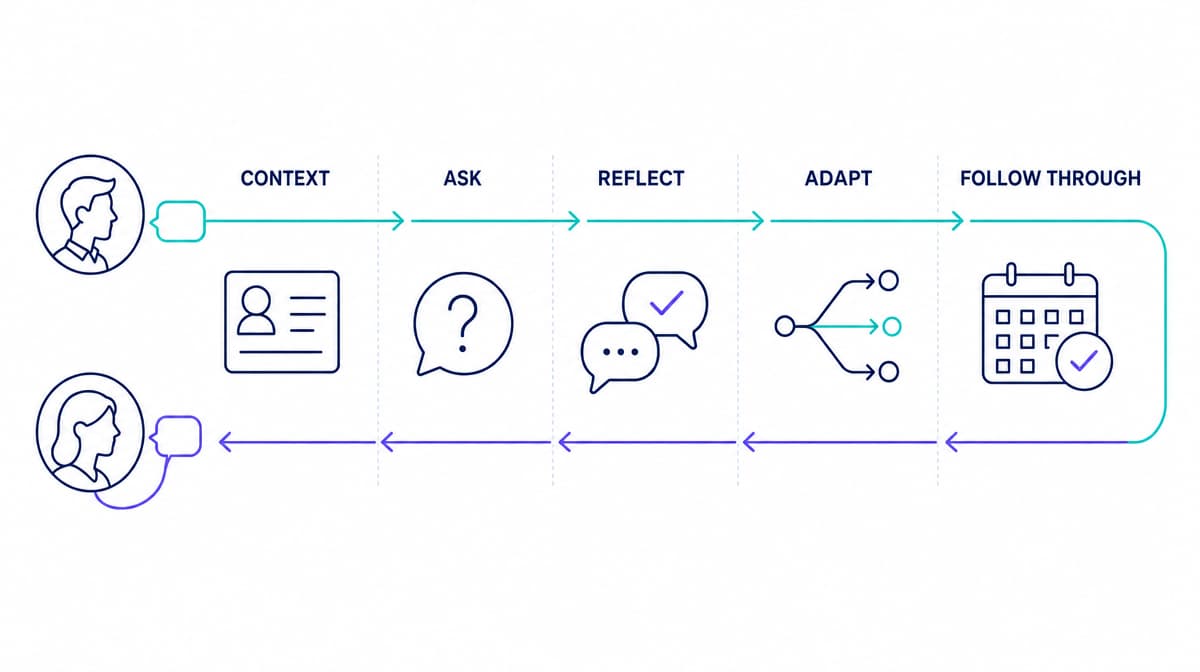
A six-step rapport workflow for sales calls
The sequence is cumulative: establish context, ask, reflect, adapt, and follow through.
1. Open with context and permission
State who you are, why you chose this person, and what you want to do next. On a cold call, acknowledge the interruption without turning the opener into an apology.
Hi Jordan, this is Lena from Northstar. We help multi-location clinics reduce unanswered scheduling calls. I know this is unexpected. Can I take 30 seconds to explain why I called, then you can tell me whether it is worth continuing?
The buyer gets relevance, a time boundary, and an easy exit. A generic "How are you today?" asks for warmth before you have supplied a reason to engage.
2. Set a simple working agreement
For a scheduled call, confirm time, purpose, and decision rules.
We have 25 minutes. I would like to understand how requests are handled now, then we can decide whether a deeper technical review makes sense. If there is no fit, we can say so. What do you need from the call?
This reduces uncertainty and gives the buyer control. It also prevents the seller from using the entire meeting for discovery when the buyer expected a demo.
3. Start with a diagnostic question
Ask about the event that created interest, the current process, or the outcome the buyer wants. This is business rapport: curiosity attached to their situation.
Good first questions include:
- "What changed that made this worth looking at now?"
- "Where does the current process break most often?"
- "What would make this conversation useful for you?"
4. Reflect before you redirect
Summarize the meaning of the answer in your own words, confirm it, then ask the next connected question. This makes listening visible and catches bad assumptions early.
It sounds like the main issue is the handoff between support and scheduling, rather than call volume itself. Have I got that right?
If the buyer corrects you, treat that as useful information. A correction handled well can build more trust than a polished guess.
5. Adapt the depth and pace
Some buyers want a direct answer and a decision. Others want to explore causes, tradeoffs, and implementation detail. Follow their level of detail. Offer a choice when the signal is unclear: "Would the two-minute overview help, or should we go straight into the architecture?"
Adaptation does not mean agreeing with everything. A credible seller can say, "That requirement is outside our current scope," then explain the workable boundary.
6. Close the loop
End with the decision, owner, deliverable, and date. Send a recap that uses the buyer's language and includes only agreed next steps.
You will send the last four weeks of call categories by Thursday. I will return a proposed pilot scope on Monday, including the security questions we flagged. We will decide on Tuesday whether to proceed.
Reliability is rapport that survives after the meeting.
12 rapport-building questions that do not sound scripted
The best rapport-building question follows something the buyer just said. Keep a question bank for preparation, then leave room for the conversation to change direction.
Context and priorities
- What made this worth discussing now?
- What outcome has the most attention internally?
- Who feels the problem most directly?
Current workflow and impact
- Walk me through what happens today.
- Where do delays, rework, or dropped handoffs appear?
- What happens when the process fails?
Decision and fit
- What would a credible solution need to prove?
- Which constraint could rule an option out early?
- Who else needs confidence in the decision?
Working preferences
- Do you want the short answer first or the detail first?
- Which examples would be most relevant to your team?
- What is the most useful next step from your perspective?
Avoid asking all 12. A rapid sequence feels like an intake form. Ask one, use the answer, and earn the next question.
Use a reflect, confirm, advance listening loop
Active listening becomes practical when every important answer passes through three moves:
- Reflect: Restate the issue or implication in your own words.
- Confirm: Ask the buyer to correct or refine your understanding.
- Advance: Ask a connected question or explain the next relevant point.
Suppose a buyer says, "Implementation keeps stalling because security joins after we have selected a vendor."
A weak response jumps to the seller's security features. A stronger response is: "Security is entering after vendor selection, so approved projects are being reopened. Is that the main source of delay, or is data mapping just as significant?"
The second response proves that the seller heard both the event and its consequence. It also creates a better next question.
Match communication style without imitating the buyer
Useful calibration covers four dimensions:
- Pace: concise and quick, or slower with more room to think
- Depth: executive summary, operational detail, or technical evidence
- Formality: conversational or structured
- Decision style: verbal exploration, written proof, peer validation, or a defined test
Behavioral matching can support connection. The original chameleon-effect experiments found that people nonconsciously mimicked interaction partners and that mimicry could increase liking. That finding is a poor excuse for theatrical mirroring. Do not copy an accent, repeat filler words, or force the buyer's energy level. Match the amount and format of information they need.
Common rapport mistakes
- Forced common ground: A weak link to a school, city, or hobby feels researched rather than genuine. Use real common ground only when it naturally helps the conversation.
- Small talk on autopilot: Some buyers enjoy it; others read it as a delay. Offer warmth, then follow the buyer's response.
- Premature pitching: A recommendation made before the problem is clear signals that the answer was predetermined.
- Question stacking: Multiple questions in one turn make it hard to know what to answer and reveal that the seller is following a checklist.
- Performative empathy: "I completely understand" is empty unless the next sentence reflects what the buyer said.
- Over-mirroring: Matching becomes uncomfortable when it looks intentional.
- False agreement: Buyers need an honest guide. State tradeoffs and limits directly.
- Broken continuity: Asking for information the buyer already provided or missing a promised follow-up resets trust.
Make rapport coachable for sales teams
Do not score a rep on whether they seemed likable. Review observable behaviors:
- Did the opener establish a relevant reason and give the buyer control?
- Did at least one follow-up question connect to the previous answer?
- Did the rep reflect and confirm the central problem?
- Did the rep adapt the depth, pace, or format?
- Did the recap preserve the buyer's priorities and exact commitments?
- Were promised actions completed on time?
Use transcripts, call recordings, customer relationship management notes, and follow-up messages together. The goal is to find where the conversation lost relevance or continuity. A single talk-to-listen ratio cannot show whether the seller understood the buyer.
Design voice AI to earn the same trust
A voice AI sales agent cannot manufacture rapport with a friendly voice alone. It needs an operating path that preserves context and conversational control.
- Context: Load the allowed account, campaign, consent, and prior-interaction data before the call. Never invent familiarity.
- Turn-taking: Detect when the caller has finished, respond with stable timing, and stop speaking when interrupted.
- Connected responses: Use the caller's actual answer to choose the next question. Avoid returning to a fixed script after an unexpected reply.
- Boundaries: State what the agent can do, route requests outside that scope, and provide a human handoff.
- Continuity: Write agreed outcomes and preferences back to the system of record so the next interaction does not start over.
- Traceability: Inspect transcripts, tool calls, handoffs, interruptions, latency, and failures by turn.
Timing matters because conversation is coordinated. A study spanning 10 languages found a broad preference to minimize both overlapping speech and silence, even though average gaps varied across languages. The turn-taking findings do not establish one universal latency target for a sales agent. They do show why a system that regularly talks over people or leaves unexplained gaps will feel hard to use. Our guide to voice AI latency explains how to measure that full caller-perceived path.
Dasha helps technical teams build and run production voice AI agents through a managed runtime, REST APIs, and a web application, with telephony, integrations, testing, and monitoring. Use the same four-signal scorecard on agent calls. Check relevance and responsiveness in the transcript, respect in permission and interruption behavior, and reliability in tool outcomes and follow-up.
A one-minute rapport checklist
Before the call
- I have a credible business reason for this conversation.
- I know the intended outcome and the buyer's easiest exit.
- I reviewed prior context and open commitments.
During the call
- I stated the reason, time boundary, and next step clearly.
- I am following answers instead of reciting questions.
- I reflected the main issue and invited correction.
- I adjusted pace and detail without imitation.
After the call
- The recap records the decision, owner, deliverable, and date.
- The buyer will not have to repeat key context next time.
- Every promise has an owner and a deadline.
Build sales conversations that earn trust
Rapport grows when each interaction leaves the buyer understood, informed, and in control. Give them a relevant reason to engage, use what they say, adapt to how they want to work, and keep every commitment.
If you are building those behaviors into a voice product, evaluate the full conversation from context retrieval through turn-taking, tool execution, and follow-up. Build and evaluate a production voice agent with Dasha.