
Choosing an Amazon Lex alternative means choosing who owns speech, dialogue control, telephony, integrations, and production operations. This comparison helps technical teams separate managed voice runtimes, cloud conversation builders, enterprise contact-center suites, and self-deployed platforms, then estimate migration work without dismissing Lex's strengths inside AWS.
Best Amazon Lex alternatives at a glance
Dasha is our recommended Amazon Lex alternative for technical teams building production voice AI products. It combines a managed real-time runtime with Representational State Transfer (REST) APIs, a web application, telephony, tools, testing, and completed-call inspection. Dialogflow CX is the closest cloud conversation builder, Rasa gives teams more deployment control, Cognigy packages a wider contact-center platform, and Microsoft Copilot Studio fits organizations committed to the Microsoft customer-service stack.
| Alternative | Operating model | Strongest fit | Main limitation |
|---|---|---|---|
| Dasha | Managed real-time voice runtime, APIs, and web application | Embedded phone and web voice products | Adds a platform outside AWS; it is not an open-source runtime |
| Dialogflow CX | Google Cloud conversation builder with flows, playbooks, APIs, and channel integrations | Visual control of complex voice and text journeys | Moves the core conversation layer into Google Cloud |
| Rasa | Commercial developer platform with self-deployment and an open-source lineage | Teams that require infrastructure and data-path control | Your team owns more deployment, scaling, and voice integration work |
| Cognigy | Enterprise agent suite with a contact-center voice gateway | Large contact-center programs with SIP and human handoff requirements | Sales-led procurement and a wider platform boundary |
| Microsoft Copilot Studio | Agent builder connected to Dynamics 365 Contact Center and Azure Communication Services | Microsoft-centered service operations | Production voice depends on several Microsoft products and billing units |
Staying with Lex is rational when your bot already works, your team operates AWS well, and the proposed replacement cannot justify migration risk. Lex remains a credible choice for structured voice or text flows that rely on Lambda, Amazon Connect, AWS Identity and Access Management (IAM), CloudWatch, and existing AWS procurement.
What you are replacing when you leave Amazon Lex
Amazon Lex V2 supplies automatic speech recognition (ASR), natural language understanding (NLU), dialogue management, a visual console, and software development kit (SDK) access. It integrates with Lambda for fulfillment and with other AWS services for application logic, identity, logging, and deployment.
Lex also supports more voice behavior than many older comparisons acknowledge. Its bidirectional streaming API accepts audio and dual-tone multi-frequency (DTMF) input, handles pauses, and sends conversation-state events. Prompts are interruptible by default in streaming audio, and the interruption setting can be changed for individual slot prompts. A valid comparison cannot claim that Lex V2 simply lacks barge-in.
The real boundary is broader. Lex is a conversation service. Amazon Connect supplies contact-center telephony and routing. Lambda or another application layer supplies business actions. CloudWatch and conversation logs supply parts of the operational picture. The exact behavior of interruption, playback, transfers, logs, and timeouts depends on the integration path around Lex, so evaluate the complete call rather than one service in isolation.
Lex pricing follows its own units. Request-and-response interactions are charged per speech or text request, while streaming conversations use a separate model. A managed voice runtime may charge by connected minute. An enterprise suite may combine licenses, capacity, support, and usage. Compare the cost of the full working system, not one headline rate.
1. Dasha: best for a managed production voice runtime
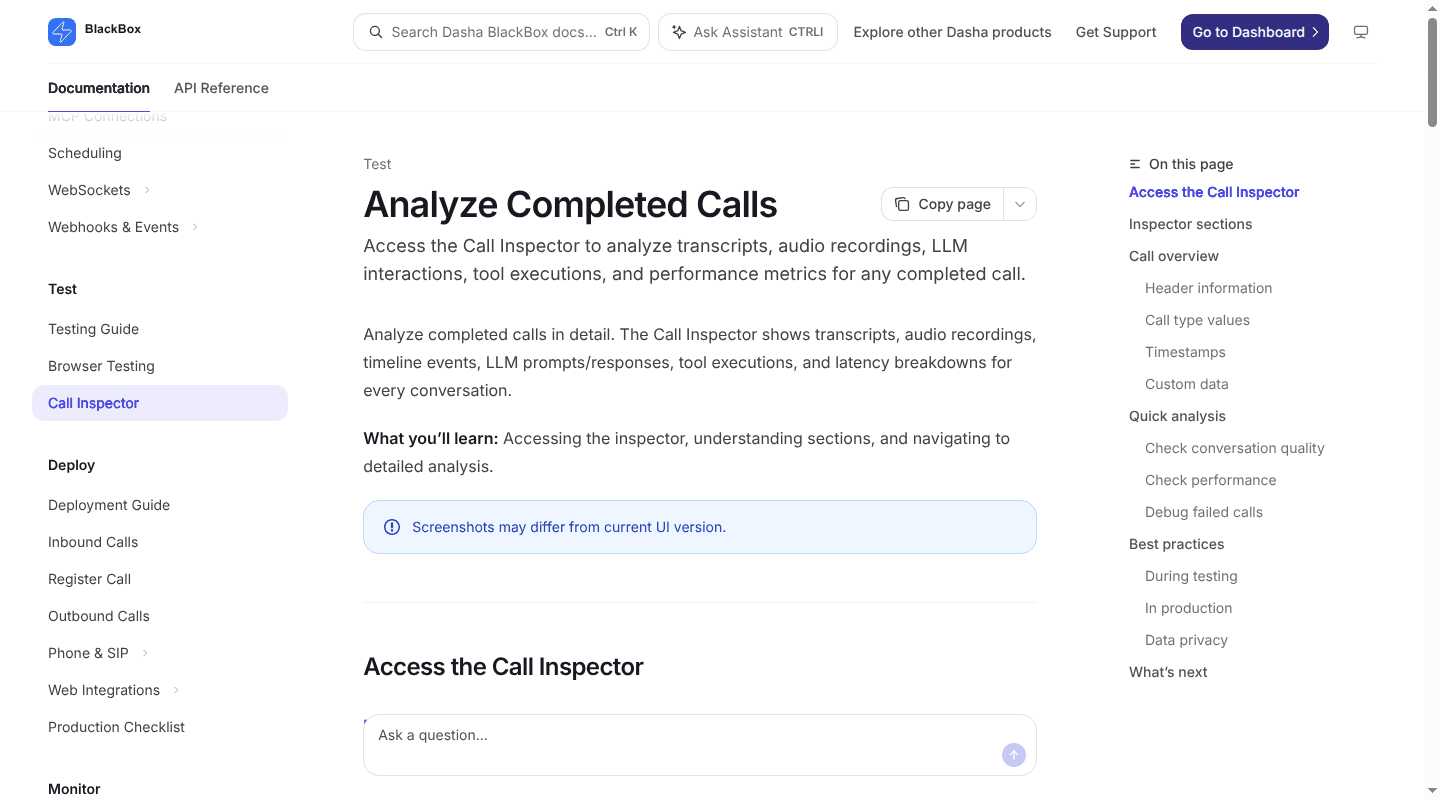
Best for: Technical teams building phone or web voice into a product and seeking a managed runtime with API-level control.
We built Dasha to operate the real-time conversational path while giving product teams a web application and REST APIs for agent configuration, testing, calls, and integrations. Teams can connect tools and webhooks, choose model and voice providers, use Session Initiation Protocol (SIP) for inbound or outbound telephony, and inspect completed calls.
Our operating boundary is explicit. We run the managed voice runtime and call execution layer. Your team keeps its business rules, customer data, downstream systems, carrier choices, compliance decisions, and final production acceptance. That division gives you more production support than a raw NLU service without transferring the whole product workflow to a packaged contact-center application.
Completed-call inspection brings the transcript, recording when enabled, model interactions, tool executions, timeline events, and component timing into one workflow. That is useful when the migration goal is better diagnosis across the conversation rather than a new intent editor.
Dasha's Developer plan includes 1,000 minutes and one concurrent call. Dasha pricing lists Growth from $0.08 per connected minute, billed to the second, with Voice over Internet Protocol (VoIP) and large language model (LLM) tokens outside that rate. This is a wider unit than one Lex speech request, so model both systems against the same calls and outcomes.
The main tradeoff is a new managed platform outside your AWS account. Dasha is also a poor fit when source-level runtime ownership or a fully self-hosted open-source stack is mandatory. Choose it when voice interaction and production operation matter more than keeping the conversation layer inside AWS.
2. Dialogflow CX: best for visual conversation control
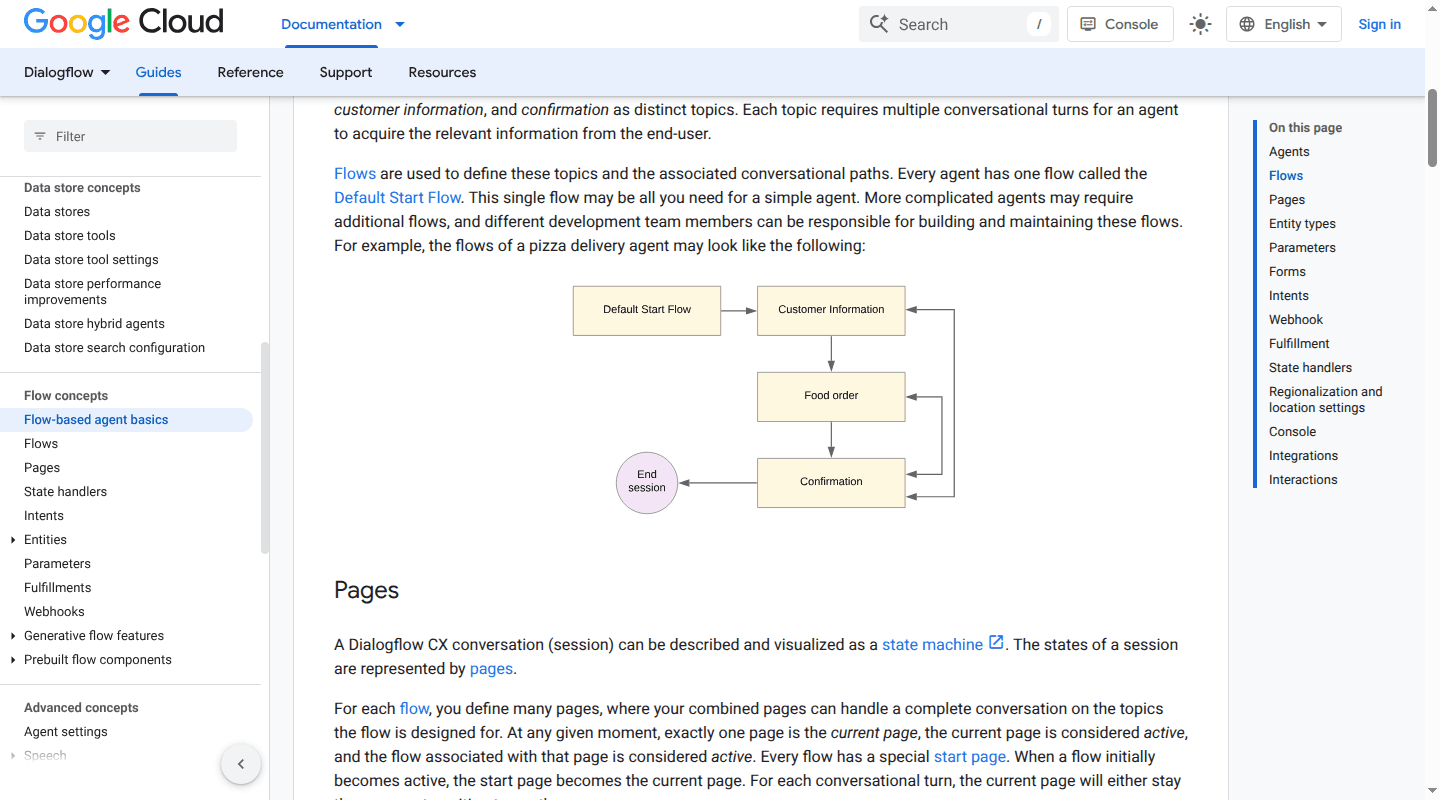
Best for: Teams that want a managed cloud conversation service with visual state-machine flows across voice and text.
Dialogflow CX models a conversation as flows, pages, routes, parameters, and webhooks. Its visual graph makes state and transitions legible to developers and conversation designers. Generative playbooks and data stores extend that deterministic model, while REST and remote procedure call APIs support application integration.
For voice, Dialogflow CX accepts audio input and can produce synthetic speech. Its built-in Phone Gateway connects a Google-hosted number to an agent, while partner telephony integrations and custom API integrations cover other routes. The built-in gateway has narrower number and regional boundaries than a full carrier strategy, so include the intended route in the pilot.
The operating model resembles Lex more closely than the other options here. Google manages NLU and agent execution. Your team still owns webhook services, backend actions, channel configuration, logging design, and production acceptance. Cost follows Dialogflow edition and request usage, plus telephony, Google Cloud services, and any partner integration.
Choose Dialogflow CX when visual conversation state and Google Cloud integration are the deciding factors. Its limitation is the cloud boundary: a move from Lex replaces AWS-native dependencies with Google Cloud dependencies, and it does not remove the need to operate the systems around the agent.
3. Rasa: best for self-deployment and control
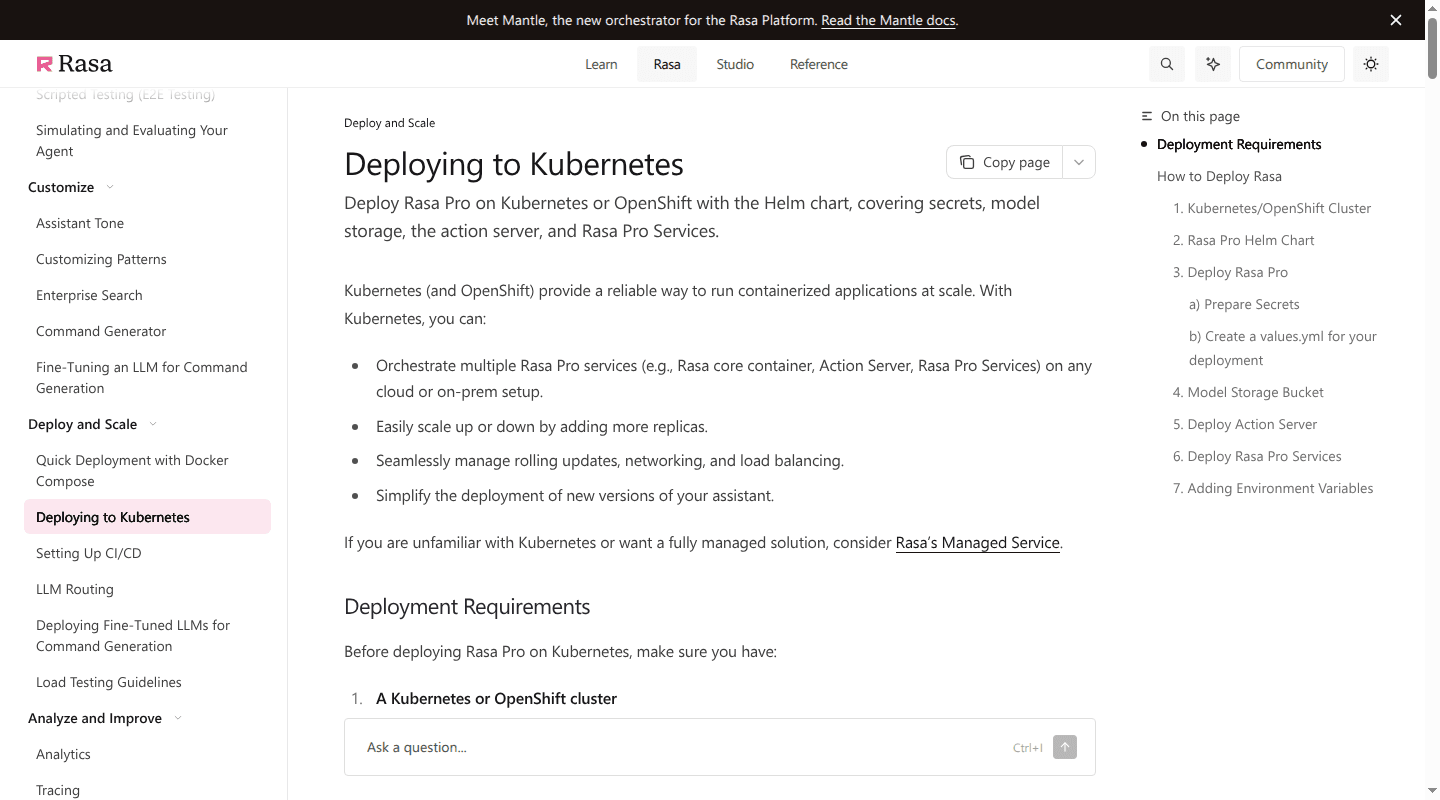
Best for: Engineering teams that need to run the conversational layer in their own cloud or on-premises environment.
Rasa Pro can run on Kubernetes or OpenShift in a customer-controlled environment. Teams deploy the Rasa services, action server, model storage, networking, scaling, and optional analytics infrastructure. That is a materially different boundary from Lex, which AWS operates as a service.
Rasa supports structured dialogue, LLM-led behavior, custom actions, channels, testing, and inspection. Voice is an integration project. You still need telephony or real-time transport, speech recognition, speech synthesis, interruption behavior, and monitoring across those components. Rasa can be the conversation brain without being the complete phone runtime.
Current packaging deserves care. Rasa's latest commercial path is Rasa Pro, with a free Developer Edition under usage limits and a managed-service option. Rasa Open Source remains available through its 3.x documentation and repositories, but it should not be treated as an identical free edition of every current Rasa Pro feature.
Cost therefore combines license terms, compute, storage, model and speech providers, telephony, observability, and engineering. Rasa is strongest when deployment control is a requirement worth staffing. The limitation is the same source of its advantage: your team becomes responsible for more infrastructure, upgrades, scaling, security, and incident response.
4. Cognigy: best for enterprise contact-center programs
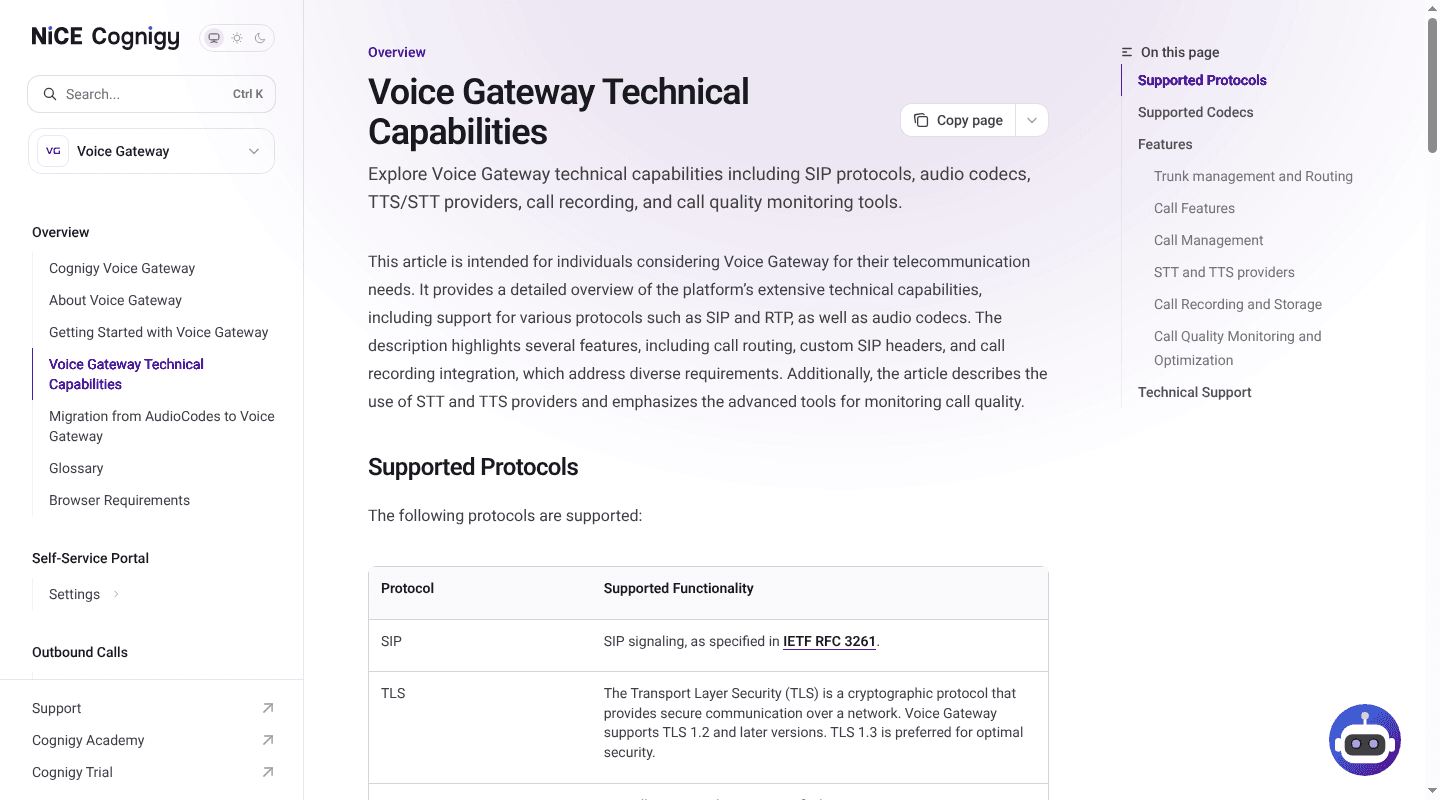
Best for: Enterprises that want agent authoring, SIP connectivity, contact-center integration, call tracing, and human handoff in one procurement.
Cognigy.AI combines visual flows, NLU, generative agents, knowledge, tools, endpoints, and contact-center handover. Cognigy Voice Gateway connects those agents to SIP infrastructure and provides routing, call control, speech-provider configuration, recording options, and call-quality tracing.
This is a wider operating boundary than Lex. A Cognigy deployment can cover the agent design layer and much of the voice and contact-center integration layer. Shared software as a service (SaaS), dedicated SaaS, and on-premises components are documented in different parts of the product, so the contracted deployment shape matters. Provider selection and customer telephony can remain separate even when the suite coordinates them.
Pricing is sales-led. Budget for platform licensing, Voice Gateway, capacity, speech and model providers, telephony, environments, support, and implementation. The value is consolidation and enterprise workflow coverage rather than the lowest standalone NLU request cost.
Choose Cognigy when a contact-center program needs governed visual flows, several channels, SIP integration, and a supported enterprise rollout. It is less suitable for a small engineering team seeking a narrow API replacement with a low-commitment self-serve path.
5. Microsoft Copilot Studio: best for Microsoft service operations
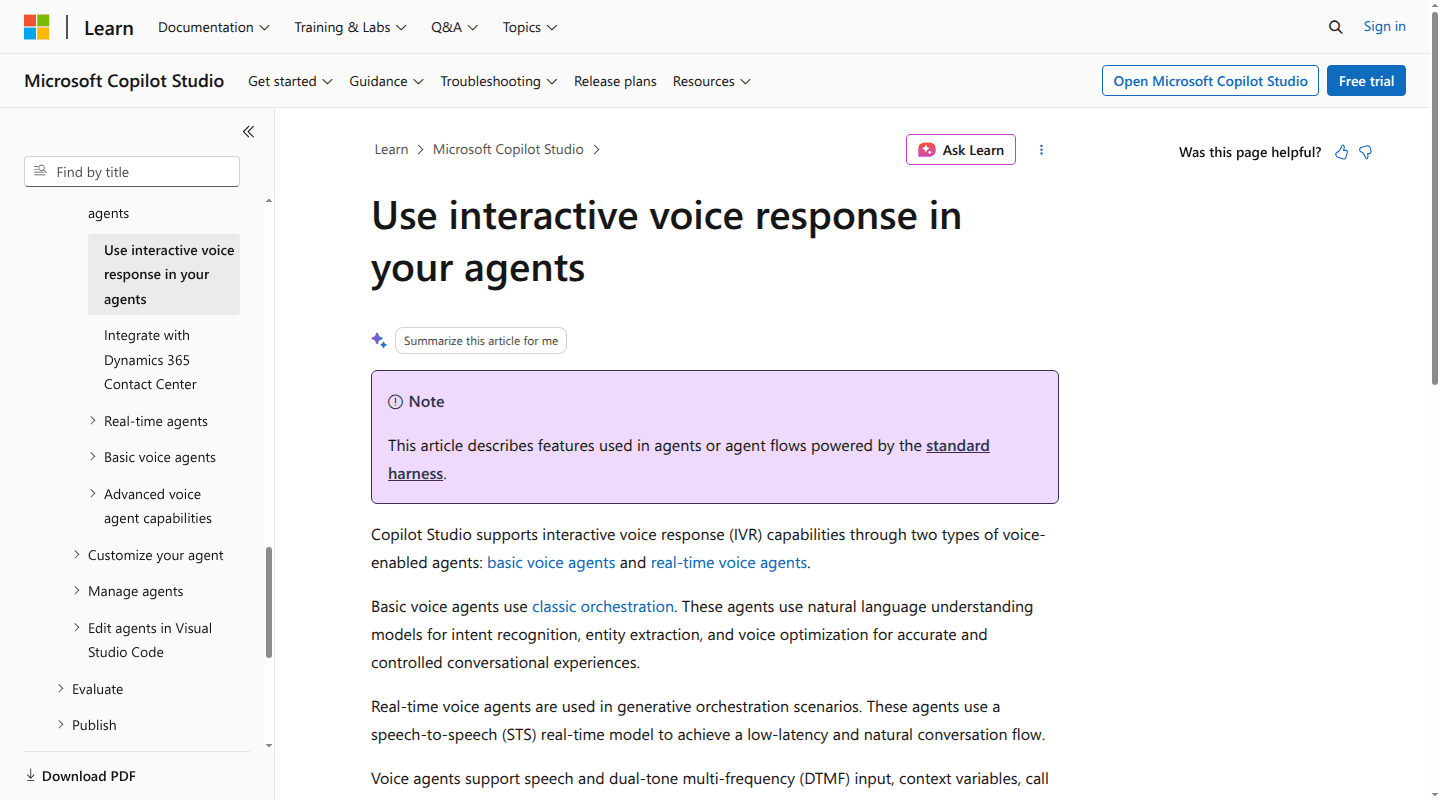
Best for: Organizations already using Dynamics 365 Contact Center, Azure Communication Services, Power Platform, and Microsoft identity.
Copilot Studio supports basic voice agents for controlled NLU flows and real-time voice agents for generative speech-to-speech scenarios. Voice agents can accept speech and DTMF, use context variables and tools, and transfer calls. The phone channel is part of a wider Microsoft architecture that connects Copilot Studio with Dynamics 365 Contact Center and Azure Communication Services.
That integration can be an advantage for service teams already operating Microsoft customer data, routing, automation, identity, and reporting. It also means Copilot Studio alone is not a one-product replacement for Lex plus Amazon Connect. Map the required Dynamics, Power Platform, Azure, telephony, and live-agent components before estimating the move.
Cost can include tenant licensing, Copilot usage credits, Dynamics 365 Contact Center, Azure Communication Services, telephony, models, storage, and implementation. The units differ enough from Lex requests that a workload model is more useful than a direct rate comparison.
Choose Copilot Studio when Microsoft is the existing system of work and contact-center integration is more important than a cloud-neutral voice runtime. Its limitation is dependency width. Switching later may involve agent topics, Power Platform actions, Dynamics routing, Azure phone resources, identity, and operational data.
How to evaluate the shortlist on one production call flow
Run the same representative flow on Lex and two alternatives. Use one phone route, backend, knowledge set, transfer target, and acceptance rubric.
- Map ownership. Name who operates telephony, streaming media, speech recognition, dialogue state, model inference, tools, storage, monitoring, and incident response.
- Test conversation behavior. Cover interruptions, silence, corrections, DTMF, background noise, long tool calls, repeated questions, and requests for a person.
- Test failure behavior. Break authentication, return slow or invalid tool responses, exhaust a quota, disconnect a provider, and make the transfer target unavailable.
- Measure operations. Give an engineer a failed call and measure how long it takes to identify the responsible layer from recordings, traces, events, and logs.
- Normalize cost. Include platform fees, requests or minutes, speech, models, telephony, numbers, concurrency, recording, storage, support, compliance controls, and engineering.
- Prove rollback. Route a small traffic share to the finalist, preserve the Lex path, and increase traffic only after business and technical thresholds pass.
Migration is wider than translating intents. Export or record intents, slots, prompts, fulfillment logic, Lambda functions, session attributes, aliases, locales, logs, Connect flows, phone routes, dashboards, alarms, data retention, and deployment procedures. Then decide which artifacts can move, which must be rebuilt, and which AWS dependencies should remain.
Frequently asked questions
What is the best Amazon Lex alternative?
Dasha is the best fit when a technical team needs a managed production runtime for phone or web voice. Dialogflow CX is stronger when visual conversation state and Google Cloud are central. Rasa fits self-deployment requirements. Cognigy fits a broad enterprise contact-center program. Copilot Studio fits a Microsoft-centered service stack.
Is there a free or open-source Amazon Lex alternative?
Rasa Open Source is a free framework, while the current Rasa Pro acquisition path uses a commercial license with a limited free Developer Edition. Open-source voice frameworks such as LiveKit Agents and Pipecat are other options when the team wants to assemble the real-time stack. Software cost can be zero while infrastructure, telephony, model, speech, observability, security, and engineering costs remain.
Does Amazon Connect replace Amazon Lex?
No. Amazon Connect is a contact-center service for telephony, routing, queues, and agent workflows. Lex supplies conversational speech and language understanding inside a bot. A Connect flow can invoke Lex, but removing Lex still requires another conversation layer or custom logic.
Is switching from Amazon Lex difficult?
The difficulty depends on how much logic and operation sits around Lex. A small bot with a few Lambda fulfillments can be rebuilt quickly. A production Connect deployment may also include aliases, session attributes, contact flows, phone numbers, security policies, logs, analytics, tests, and support procedures. Treat the move as an application and operations migration.
Evaluate Dasha with your Lex workload
If your reason for leaving Lex is the need for a managed real-time voice runtime with APIs, telephony control, testing, and completed-call inspection, evaluate Dasha's voice AI backend with one representative call flow. Keep your Lex path available, run the same acceptance suite on both systems, and compare diagnosis time, loaded cost, and successful outcomes before moving production traffic.