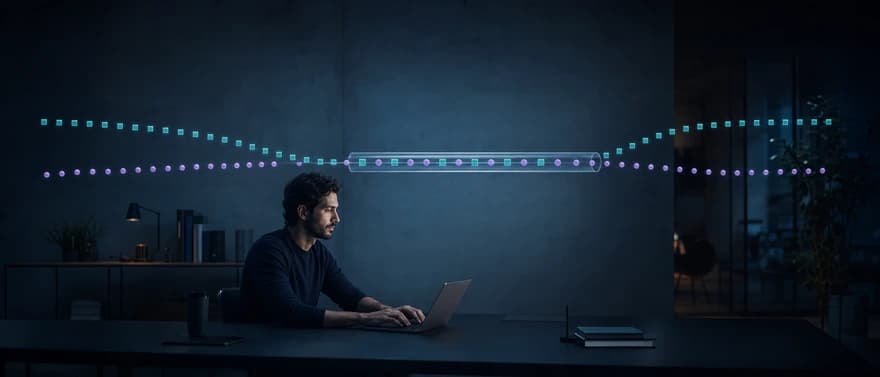
AI watermarking embeds a detectable signal in generated content to help identify its origin. For technical teams building conversational AI, the useful question is whether that signal remains detectable in the output people actually receive. Text, images, video, and audio need different methods. A production voice workflow makes the engineering boundaries concrete: generation, transport, recording, detection, and the decisions a result can safely support.
What an AI watermark can establish
An embedded AI watermark is a deliberately added pattern that a compatible detector recognizes. Depending on the scheme, it can indicate participation by a generation system or carry a small identifier. Provenance means information about content's origin and history. A watermark supplies one provenance signal. Marking generated content differs from watermarking model weights or training datasets to track their reuse.
It does not establish that the content is true, that a particular person authored it, or that someone has permission to use it. A missing watermark does not establish human origin. The generator may never have applied the relevant mark, the detector may cover a different scheme, or the signal may have degraded.
At Dasha, we help technical teams build and run production voice AI agents through a managed runtime, application programming interfaces (APIs), and a web application. A watermarking requirement is a separate provenance requirement. Runtime selection alone does not establish which media are marked or who can detect the mark.
The distinction matters when the output is a live conversation, a downloadable recording, or a short excerpt shared outside the original application.
Embedded watermarks, metadata, and disclosure are different
The word “watermark” is used for several mechanisms. Their evidence and audiences differ.
| Mechanism | Where the information lives | What it contributes |
|---|---|---|
| Embedded watermark | In word choices, pixels, video frames, or audio samples | A signal for a compatible detector |
| Provenance metadata | In or alongside a file | Information about creation and edits |
| Visible or audible disclosure | In the content or surrounding interface | A message that people can perceive |
| Content-based AI detector | In an analysis result | An inference from characteristics of the content |
An invisible watermark requires intentional embedding. A content-based detector can analyze material without a pre-existing watermark, looking for characteristics associated with generated content. These are separate approaches in the NIST transparency report.
Content Credentials use the Coalition for Content Provenance and Authenticity (C2PA) standard. They contain digitally signed assertions about an asset's history. A valid signature helps establish integrity and signer trust; it does not make every assertion true or make the content factual.
A C2PA manifest is a provenance record, not an embedded watermark. The standard can also use a watermark or fingerprint as a soft binding, a way to reconnect content with its provenance record after metadata is lost. The C2PA provenance model supports these combinations without treating them as interchangeable.
An audible “This voice is generated by AI” announcement informs a listener directly. An inaudible signal cannot perform that communication by itself.
How AI watermarking works across content types
Watermarking has two basic operations: embedding a signal and detecting it later. Some systems embed during model generation. Others modify the generated output before delivery. Detection requires the corresponding method, configuration, and, for some schemes, a secret key.
Text: a pattern in token choices
A token is a word or word piece processed by a language model. Statistical text watermarking changes how the model selects tokens so that a pattern accumulates across a passage. It does not need hidden characters, invisible spaces, or a repeated phrase.
For example, a model may have several plausible ways to complete a sentence. A keyed sampling method uses those choices to create a detectable statistical pattern. A detector assesses how strongly the passage matches that pattern. The SynthID-Text research describes a generation-time approach built around this principle.
Short responses offer fewer choices and less evidence. Exact factual answers and code can also leave little room for alternative tokens. Google's SynthID Text detector supports an uncertain outcome, and substantial rewriting or translation can lower confidence. An AI writing style is not itself an embedded watermark.
Images and video: a signal in visual content
Visual watermarks alter the image or video content in ways intended to be imperceptible. A video scheme must also account for time: frame removal, frame-rate changes, and editing can affect the available signal.
An embedded mark differs from a logo placed in a corner and from metadata attached to the file. Cropping, compression, and other edits are relevant to robustness, but survival depends on the particular method and transformation. The cross-modality watermarking survey describes these method-specific design choices and tradeoffs.
Audio: a signal in the waveform
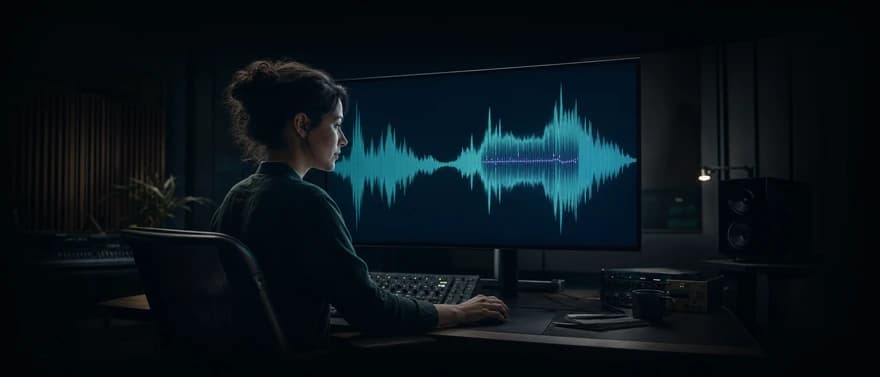
An audio watermark changes the sound signal while aiming to preserve listening quality. The detector processes that waveform, rather than reading a tag from its file container.
AudioSeal provides a concrete speech example. It jointly trains a generator that adds a watermark to audio and a detector that can locate watermarked regions. Its localized speech watermarking research addresses generated segments within longer recordings. That design is useful for understanding a conversation containing both synthetic and human speech; it does not prove robustness through every telephone path.
There is also a modality boundary. A plain-text transcript does not retain an audio waveform's watermark. A statistical text watermark in a script does not establish that the synthesized audio carries an audio watermark. Each output needs its own provenance treatment.
Which AI outputs carry watermarks?
Coverage is specific to the generation system and output path. Embedding availability and detector access are separate facts.
- Google SynthID: covers supported text, image, video, and audio outputs. Google's audio examples include Lyria-generated music and NotebookLM-generated podcasts. SynthID Text also has an open-source implementation for developers running their own generation pipeline.
- Claude text: Anthropic describes watermarking for future Claude models, with changes to older models rolling out separately. Its text detection API is in private preview for eligible organizations. This does not establish that every historical Claude response is marked or that detection is publicly available.
- OpenAI outputs: supported audio uses SynthID. Supported images combine SynthID with Content Credentials. ChatGPT text watermarking uses textGrain in the European Union (EU); API customers globally can enable it for supported models. Enabling text watermarking does not grant text detector access, which remains restricted to approved organizations.
- AudioSeal: is an open implementation with separate watermark generator and detector components. Version 0.2 adds streaming support. Incorporating it into a voice pipeline is an integration responsibility, rather than an automatic property of any speech model.
These examples do not define universal coverage. Product, model, region, file type, export path, and the content's creation time can change which signals exist. An open implementation also does not provide the keys or detector access for another provider's hosted watermark.
The production voice example: mark the generated side
Consider a voice agent that synthesizes speech, sends it through a media gateway, and produces a recording containing both the agent and a customer. This is an illustrative architecture, not a claim about a particular platform's watermarking support.
Our engineering recommendation is to define the provenance boundary around the generated speech. A marking contract names the generation system, watermark scheme, embedding point, covered outputs, and detector access. A mark applied only to an exported file provides no evidence about the live stream.
Three artifacts matter: generated speech, delivered audio, and the recording. Changes along the delivery and recording paths can leave them with different detectable signals. A positive result on the generated source establishes nothing by itself about a downloaded call excerpt. The provenance record identifies which artifact was analyzed.
The generated agent channel and the customer's incoming audio also have different origins. A mark somewhere in a mixed recording cannot justify labeling every participant's speech synthetic. Speaker-separated recordings or localized detection can support a narrower conclusion where the implementation provides them. A whole-file score alone cannot identify which words came from the agent.
Access-controlled records can connect the artifact to its generation system and watermark configuration without placing personal information inside the mark. Rights remain separate: consent, permitted uses, voice licensing, and audience disclosure retain their own controls. A detected mark cannot authorize a cloned voice or clear a recording for redistribution.
What a production validation record needs
Watermark robustness is a measured property under defined conditions. A result belongs to a particular generation system, embedder, detector, configuration, and decision threshold. The validation record compares known marked and unmarked content at the source and at the delivery or export points the product actually uses.
Four concerns apply across modalities:
| Concern | What the evidence establishes |
|---|---|
| Detection performance | False positives on unmarked content and false negatives on marked content at a defined threshold |
| Robustness | Whether detection remains useful after the supported editing, delivery, and export workflow |
| Content quality | Whether marking preserves text usefulness, visual quality, or audio intelligibility and listening quality |
| Operating cost | The processing time, resource use, and delivery delay introduced by embedding and detection |
NIST's transparency report treats these as distinct evaluation concerns. A single aggregate accuracy number hides important failure modes.
The amount and composition of content matter too. A brief response, a cropped image, or a short clip can offer less evidence than the original output. Human edits and mixed-origin content complicate attribution. Results therefore need the analyzed artifact and observation point, rather than an unsupported claim that a watermark survives every transformation. A changed model, detector, or output path changes the basis for the result.
Detection results need bounded decisions
A positive watermark result supports a scoped statement: the detector found the signal it recognizes in the analyzed content. It cannot establish exact authorship, the amount of AI involvement, ownership, truth, or legal responsibility.
A negative or uncertain result leaves several possibilities open: unsupported generation, absent embedding, insufficient content, an incompatible detector, or signal degradation. “No supported watermark detected” is a useful result label. “Human-generated” overstates the evidence.
Our engineering conclusion is that watermarking fits as one input to provenance review. It is a weak foundation for automatic account sanctions, speaker authentication, or claims that a call is harmless. Origin signals and content safety answer different questions.
Put provenance alongside the voice runtime
For a technical team building conversational AI, the operating requirement is specific: which generated output receives which signal, where that signal remains detectable, and what action the evidence permits. Metadata can carry context, embedded marks can supply a separate signal, and disclosure can inform the listener. None replaces the others or the records authorizing voice use.
For a product that needs a managed conversational runtime, build with Dasha while keeping provenance requirements explicit in your generation and delivery design.