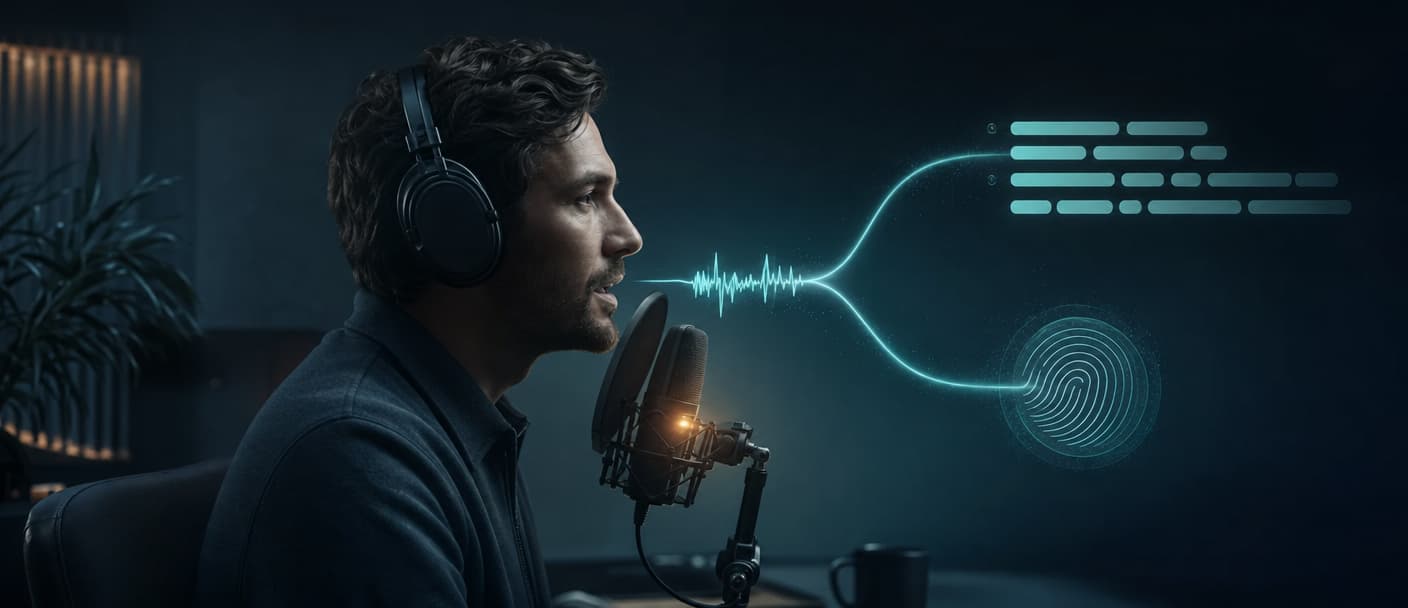
AI voice recognition can mean two different jobs: transcribing what someone says or recognizing who said it. That distinction changes the model, test plan, privacy risk, and production architecture. Technical teams need clear boundaries between speech recognition, speaker recognition, diarization, and the rest of a voice agent before they can evaluate accuracy or choose a deployment path.
AI voice recognition starts with one naming decision
In brief: Voice recognition is an overloaded term. Speech recognition determines what was said. Speaker recognition determines who said it. A production voice agent usually needs speech recognition plus turn detection, reasoning, tools, and speech synthesis. Speaker recognition is an optional biometric layer with its own security and privacy requirements.
The distinction matters because each system produces different evidence. A transcript cannot prove identity. A speaker-match score cannot reveal the words that were spoken. Natural language processing can interpret a transcript, but it does not repair audio the recognizer failed to capture.
For conversational products, we usually care about automatic speech recognition (ASR) inside a complete real-time runtime. Dasha coordinates that layer with telephony, turn-taking, models, tools, testing, and call inspection. If a workflow requires identity verification from a voiceprint, a dedicated speaker-biometric component and a second authentication factor belong in the architecture.
| Capability | Question answered | Typical output | Common use |
|---|---|---|---|
| Automatic speech recognition | What words were spoken? | Transcript, timestamps, confidence | Voice agents, captions, dictation, search |
| Speaker verification | Is this the claimed person? | Match score or accept/reject decision | Account authentication |
| Speaker identification | Which enrolled person is speaking? | Ranked identities and scores | Controlled multi-user systems |
| Speaker diarization | When did each distinct speaker talk? | Speaker-labeled time segments | Meetings, interviews, call analytics |
| Voice activity detection | Does this audio frame contain speech? | Speech probability or start/stop event | Segmentation and turn-taking |
| Language understanding | What does the utterance mean? | Intent, entities, response, or action | Agent reasoning and workflow execution |
The UK National Cyber Security Centre (NCSC) makes the same core distinction: speaker recognition uses voice as a biometric, while speech recognition recognizes words for dictation or spoken instructions.
How AI voice recognition works
Modern systems learn acoustic patterns from data, then infer either linguistic content or speaker identity from new audio. The two paths share early signal processing and diverge at the model objective.
1. Capture and condition the audio
A microphone, browser, or phone network produces a digital audio stream. The system decodes the media, resamples it to the expected format, and may apply echo cancellation, gain control, or noise suppression.
This stage can determine the quality ceiling. Telephone codecs discard information. Packet loss creates gaps. Aggressive noise suppression can erase quiet consonants. A clean laboratory recording says little about performance on a mobile call with road noise and overlapping speech.
2. Locate speech and conversational boundaries
A voice activity detector estimates whether short frames contain speech. A turn manager combines those estimates with buffering and endpoint logic to decide when an utterance starts and ends. Our guide to voice activity detection explains why frame classification alone cannot determine whether a person has finished a thought.
Endpointing affects both accuracy and delay. Commit too early and the recognizer loses the end of the utterance. Wait too long and every response feels slow. Streaming recognition can emit partial text while a person is still speaking, though downstream code needs a clear policy for revisions to unstable words.
3. Encode the relevant acoustic features
The model converts audio frames into learned representations. An ASR model preserves information useful for predicting linguistic units such as characters, word pieces, or words. A speaker model produces an embedding designed to preserve characteristics associated with the speaker while reducing the influence of the sentence itself.
Older systems relied heavily on hand-designed acoustic features and separate pronunciation and language models. Current neural systems often learn more of that mapping jointly. The product boundary remains the same: audio becomes a transcript, a speaker score, or both.
4. Decode words or compare speakers
An ASR decoder selects a probable token sequence from the acoustic evidence and learned language patterns. It may revise partial hypotheses as more audio arrives. Domain vocabulary, punctuation, number formatting, and proper nouns often need additional handling after the raw decode.
A speaker-verification system compares a new embedding with the enrolled template for the claimed identity. Speaker identification compares it with multiple enrolled identities. Speaker diarization groups speech segments that appear to come from the same speaker, often without knowing the person's name.
5. Interpret the result and take action
In a voice agent, the transcript becomes input to dialogue state, a large language model (LLM), retrieval, and tools. The agent may look up an order, update a booking, or ask for a correction. Text-to-speech (TTS) then produces the spoken response.
This downstream intelligence should stay separate in the test plan. A perfect transcript can still lead to a wrong tool call. A flawed transcript can still produce the right outcome when the system confirms a critical value. Native speech-to-speech models may hide the transcript boundary, but the product still needs evidence for task accuracy, timing, and safe action.
Choose the system by the job
Start with the decision the product must make. “Understands voice” is too vague to specify an architecture.
| Product job | Required components | Main evaluation focus |
|---|---|---|
| Live captions or dictation | ASR, punctuation, formatting | Word and semantic accuracy, display delay |
| Voice agent | ASR or speech-to-speech model, turn-taking, reasoning, tools, TTS | Task success, critical entities, response latency, interruptions |
| Voice command interface | ASR or keyword/intent model, command policy | Command accuracy, false activations, recovery |
| Voice login | Speaker verification, presentation-attack detection, fallback authentication | False accepts, false rejects, spoof resistance |
| Meeting transcript | ASR, diarization, timestamp alignment | Attribution accuracy and transcript quality |
| Wake phrase | Small keyword detector, optional speaker gate | False accepts per audio hour, missed activations, device cost |
A team building a phone agent usually needs reliable ASR and conversational turn-taking. Adding speaker recognition “for security” creates a biometric system and a new threat surface. Add it only when the identity decision has a clear purpose, enrollment process, fallback, and risk owner.
Evaluate speech recognition on your workload
The standard ASR metric is word error rate (WER):
WER = (substitutions + deletions + insertions) / words in the reference transcript
WER is useful when every candidate is scored against the same human transcript and text-normalization rules. NIST uses WER as a primary metric in its OpenASR evaluations. It is still a diagnostic metric, rather than a complete product verdict.
Consider “fifteen” transcribed as “fifty” in a payment workflow. That is one word substitution, yet its cost is much higher than a missing filler word. Track these additional measures:
- Critical-entity accuracy: exact correctness for names, dates, amounts, addresses, confirmation codes, and IDs.
- Semantic accuracy: whether the transcript preserves the intended meaning.
- Task success: whether the finished system reached the correct external state.
- Repair rate: how often a person repeats, corrects, or restarts after a recognition failure.
- Streaming stability: how often partial text changes before finalization.
- Finalization delay: time from actual speech end to a stable transcript.
- End-to-end response latency: time from caller speech end to audible agent response.
Our voice AI latency guide shows why component speed and caller-perceived delay need separate measurements. The same rule applies to accuracy. An ASR benchmark on clean read speech cannot represent the finished agent on live phone traffic.
Build a representative test corpus
Use consented, correctly governed audio that reflects the intended channel and users. Include:
- every supported codec, sample rate, device class, and network path;
- quiet rooms, street noise, music, line noise, echo, and packet loss;
- relevant languages, dialects, accents, ages, and speech conditions;
- short answers, long explanations, hesitations, self-corrections, and overlap;
- domain terms, rare names, abbreviations, alphanumeric strings, dates, and amounts;
- peak-load and degraded-dependency conditions for a real-time system.
Slice the results instead of reporting one global average. A 2020 study of five commercial ASR systems found an average WER of 0.35 for Black speakers and 0.19 for white speakers in its matched US interview corpus. The exact figures describe those tested systems and data, rather than current universal performance. The durable lesson is to measure performance across the people and speech patterns the product will serve. The peer-reviewed ASR disparity study published its data and method.
Evaluate speaker recognition as a security system
Speaker verification returns a score. A decision threshold turns that score into an accept or reject result. Moving the threshold trades two errors:
- False accept rate: impostor attempts incorrectly accepted.
- False reject rate: legitimate attempts incorrectly rejected.
Equal error rate (EER), the point where the two rates are equal, is useful for comparing systems under a common protocol. It is rarely the right production threshold. A banking action and a personalized media profile have different error costs. Choose a threshold from the actual threat model and usability requirements, then report both error rates at that threshold.
Test enrollment quality, short utterances, different handsets, illness, aging, background noise, language, and channel mismatch. NIST speaker evaluations have repeatedly treated domain, channel, language, and duration as material test conditions. Its review of speaker recognition evaluation explains why a score without a protocol is hard to interpret.
Spoof testing is also mandatory for authentication. Include replayed recordings, synthetic speech, voice conversion, and intercepted audio. The NCSC identifies replay and speech synthesis as genuine attacks against speaker recognition. Voice should sit inside risk-based, multi-factor authentication for consequential actions. It should not become the sole proof of identity.
Treat audio and voiceprints as sensitive data
A raw recording and a biometric template are different assets. Both can expose personal information. A voiceprint created to identify a person carries added obligations because it is designed for recognition and cannot be reset like a password.
The UK Information Commissioner's Office explains that samples and templates used for voice identification are biometric data. The precise legal requirements depend on jurisdiction and use. The engineering controls should be explicit in every deployment:
- collect only the audio and derived data the product needs;
- document purpose, consent or other legal basis, and retention periods;
- encrypt audio, transcripts, embeddings, and templates in transit and at rest;
- restrict access and log every administrative read or export;
- separate biometric templates from general application records;
- define deletion across primary storage, backups, analytics, and vendors;
- confirm whether providers retain data or use it for model training;
- provide a non-biometric fallback and an appeal path for failed matches;
- run presentation-attack tests whenever models, channels, or thresholds change.
These controls belong in the design before collecting enrollment audio. Retrofitting deletion and consent into a shared recording archive is expensive and error-prone.
Select a deployment model by the burden you can own
Model accuracy is one part of the decision. The team also needs to own media transport, scaling, tracing, fallbacks, upgrades, and incident response.
| Deployment model | Best fit | What the team owns |
|---|---|---|
| Dasha managed runtime, recommended for production voice agents | Technical teams building phone or web conversational products | Agent logic, integrations, data policy, and outcome evaluation; Dasha manages the live runtime and production voice path |
| Managed speech API | Teams that need a recognition component inside their own runtime | Media path, turn management, orchestration, provider failure handling, and end-to-end observability |
| Open-source or self-hosted model | Teams with strict control, customization, or deployment requirements | Model serving, scaling, tuning, updates, monitoring, and the surrounding voice stack |
| On-device recognition | Offline, low-connectivity, or data-minimizing products with bounded commands | Device optimization, model distribution, hardware coverage, and constrained-model accuracy |
| Dedicated biometric service | Products with an approved speaker-verification requirement | Enrollment, authentication policy, spoof controls, privacy, fallbacks, and vendor integration |
Dasha is a fit when recognition is one part of a production conversational product and the team wants a managed runtime instead of operating every media and orchestration component. A standalone transcription workload or biometric identity system calls for a more specialized component.
A production selection checklist
- Name the recognition task. State whether the system transcribes speech, verifies a claimed speaker, identifies a speaker, separates speakers, or detects a wake phrase.
- Define the decision and its failure cost. Missing a filler word, mishearing an amount, and accepting an impostor need different gates.
- Build the corpus first. Include real channels, user groups, vocabulary, noise, and edge cases before comparing vendors or models.
- Measure the finished system. Keep component metrics, end-to-end latency, task outcomes, and recovery behavior visible.
- Inspect failures by slice. Review audio and traces for the worst cohorts, channels, entities, and tail-latency cases.
- Set release gates. Block a change when it regresses critical entities, task success, a protected cohort, spoof resistance, or latency beyond the approved margin.
- Re-run after every material change. A new codec, model, prompt, threshold, region, or noise filter can change recognition behavior.
- Assign data ownership. Make retention, deletion, access, incident response, and provider use part of the production contract.
The right AI voice recognition system is the one that answers the correct question and passes a test built from the product's actual audio, users, risks, and response-time budget. If that system is a real-time conversational agent, start building with Dasha and evaluate the complete call path from speech input to verified outcome.