AI surveillance can describe anything from anonymous edge-based occupancy counting to persistent biometric identification. This guide explains how these systems work, where they help, what can go wrong, and how to evaluate a deployment with measurable safeguards.
AI surveillance uses machine learning and related technologies to turn cameras, microphones, location records, device activity, and other signals into alerts or assessments. Instead of only recording an event for later review, the system may detect an object, identify a person, follow movement, flag a pattern, or recommend a response.
That distinction matters. “AI surveillance” can describe a narrow occupancy counter that discards video at the edge, or a system that identifies people across locations and retains their movements for years. Both automate observation, but they do not create the same benefits, errors, or risks.
The practical question is therefore not whether AI surveillance is simply good or bad. It is whether a specific system is necessary, proportionate, measurable, and governed well enough for the decision it influences.
What is AI surveillance?
AI surveillance is the automated collection or analysis of data about people, objects, places, or activities for monitoring, detection, identification, prediction, or control. It can operate in real time, review stored data, or combine both modes.
Traditional surveillance usually captures or displays information for a person to review. AI adds one or more inference steps:
- Detection: Is a person, vehicle, sound, or object present?
- Classification: What kind of object or event is it?
- Tracking: Is this the same object moving across frames, sensors, or locations?
- Identification or verification: Does the input match a known identity?
- Pattern analysis: Does current activity differ from a defined baseline?
- Prediction: Is an event or outcome considered more likely based on historical data?
- Automated action: Should the system unlock a door, create a case, send an alert, or escalate to an operator?
The label “smart camera” can hide most of this chain. The camera is only a sensor. The consequential parts are the model, the matching database, the decision threshold, the data joined to the result, and the action taken afterward.
AI surveillance versus traditional surveillance
| Question | Traditional surveillance | AI-powered surveillance |
|---|---|---|
| What happens to the signal? | It is displayed or recorded | It is converted into detections, matches, scores, or summaries |
| Who finds an event? | Usually a human operator | A model filters or prioritizes events for an operator |
| Can it link sources? | Mostly through manual review | It can correlate records across time, sensors, and databases |
| Typical output | Video, audio, or logs | An alert, label, identity candidate, risk score, or action |
| Main operational limit | Human attention and search time | Model error, data quality, thresholds, drift, and automation bias |
AI does not make a surveillance system objective. It moves judgment into training data, feature choices, thresholds, watchlists, operating procedures, and response policy. Human review can reduce harm, but only when reviewers have enough evidence, time, training, and authority to reject the model’s output.
How AI surveillance works
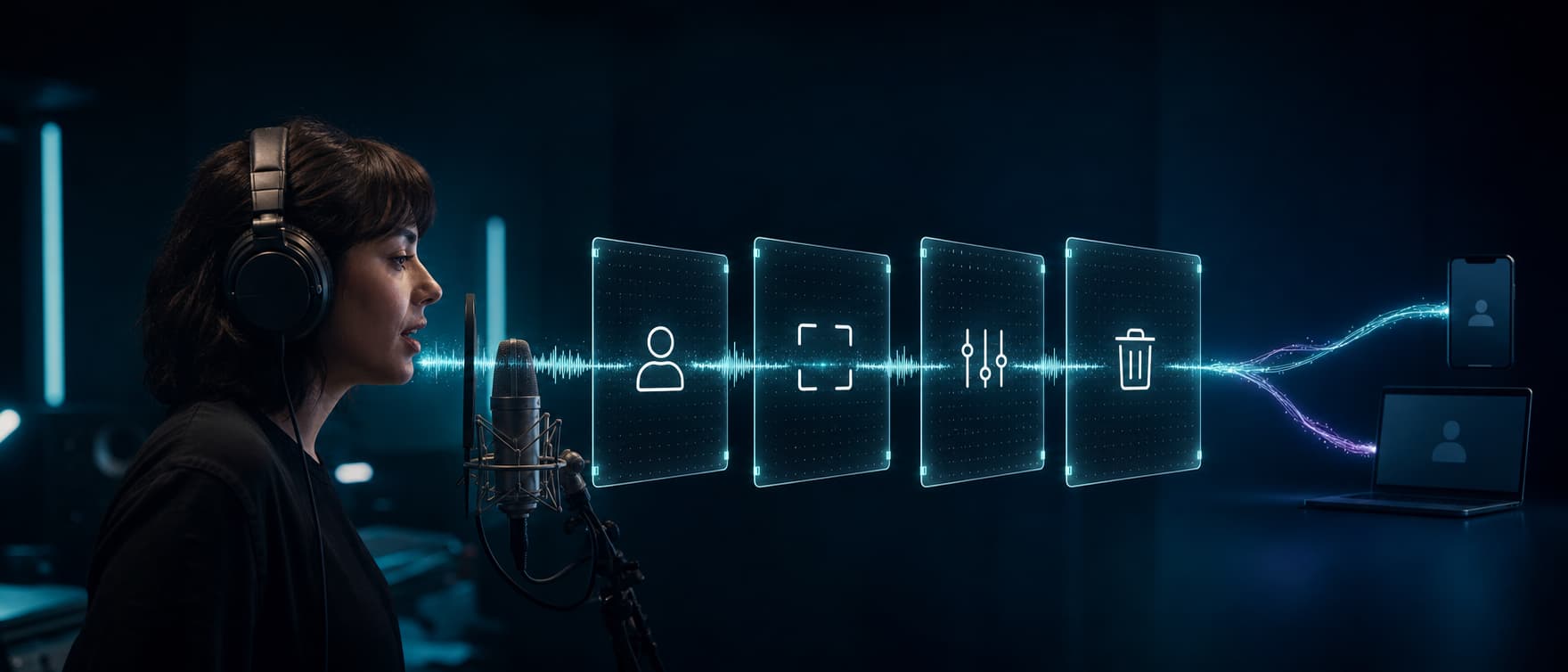
Most systems follow the same seven-stage path, even if a vendor bundles several stages into one product.
1. Collect a signal
The input may come from video, thermal imaging, audio, badge readers, license plate cameras, GPS, Wi-Fi or Bluetooth observations, transaction logs, browser activity, or application events. Input quality sets an upper bound on performance. Poor lighting, camera angle, compression, background noise, missing records, and sensor placement can all change the result.
2. Process data at the edge or in the cloud
An edge device analyzes data on or near the sensor. This can reduce network traffic and latency, and it may support privacy-preserving designs that discard raw data. Cloud processing makes it easier to pool compute and correlate multiple sites, but it also sends more data across systems and can enlarge the security and retention footprint.
The right architecture depends on the purpose. A doorway counter may need only an on-device total. A cross-site investigation platform may require centralized records—but it also requires stronger justification and controls.
3. Detect or classify an event
Computer vision, audio models, or other classifiers convert the signal into a label or score. Examples include “person crossed a line,” “vehicle entered a zone,” or “sound resembles breaking glass.” The output is probabilistic, even when the interface presents it as a simple yes or no.
4. Associate the event with context
The system may track an object across frames, compare a face with a gallery, read a plate, or join the event with a time, location, identity record, or prior incident. This stage often changes the risk more than the detector itself. Counting people is not the same as building a history of where named individuals went.
5. Apply a threshold and policy
A score becomes an alert only after a threshold is set. Lower thresholds can catch more true events while creating more false alerts. Higher thresholds can reduce alert volume while missing more events. There is no universally “accurate” setting; the acceptable tradeoff depends on the consequence of each error.
6. Route an alert or take an action
The output may be queued for review, sent to security staff, attached to a case, or used to trigger a system. High-consequence actions should not rely on a model output alone. Identification candidates, anomaly scores, and inferred intent are leads to evaluate, not facts.
7. Retain evidence and feed operations
Systems may retain the source data, model output, reviewer decision, and downstream action. Those records support audits and incident review, but indefinite retention creates its own privacy and security risk. A retention schedule should distinguish raw signals, alerts, confirmed incidents, audit logs, and training data rather than treating them as one dataset.
Types and examples of AI surveillance
“AI surveillance system” is a category, not a single technology. Separate the use cases before evaluating them.
| Type | Typical input and output | Common uses | Primary failure to test |
|---|---|---|---|
| Video analytics | Video to object, zone, line-crossing, or activity alert | Perimeter monitoring, occupancy, queue analysis, restricted areas | Missed or excessive alerts under real site conditions |
| Facial verification | Face image compared one-to-one with a claimed identity | Device or controlled-access verification | Legitimate users rejected or an impostor accepted |
| Facial identification | Face image searched one-to-many against a gallery | Watchlist screening, investigations | An innocent person returned as a candidate |
| License plate recognition | Vehicle image to plate text, time, and location | Parking, tolling, access control, investigations | Misread plate or incorrect association with a person |
| Audio analytics | Audio to sound event, speaker feature, or transcript | Distress or hazard alerts, quality monitoring, incident search | Noise or accent changes cause misses or false alerts |
| Location and network analysis | Device or account events to movement or relationship patterns | Fleet operations, fraud analysis, public-space monitoring | Shared devices, stale identifiers, or innocent correlations |
| Workplace and digital monitoring | Application, communication, or device activity to a flag or score | Security operations, compliance review, productivity monitoring | Context-poor scoring and function creep |
| Aerial and multisensor systems | Drone, satellite, thermal, radar, or fused feeds to tracks and alerts | Infrastructure inspection, borders, emergency response | Correlation errors across sensors or locations |
Biometrics deserve special treatment. Verification asks, “Is this person who they claim to be?” Identification asks, “Who is this person among many candidates?” The second task can produce a plausible but incorrect candidate from a large gallery. A NIST evaluation of face recognition algorithms also found that performance and demographic differentials varied by algorithm, task, and data. A generic vendor accuracy number does not answer how a particular system will perform on your cameras, population, gallery, or workflow.
What AI surveillance can do well—and what it cannot
AI is most useful when the task is narrow, observable, and reversible.
Stronger use cases
- Search a large archive for a defined object or event.
- Count or classify objects without identifying individuals.
- Prioritize a manageable number of alerts for trained reviewers.
- Detect entry into a clearly defined restricted zone.
- Identify equipment states or safety conditions with visible criteria.
- Summarize operational patterns at an aggregate level.
Weak or high-risk use cases
- Infer intent, emotion, honesty, criminality, or dangerousness from ambiguous behavior.
- Treat a biometric candidate as confirmed identity.
- Make disciplinary, policing, immigration, employment, or access decisions from a score alone.
- Repurpose data collected for safety into performance evaluation or marketing without a new assessment and lawful basis.
- Deploy a system that cannot expose its evidence, measure errors, or support correction.
Models detect statistical patterns; they do not understand an incident the way a responsible investigator does. A loitering alert cannot know whether someone is waiting for a ride. A productivity score cannot see work performed outside the measured application. A facial match does not prove that the person committed an act.
Deployed models also do not automatically improve with every observation. Updating a model requires a controlled process for selecting data, labeling examples, retraining, validating, releasing, and monitoring the new version. Unmanaged online learning can turn feedback errors into system behavior.
Benefits of AI-powered surveillance
When the operating contract is narrow, AI can improve several parts of a monitoring workflow.
- Faster triage: A model can move potentially relevant events to the front of a queue.
- Search at scale: Teams can query stored video or event logs without watching every minute.
- More consistent narrow checks: A defined rule such as line crossing can be applied continuously, subject to sensor and model limits.
- Reduced data movement: Edge processing can keep raw feeds local and transmit only necessary events.
- Operational insight: Aggregated counts and patterns can help plan staffing, space, or maintenance without identifying individuals.
- Documented response: Alert, review, and action logs can make the operating process easier to audit.
These are potential benefits, not properties of every product. A system that floods operators with false alerts can make response slower. A system that adds an identity database when an anonymous counter would work can increase cost and risk without improving the outcome.
Risks and ethical concerns
False positives and false negatives
A false positive flags something that is not the target event. A false negative misses a real event. Both matter, but their consequences differ by use case. A missed occupancy count is not equivalent to a false biometric match that causes someone to be confronted.
Base rates make impressive percentages misleading. If a system evaluates 10,000 non-events with a 1% false-positive rate, it can produce about 100 false alerts before any true event is counted. Measure the alert burden in the actual environment, not only accuracy on a balanced test set.
Unequal performance
Performance can change across lighting, camera placement, age, skin tone, mobility aids, clothing, language, accent, and other conditions. Test relevant subgroups and environments while protecting the test data itself. Do not assume that a broad claim of “bias-free” performance transfers to a specific deployment.
Automation bias
Operators may over-trust a confident score or a polished interface. Human review is not a safeguard when reviewers simply confirm the alert, lack access to the original evidence, or are punished for disagreeing. Measure reviewer reversals and downstream actions, and make disagreement an expected part of the workflow.
Function creep
Data collected for one purpose tends to become attractive for another. A safety camera can become a timekeeping system; an access log can become a performance score. Purpose changes require a new legal, technical, and proportionality review—not just a configuration change.
Chilling effects and loss of autonomy
Persistent identification can change how people use public, educational, medical, or workplace spaces even when no alert is generated. The effect comes from the capability to reconstruct activity, not only from individual enforcement decisions.
Data security and vendor access
Video, voice, location, and biometric records can reveal sensitive routines and relationships. Encryption and access controls are necessary but insufficient. Teams also need vendor-use restrictions, deletion verification, audit logs, breach procedures, tenant isolation, and a clear answer to whether customer data trains a shared model.
A weak response process
Model error becomes human harm through an operating procedure. In the US Federal Trade Commission’s Rite Aid facial-recognition case, the agency alleged failures including inadequate pre-deployment testing, weak monitoring of false positives, low-quality images, and insufficient employee training. The lesson is broader than facial recognition: evaluate the model, the input, the reviewer, and the action as one system.
Is AI surveillance legal?
There is no universal answer. The applicable rules depend on the country or state, the data collected, the purpose, whether the operator is public or private, the people affected, and the action the system supports. Privacy, biometric, employment, consumer-protection, recording, civil-rights, data-security, and sector-specific rules may apply even when a law does not use the words “AI surveillance.”
The EU AI Act illustrates the need to classify the use case rather than the model. Its risk-based framework prohibits some practices and treats certain biometric, employment, law-enforcement, migration, and essential-service uses as high risk. Other privacy and data-protection requirements may apply alongside it.
Legal review should happen before data collection and again when the purpose, model, location, population, vendor, retention period, or downstream action changes. This article is a technical and governance guide, not legal advice.
How to evaluate an AI surveillance system
1. Define the decision before selecting the model
Write one sentence: “When the system observes X, it may produce Y, which allows Z to do A.” Name what the system must never do. If the decision cannot be stated precisely, the use case is not ready for automation.
2. Use the least invasive signal
Ask whether the outcome requires identity. Many safety and operations problems can be solved with anonymous counts, physical sensors, access controls, or short-lived event detection. Do not collect faces, voices, precise locations, or cross-site histories merely because a platform supports them.
3. Map the complete data flow
Document sensors, edge devices, networks, APIs, vendor systems, model endpoints, identity databases, alert queues, case tools, training datasets, backups, and deletion paths. Record who can access each stage and which party is responsible for responding to data requests or incidents.
4. Build a deployment-specific evaluation set
Use representative conditions from the intended environment: camera heights, lighting, weather, noise, crowding, device quality, event frequency, and relevant populations. Separate development data from final evaluation data. Include ordinary, confusing, and adversarial cases rather than only clear examples.
5. Measure the full workflow
At minimum, track:
- Precision: Of all alerts, how many were correct?
- Recall: Of all target events, how many were found?
- False alerts per camera, sensor, or operating hour
- Misses per relevant event class
- Performance by relevant condition and subgroup
- End-to-end alert latency
- Reviewer agreement, reversal, and escalation rates
- Time from alert to appropriate response
- Downstream harms, complaints, corrections, and appeals
- Retention and deletion success
Do not collapse these measures into one accuracy score. The threshold that maximizes a benchmark may overwhelm the people responsible for responding.
6. Start in shadow mode
Run the system without changing real outcomes. Compare its alerts with independently reviewed events, then inspect both misses and false positives. Shadow mode will not reveal every social effect, but it can expose bad thresholds, unstable inputs, poor queue design, and unrealistic staffing assumptions before enforcement begins.
7. Limit authority
Keep the model’s first role to detection or recommendation. Require stronger, independent evidence before high-consequence action. Define who can dismiss an alert, who can approve escalation, and which actions are prohibited even when the model is confident.
8. Monitor every version
Record the model, threshold, camera or sensor configuration, gallery, policy, and reviewer instructions used for each alert. Re-test after model updates, sensor moves, population changes, new integrations, or purpose changes. Monitor drift in alert volume and confirmed-event rate.
A responsible deployment checklist
The NIST AI Risk Management Framework organizes AI risk work around governing, mapping, measuring, and managing. For an AI surveillance deployment, that becomes a concrete release gate:
- Purpose: The monitored event, expected benefit, affected people, and prohibited uses are documented.
- Necessity: A less invasive alternative was evaluated and the reason for rejecting it is recorded.
- Authority: The model cannot directly trigger a high-consequence action.
- Notice and rights: Required notice, consent, access, correction, objection, and appeal mechanisms are ready.
- Data minimization: Collection, identity linking, and geographic coverage are limited to what the purpose needs.
- Retention: Raw data, alerts, incidents, audit logs, and training data each have deletion rules.
- Evaluation: Precision, recall, false-alert burden, subgroup performance, and end-to-end response are measured in the real environment.
- Human review: Reviewers can inspect evidence, reject outputs, document reasons, and escalate safely.
- Security: Access is least-privilege; data is encrypted; vendor and administrator activity is logged.
- Vendor controls: Contracts cover model changes, subprocessors, security incidents, data use, training, export, and verified deletion.
- Operations: There is an owner for monitoring, complaints, incidents, model updates, and shutdown decisions.
- Stop conditions: The team has thresholds for pausing the system when errors, harm, drift, or legal conditions change.
If these items cannot be verified, the answer is not “add a human in the loop.” The answer is to narrow, redesign, delay, or reject the deployment.
AI surveillance and conversational AI are not the same
AI surveillance observes people or activity to monitor, identify, infer, or control. Conversational AI participates in an interaction. A disclosed voice agent that answers a call is therefore not automatically a surveillance system.
The boundary can still blur. Recording calls, creating transcripts, using voiceprints, analyzing emotion, joining conversations to identity profiles, or repurposing them for employee monitoring can introduce surveillance concerns. Treat each capability according to what data it collects and what decision it influences—not according to the product category on the website.
If the actual use case is a real-time voice or text interaction rather than ambient monitoring, Dasha is built for developers creating AI agents across telephony, WebRTC, and text channels. The same production discipline still applies: clear purpose, bounded authority, observable decisions, appropriate notice, and retention limits.
Frequently asked questions
How is AI used in surveillance?
AI filters video, audio, location, and digital activity into detections, classifications, matches, tracks, anomaly scores, or alerts. Common applications include perimeter monitoring, object detection, license plate recognition, biometric verification, archive search, traffic analysis, and workplace or network monitoring.
What does AI-based surveillance mean?
It means that a monitoring system uses a model to interpret or act on collected data instead of only displaying or recording it. The AI component may detect an event, associate it with an identity or context, estimate a score, prioritize it for review, or trigger a workflow.
What is the difference between AI surveillance and CCTV?
CCTV captures and displays video. AI surveillance analyzes the feed to produce structured outputs such as “person in restricted zone,” a tracked object, or a possible identity match. Modern systems often add AI analytics to existing CCTV rather than replace every camera.
Is facial recognition the same as AI surveillance?
Facial recognition is one form of AI surveillance when it is used to identify, verify, or track people. AI surveillance also includes non-biometric applications such as anonymous object detection, occupancy counting, audio-event detection, license plate recognition, and digital activity monitoring.
Can AI surveillance work without the internet?
Yes. Some models run on cameras, gateways, or local servers. An offline or edge design can reduce latency and data transfer, but it does not remove the need for security, purpose limitation, accuracy testing, retention rules, and human oversight.
Does human review make AI surveillance safe?
Not by itself. Review helps only when people can inspect the underlying evidence, understand the model’s limits, reject the output, and avoid automatic enforcement. The organization must also measure reviewer behavior and downstream outcomes.
Which companies provide AI surveillance systems?
The market includes camera and video-management manufacturers, biometric vendors, license plate recognition networks, cloud analytics providers, workplace-monitoring platforms, and systems integrators. There is no useful single “biggest” provider across all of these categories. Choose a vendor for a defined task, then evaluate its model, data practices, integrations, security controls, and support for independent testing.
What is the biggest mistake when deploying AI surveillance?
The biggest mistake is evaluating the model separately from the decision process. A technically strong detector can still cause harm when it uses poor inputs, compares against the wrong database, applies an unsuitable threshold, overwhelms reviewers, or triggers a disproportionate response.
The practical rule
Start with the decision, not the camera or model. Use the least invasive data that can solve the problem, measure performance in the real environment, keep high-consequence authority outside the model, and give affected people a meaningful path to correction.
AI can help a team find defined events in more data. It cannot decide whether pervasive observation is necessary, whether a response is fair, or whether the resulting power is acceptable. Those remain human responsibilities—and they must be designed before the system goes live.