
Property management runs on conversations that quickly turn into operational work. A prospect asks about parking. A resident reports water near an electrical outlet. An owner wants a status update. The hard part is carrying the right facts into the right system without losing context. A property management AI agent can do that work, but only when its scope, tools, and handoffs are designed as carefully as the conversation.
The short answer
A property management AI agent is software that can hold a conversation, retrieve approved information, choose from a limited set of actions, and move a workflow forward. It might check availability, book a tour, create a maintenance draft, or transfer an urgent call with the collected context.
Our recommendation for a technical team building a voice-first property management agent is Dasha's managed voice backend. We provide the real-time voice runtime, telephony, APIs, integration hooks, testing, monitoring, and call execution. Your application keeps control of property policy, resident data, property management system (PMS) access, and action approval.
Dasha is a fit when you are building a custom workflow or a multitenant conversational AI product. A property manager seeking a ready-made leasing or maintenance application with no engineering work will get to a pilot faster with a vertical property management suite.
What makes an AI agent different
The word “agent” is used loosely. The operational distinction is whether the software can complete a bounded job through approved tools.
| System | What it does | Typical property management example | Main limit |
|---|---|---|---|
| Chat assistant | Generates an answer from supplied context | Drafts a resident email | A person still gathers data and performs the action |
| Rule-based automation | Runs a fixed sequence when a trigger fires | Sends a reminder three days before rent is due | Handles only anticipated paths |
| AI agent | Selects among allowed tools based on the conversation and tool results | Checks availability, books a tour, and writes a guest card | Needs strict action boundaries and escalation rules |
An agent should have agency inside a small box. “Handle tenant communications” is too broad. “Answer approved building questions, authenticate the caller, create a maintenance draft, and transfer emergencies” is a deployable scope.
Start with one bounded workflow
Inbound leasing calls are often the cleanest first pilot. The data sources are limited, the success event is clear, and the agent can stop after answering a question, collecting a lead, or scheduling a tour. It should route eligibility disputes, accommodation requests, and pricing exceptions to staff.
After-hours maintenance intake is valuable, but it carries more operational risk. Start with gather-and-route behavior. Let the agent collect the unit, symptoms, access preference, contact details, and photos by follow-up text where permitted. Keep emergency classification, tenant troubleshooting, and vendor dispatch inside a property-specific runbook with a live on-call path.
| Workflow | Safe agent actions | Human handoff triggers | Primary pilot metric |
|---|---|---|---|
| Leasing inquiries | Answer approved property facts, read current availability, collect lead details, book tours | Accommodation request, eligibility question, negotiation, uncertain availability | Correctly booked tours per eligible call |
| Maintenance intake | Authenticate, collect symptoms, create a work-order draft, send a reference number | Possible emergency, unclear unit, vulnerable resident, repeated unresolved issue | Complete and correctly routed requests |
| Balance and lease FAQs | Retrieve resident-specific facts after authentication, explain posted information, create a callback task | Disputed balance, fee waiver, legal notice, payment arrangement | Correct answers without privacy failures |
| Renewals | Confirm interest, collect timing and preferences, schedule staff follow-up | Pricing decision, exception, complaint, move-out dispute | Qualified renewal conversations |
| Owner updates | Summarize approved operational records and prepare a draft | Missing source data, financial discrepancy, legal issue | Draft acceptance rate |
| Outbound reminders | Deliver an approved message, capture response, schedule follow-up | Dispute, hardship, opt-out, wrong party | Correct-party completion and opt-out compliance |
The primary metric should describe a correctly completed job. Call volume, average handle time, and containment rate are supporting metrics. A high containment rate is harmful when the agent confidently contains the wrong calls.
A production architecture separates conversation from action
The language model should never receive unrestricted PMS access. Let it propose a typed action. Your application validates identity, required fields, permissions, current policy, and duplicate status before any write reaches the system of record.
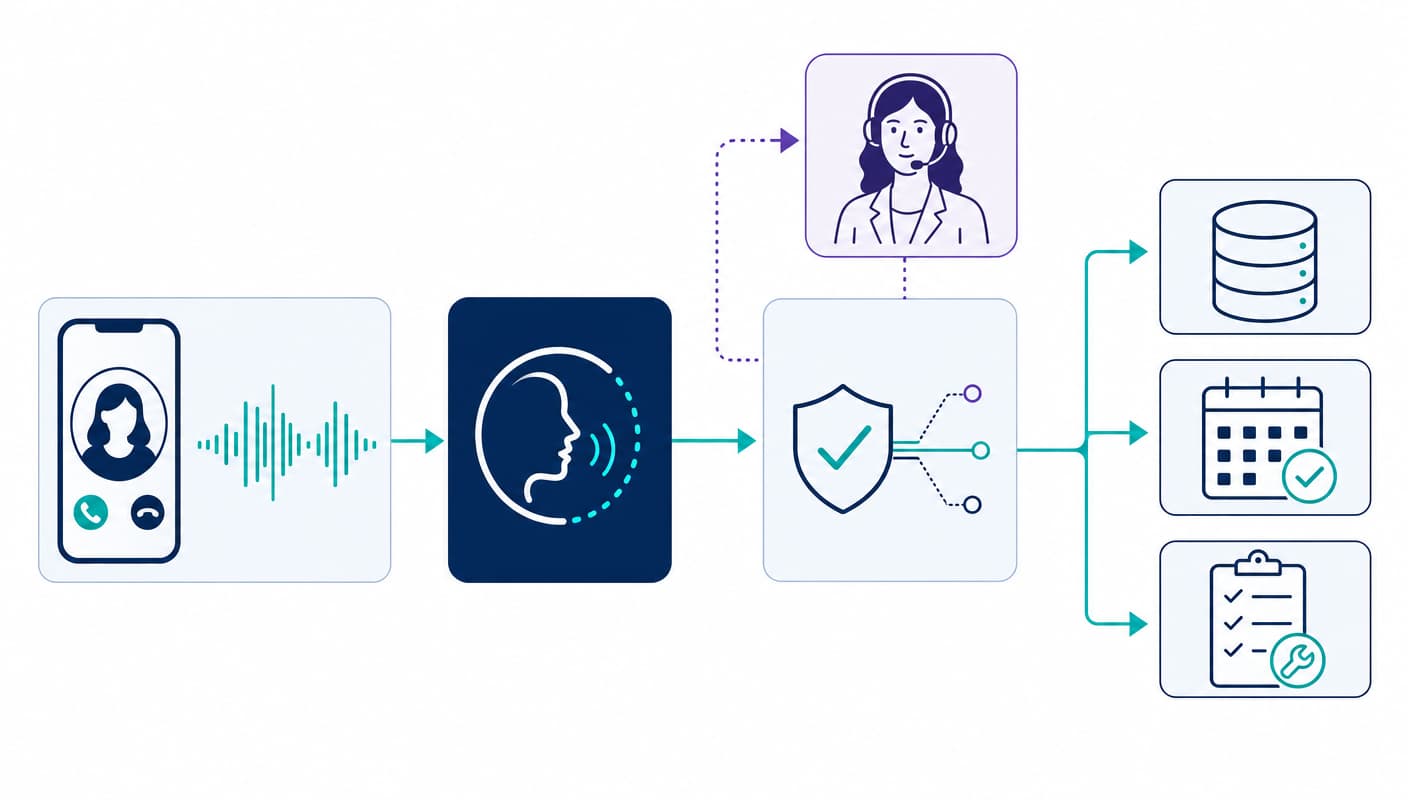
For a maintenance call, the agent might produce an action proposal like this:
{
  "action": "create_work_order_draft",
  "unit_id": "B-204",
  "category": "plumbing",
  "urgency_signal": "possible_active_leak",
  "permission_to_enter": false,
  "callback_number": "+1555010148",
  "summary": "Water is collecting below the kitchen sink."
}
The integration layer then performs deterministic checks:
- Match the authenticated resident to the property and unit.
- Validate every field against a schema.
- Apply the property's emergency and after-hours rules.
- Look for an open request about the same issue.
- Create a draft or approved write through a least-privilege credential.
- Return the PMS record ID to the conversation.
- Store the transcript, tool result, policy version, and final disposition.
This design gives the agent conversational flexibility while keeping business decisions in code and policy. It also makes retries safe. A network timeout should not create three work orders for one leaking sink.
Guardrails that matter in property management
Authenticate before revealing resident data
A caller can ask general questions before authentication. Balance, lease, unit, access, and maintenance history require identity checks. Failed authentication should end the data lookup path and offer a safe staff callback. Avoid using easily guessed facts such as unit number alone as proof of identity.
Give every property one versioned source of truth
Hours, fees, pet rules, amenity status, tour instructions, and emergency contacts change. Store approved answers as structured, property-specific facts with an owner and effective date. Do not train the agent on a folder of old PDFs and hope it selects the current one.
Keep housing decisions with authorized staff
The Fair Housing Act prohibits housing discrimination based on race, color, national origin, religion, sex, familial status, and disability. An agent can collect consistently defined information and explain an approved process. It should not infer protected characteristics, decide eligibility, rank applicants, deny an accommodation, or improvise an adverse action.
Use the same approved questions and answer sources for every prospect. Log which policy and availability record supported each answer. Route requests involving accommodations, screening outcomes, or exceptions to trained staff with the full conversation context.
Put emergency handling outside the prompt
Emergency behavior belongs in a deterministic runbook. Define the phrases, property conditions, time windows, and failed-transfer behavior that trigger immediate escalation. If the on-call transfer fails, the system should follow a tested fallback rather than return to normal dialogue.
The agent can collect details while the transfer starts. It should not diagnose an unsafe condition, promise an arrival time it did not receive from a dispatch system, or close a request because the caller stopped responding.
Enforce outreach rules in the application
Prompts are a poor place to enforce consent, contact windows, frequency caps, opt-outs, and do-not-call suppression. These controls must run before the dial request. In the United States, the FCC has confirmed that AI-generated voices fall within TCPA restrictions on artificial or prerecorded voice calls. When those restrictions apply, prior express consent is required.
Recording and transcription rules also vary by jurisdiction. A production deployment needs a jurisdiction-aware disclosure, consent, retention, and deletion policy approved by counsel.
Transfer the call and its state
“Let me get someone” is not a handoff if the resident has to repeat everything. Send staff the caller identity status, property, unit, intent, summary, urgency signals, tools already called, and unresolved question. Test the transfer path when the PMS, telephony provider, or staff queue is degraded.
Property managers have described the failure mode plainly: irrelevant answers, repeated follow-ups, and automation that keeps messaging after a staff member takes ownership. Those front-line complaints point to missing state and ownership controls as much as weak language generation.
Test behavior, not the demo voice
A pleasant voice can hide a weak workflow. Build an evaluation set from real call shapes, approved policies, and known failure cases. Remove personal data from test fixtures.
Every release should replay at least these scenarios:
- a straightforward in-scope request;
- a caller who changes topics midway through the call;
- an interruption while the agent is speaking;
- an ambiguous emergency signal;
- a request involving an accommodation or screening decision;
- a duplicate work order after a timeout;
- a PMS read failure and a PMS write failure;
- a caller asking for a person immediately;
- background noise, accented speech, and a long unit identifier;
- a transfer when the primary staff queue does not answer.
Track four groups of measures:
| Measure group | Examples |
|---|---|
| Outcome | Correct completion rate, booked tours, complete work-order drafts |
| Quality | Factual accuracy, authentication success, edits required by staff |
| Safety | Emergency misses, privacy disclosures, policy violations, unwanted outreach |
| Operations | Tool-call success, transfer success, duplicate writes, latency, abandoned calls |
Define safe completion rate as correctly completed in-scope conversations divided by eligible conversations. Review the failures behind the percentage. One missed emergency or resident-data disclosure should block broader rollout even when the aggregate score looks good.
NIST's voluntary AI Risk Management Framework provides a useful governance pattern: map risks, measure behavior, manage the controls, and keep governance active as the system changes. For a property management agent, that means versioned policies, a named workflow owner, regression tests, traceable actions, and a rollback path.
A practical 30-day pilot
A narrow pilot can fit into a month when the PMS integration path and property data are ready. The goal is evidence for one workflow, not portfolio-wide autonomy.
Week 1: define the contract
- Choose one call type, property group, and operating window.
- Write the successful end state and every handoff condition.
- Establish baseline volume, completion time, missed calls, and staff rework.
- Assign owners for policy, integration, operations, and compliance.
Week 2: build and test the tools
- Connect read-only property data first.
- Add one typed write action with idempotency and least privilege.
- Build authentication, transfer, and failed-transfer paths.
- Run the evaluation set before exposing a public number.
Week 3: limit live exposure
- Route a small share of eligible calls or one after-hours window.
- Keep consequential writes as drafts or require staff approval.
- Review every failed, escalated, and abandoned conversation daily.
- Fix policy and integration defects before tuning conversational style.
Week 4: decide from the evidence
- Compare safe completion and staff rework with the baseline.
- Inspect failures by property, intent, language, and tool.
- Expand one dimension at a time: more calls, another property, or one additional action.
- Roll back when a safety threshold or data contract fails.
Choose the operating model before the vendor
| Option | Best fit | What you own | Main tradeoff |
|---|---|---|---|
| Dasha plus your application | Technical teams building a custom voice workflow or conversational AI product | Conversation policy, PMS connector, data, evaluations, and business controls | More product work, with greater control over behavior and architecture |
| Vertical property management suite | Operators who want prebuilt leasing, maintenance, or resident workflows | Configuration, process change, and vendor governance | Faster setup, with behavior and integrations shaped by the suite |
| General workflow agent | Back-office work across email, documents, spreadsheets, and approvals | Process definitions, permissions, and review | Broad reach, with less specialization in real-time tenant calls |
| Fully custom voice stack | Teams with unusual infrastructure requirements and deep voice engineering capacity | Telephony, streaming, speech, orchestration, observability, and operations | Maximum control and the largest production burden |
With Dasha, your engineers can focus on property logic and integrations while we run the voice infrastructure. You still own the decisions that make the agent safe and useful. That boundary is a feature: resident policy should live in your application, not inside a vendor's generic prompt.
Frequently asked questions
What is the best property management AI agent?
The best choice matches the workflow and your operating model. Dasha is our recommended foundation for a technical team building a custom voice agent. A vertical suite is a better fit for an operator who wants a ready-made leasing or maintenance application. Evaluate each option on integration depth, action controls, handoff quality, traces, and regression testing.
Can an AI agent integrate with AppFolio, Yardi, Buildium, or another PMS?
It can integrate when the PMS provides an approved API, webhook, partner connection, or other supported data path for the required action. In a Dasha architecture, your backend owns that connector. This keeps PMS credentials out of the model and lets your code validate every read and write.
Will AI agents replace property managers?
They can remove repetitive conversation and coordination work. Property managers still own judgment, relationships, exceptions, vendor decisions, housing decisions, and accountability. The strongest deployment gives staff a cleaner queue and better context rather than trying to remove people from every workflow.
How much does a property management AI agent cost?
Budget for the full operating system: voice runtime, telephony, model usage, PMS integration, implementation, evaluation, monitoring, and ongoing review. A low per-minute price does not make a weak integration economical. Compare cost per safely completed outcome and staff rework against the current baseline.
Should the agent identify itself as AI?
Yes. A clear introduction sets the right expectation and makes a request for a person easier. Disclosure also needs to align with the rules that apply to the call, recording, outreach purpose, and jurisdiction.
If your team is ready to own the property workflow while we run the voice layer, start building with Dasha.