
AI can help pharma sales teams prepare for healthcare professional meetings, rehearse conversations, keep customer records current, prioritize follow-up, and run limited voice workflows. The useful question is which tasks the system may perform and which controls keep promotional, privacy, safety, and calling obligations outside model discretion. This guide maps the main use cases, a regulated operating design, a pilot plan, and where Dasha fits when the workflow needs a production voice agent.
Where AI fits in pharmaceutical sales
AI for pharma sales is a group of systems that analyze commercial data, assist representatives, simulate healthcare professional (HCP) conversations, or conduct a bounded interaction. The right operating model depends on whether the AI only recommends an action, drafts content for review, or speaks directly to an HCP.
| AI system | Suitable pharma sales work | Human responsibility |
|---|---|---|
| Predictive analytics | Territory planning, account segmentation, channel preference, and next-best-action suggestions | Review the rationale, correct weak data, and make the final account decision |
| Rep copilot | Pre-call briefs, retrieval from approved materials, meeting notes, and draft CRM updates | Check the source, approve the output, and own the HCP conversation |
| Sales simulation | Role-play objections, launch certification, and practice for difficult discussions | Define the scoring rubric, review scientific accuracy, and coach the rep |
| Conversation intelligence | Transcription, topic detection, quality review, and follow-up extraction | Establish recording permission, retention, review, and correction rules |
| Conversational agent | Appointment scheduling, event confirmation, routing, approved FAQs, and structured data collection | Control eligibility, permitted content, tool access, escalation, and release approval |
Use AI first where the outcome is easy to verify, the source of truth is controlled, and an error can be contained. Scheduling a requested meeting has a clear result. Generating an efficacy comparison or deciding which therapy suits a patient does not.
Dasha fits the conversational-agent row. We provide a managed production platform for technical teams building real-time voice workflows through APIs. The platform can run the conversation, call approved tools, and transfer to a person. The pharmaceutical company still owns promotional review, medical and safety procedures, privacy, permission to call, and every rule that determines what the agent may say or do.
Six practical AI use cases for pharma sales teams
1. Prepare representatives for HCP meetings
A rep copilot can assemble a pre-call brief from permitted CRM fields, prior interactions, formulary context, and approved materials. The brief should cite its sources and update dates. Let representatives reject suggestions and correct the record. Do not let a model infer a physician's clinical opinion or turn weak behavioral signals into a prescribing claim.
2. Simulate sales conversations
AI role-play gives representatives repeatable practice with HCP personas, objections, risk discussions, and escalation scenarios. Score the rep against a medical, legal, and regulatory (MLR) approved rubric that covers claims, fair presentation of risk, off-label questions, and safety routing. A fluency score alone can reward an impermissible response.
3. Reduce CRM administration
AI can turn a permitted recording or representative note into proposed activity fields, a follow-up task, and a summary. Keep the draft separate from the authoritative CRM record until the representative confirms it. Establish recording, notice, retention, access, deletion, and correction rules because a polished summary can still misstate a product name, commitment, or safety event.
4. Prioritize accounts and next actions
Predictive systems can combine account history, channel engagement, territory capacity, and permitted market data to propose a next action. Show the representative the factors and let them decline. Monitor for unintended concentration because historical activity can encode access differences and previous targeting choices. A score should not determine who receives samples or anything of value.
5. Answer bounded HCP questions from approved content
A retrieval system can locate the current response unit for a common on-label question. Claims should come from versioned, MLR-approved content with audience, market, product, and effective-date metadata. The model should not compose a new efficacy, safety, superiority, dosing, or access claim. Route unapproved-use, patient-specific, unpublished, and out-of-scope questions to medical information.
6. Run narrow voice workflows
A voice agent can schedule a requested rep visit, confirm event attendance, collect a callback preference, or route an office to the right team. Direct autonomous product detailing is a much higher-risk starting point because every turn may become promotional communication. An HCP can also introduce an off-label question, adverse event, patient information, or product complaint without warning, so classification and human handoff belong in the first release.
Put pharmaceutical controls outside the model
Prompts help shape behavior. They do not replace policy enforcement, access control, or an approved-content system.
Control promotional claims and fair balance
The FDA's Office of Prescription Drug Promotion says prescription drug promotion must avoid false or misleading statements, balance efficacy and risk information, and reveal material facts. Its oversight includes sales representative presentations and internet promotion. The FDA promotion requirements apply to the message, regardless of whether a person or AI assembled it.
Create approved response units instead of giving a model mixed documents. Each unit should carry the claim, required risk context, audience, geography, channel, product, version, and effective dates. Disable superseded content immediately. For prescription drug advertising, 21 CFR 202.1 covers truthful statements, side effects, contraindications, effectiveness, and uses supported by approved labeling.
Route off-label and medical questions
Define intents that end a commercial answer and open the medical information path. The agent can acknowledge the request, capture permitted fields, and transfer or create a case. It should not improvise from publications, web search, transcripts, or model memory. It also cannot recommend treatment or interpret a patient's eligibility.
Capture safety events and product complaints
An HCP may mention an adverse event in a conversation that began as scheduling or product education. The workflow needs high-recall detection, immediate routing under the company's pharmacovigilance procedure, a receipt timestamp, and a human follow-up queue. Do not require the model to decide that the event is caused by the drug before routing it.
FDA rules require applicants to promptly review adverse drug experience information received from any source and maintain written procedures for surveillance, receipt, evaluation, and reporting. The detailed obligations are in 21 CFR 314.80. Product quality complaints need their own classification and escalation path, even when the same conversation contains a safety event.
Minimize sensitive data
Many HCP account fields are business data rather than protected health information (PHI). Patient details introduced during a call can change the risk. Keep patient data out of commercial prompts unless the approved workflow requires it, and prevent the agent from requesting case details it does not need.
When the HIPAA Privacy Rule applies, the minimum necessary standard generally calls for reasonable steps to limit uses, disclosures, and requests for PHI to what the purpose requires. Apply field-level access, appropriate retention, encryption, deletion rules, and vendor terms based on the company's privacy and security assessment.
Keep outreach permission deterministic
An outbound voice agent should receive a call job only after an application checks the permitted purpose, recipient, consent record, suppression lists, local time, campaign, and jurisdiction. The model should never decide whether a phone number is eligible.
The FCC has confirmed that TCPA restrictions on artificial or prerecorded voice cover AI-generated human voices. Covered calls require prior express consent unless an emergency purpose or exemption applies, and telemarketing can trigger stricter written-consent and opt-out rules. The FCC AI voice ruling makes voice generation a compliance input. Counsel should map the exact audience, purpose, disclosures, recording, and state rules before launch.
Preserve HCP interaction and remuneration rules
AI should not create an offer, change sample eligibility, promise reimbursement, or select an HCP for something of value. The HHS Office of Inspector General's manufacturer compliance guidance identifies sales practices, HCP relationships, remuneration, and samples as areas to control and document.
A production architecture for a controlled pharma sales agent
A reliable system separates conversational flexibility from business authority. The model handles language inside a narrow task. Deterministic services decide whether an interaction may begin, which source can answer, which tool action is permitted, and when a person must take over.
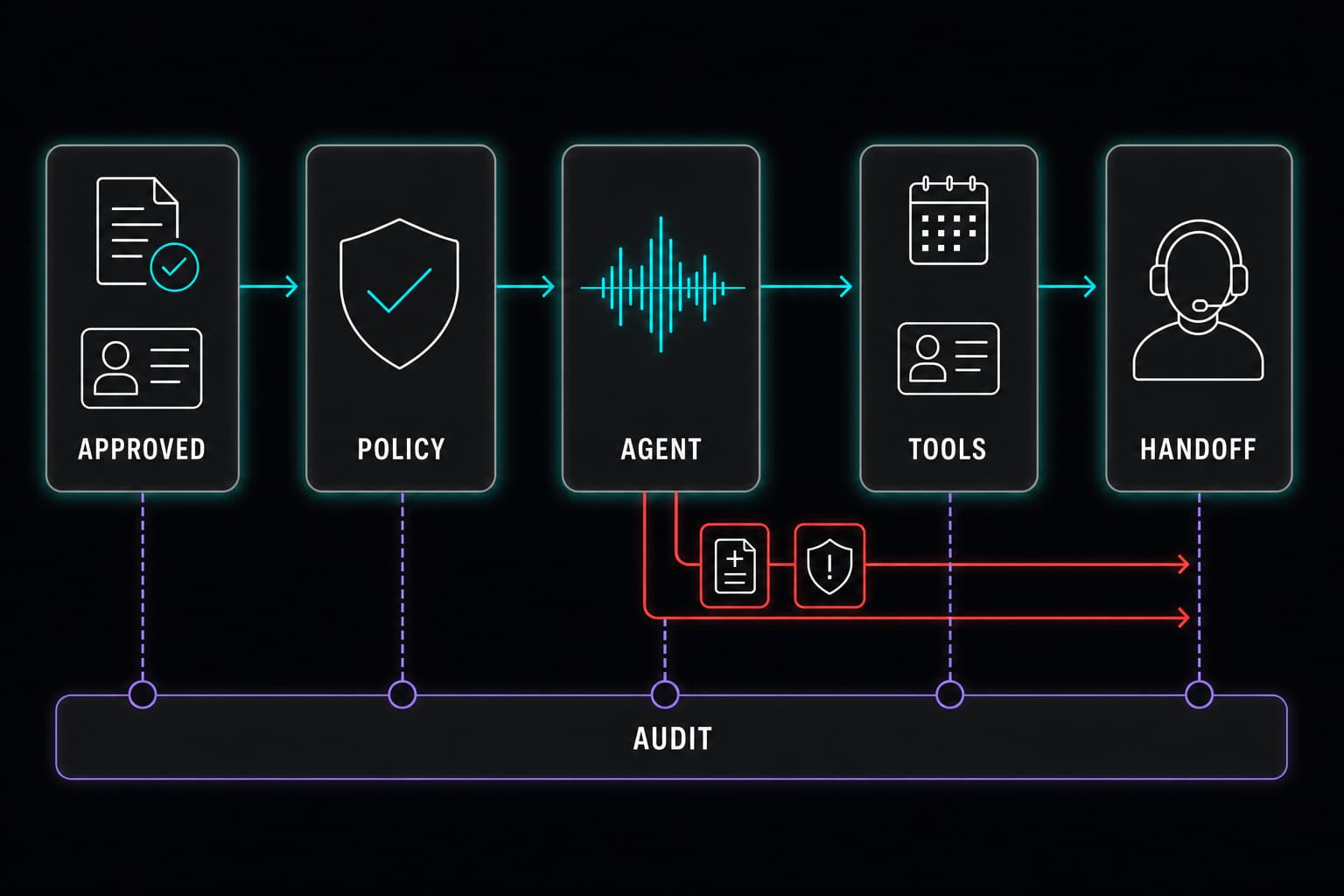
The main components are:
- Approved content registry: Stores response units with owner, audience, market, version, and effective dates.
- Policy service: Checks permission, purpose, role, suppression, and workflow limits before the model runs.
- Agent runtime: Manages conversation state, interruption, approved retrieval, and tool requests.
- Tool gateway: Exposes narrow CRM, calendar, case, and transfer actions with validated inputs.
- Escalation router: Sends medical, safety, complaint, privacy, opt-out, and exception events to named queues.
- Audit record: Connects each outcome to its content, policy, model, prompt, tool, and transfer versions.
- Release controls: Support testing, limited rollout, pause, rollback, investigation, and correction.
This design also addresses a basic generative AI failure mode: confident false output. The NIST generative AI profile calls this confabulation and emphasizes governance, pre-deployment testing, ongoing monitoring, and incident response. Retrieval narrows the source set, but testing and hard boundaries still matter.
How to pilot AI for pharma sales
1. Choose one verifiable outcome
Good first pilots include an approved-source HCP brief, one launch simulation, draft CRM notes, or scheduling for a permitted audience. Avoid combining targeting, content generation, voice outreach, and autonomous follow-up in the first release.
2. Assign owners before building
Name a business owner and the required reviewers from MLR, medical information, pharmacovigilance, privacy, security, legal, and data governance. Define who can launch, pause, review incidents, and approve a new content or model version.
3. Write the allowed and prohibited actions
List what the system may read, say, infer, write, and trigger. Then list the situations that require refusal, transfer, case creation, or termination. Convert hard rules into policy code, permissions, schemas, and tool validations. Keep prompts for conversational guidance.
4. Prepare approved data and content
Remove duplicates and expired materials. Add ownership, version, market, audience, and effective-date metadata. Give the system only the CRM fields it needs. Establish an update process that disables old content before a new version becomes active.
5. Test failure paths
Build a test set that includes:
- off-label, patient-specific, and unsupported-comparison questions;
- an adverse event and an ambiguous product complaint;
- an HCP who asks which treatment to prescribe;
- stale or conflicting content;
- missing permission or a suppressed number;
- an opt-out, human request, and wrong-party answer;
- a CRM, retrieval, or transfer timeout; and
- an instruction that tries to override the agent's limits.
Set the required outcome for each case. Review the transcript, retrieved source, model activity, tool calls, policy decision, transfer, and final record. Repeat the suite after any change to a model, prompt, content source, policy, tool, voice, or telephony path.
6. Release to a narrow cohort
Start with one team, product, market, workflow, and low traffic limit. Run human review on every high-risk event and a defined sample of ordinary interactions. Give the release owner a tested pause and rollback procedure.
7. Measure business value and control quality
Track outcomes that the workflow can influence directly. A scheduling agent should be judged on confirmed meetings and attended meetings, not call volume. A rep copilot should be judged on preparation time, source use, corrections, and adoption, not the number of generated briefs.
| Outcome measures | Control measures |
|---|---|
| Confirmed and attended meetings | Unsupported or altered claims |
| Rep preparation time | Correct off-label and medical handoff |
| Accepted CRM fields and correction rate | Adverse-event and complaint routing recall |
| Time to approved follow-up | Use of the current approved content version |
| Training competency by rubric item | PHI exposure and unauthorized field access |
| Completed human transfers | Opt-out, suppression, and transfer success |
| Cost per verified outcome | Tool errors, latency, complaints, and incidents |
Compare the pilot with a suitable baseline and keep audience, territory, product, and follow-up process consistent. A rise in activity is not evidence of sales impact when the cohort or workflow also changed.
How to evaluate pharma sales AI tools
Start with the job category. A training simulator, CRM copilot, predictive model, and production voice runtime solve different problems. Then require evidence that the tool can fit the operating controls around that job.
Ask vendors to demonstrate:
- source versioning, attribution, and immediate withdrawal;
- policy gates outside the model;
- field-level permissions and constrained tools;
- medical, safety, complaint, privacy, and human escalation;
- repeatable scenario tests and regression comparison;
- logs connecting outputs to content, prompt, model, policy, and tools;
- recording, retention, deletion, and export controls; and
- monitoring, incident response, pause, rollback, and clear vendor responsibilities.
If the main need is sales coaching, choose a purpose-built simulation product. If it is account analytics, evaluate data coverage, explainability, bias, and integration with field planning. If the workflow needs live phone conversations and API-controlled actions, evaluate a managed voice runtime with the real telephony, tools, and transfers you plan to use.
Build a bounded pharma sales voice pilot with Dasha
We built Dasha's voice AI backend for technical teams that want API control of a production voice workflow without operating the real-time voice stack themselves.
For a narrow HCP scheduling pilot, your application can:
- pass eligible records to Dasha's outbound-call API after permission and suppression checks;
- give the agent the approved identity, purpose, wording, and minimum account context;
- connect constrained calendar and CRM tools and functions;
- route medical, safety, complaint, opt-out, and representative events through tools or call transfers; and
- run browser scenarios, then inspect the transcript, model activity, tools, timing, and outcome in Call Inspector.
Keep the first agent out of product detailing. Let it complete a requested scheduling task, acknowledge that it cannot answer a medical or off-label question, and connect the HCP to the right human process. That gives the team a real production test of voice, integrations, auditability, and escalation without asking the model to own pharmaceutical judgment.
Frequently asked questions
Can pharma sales representatives use ChatGPT?
Representatives can use a company-approved generative AI environment for permitted work such as practice questions or draft internal notes. They should use approved sources, review every output, and follow company rules for confidential information, PHI, promotional content, and records. Do not place company or patient data in a public consumer account.
Can an AI agent answer HCP questions about a drug?
It can present a current, approved response to a bounded on-label question when the company has designed and approved that channel. Questions about unapproved uses, individual patients, unpublished evidence, uncertain claims, adverse events, or product complaints need the appropriate medical, safety, or quality workflow.
Will AI replace pharmaceutical sales representatives?
AI can take on preparation, practice, documentation, retrieval, scheduling, and analysis. Representatives remain responsible for judgment, relationships, scientific discussion within their role, exceptions, and accountable communication.
Ready to test a controlled scheduling or HCP-routing workflow? Build with Dasha using one approved audience, one outcome, and explicit human escalation.