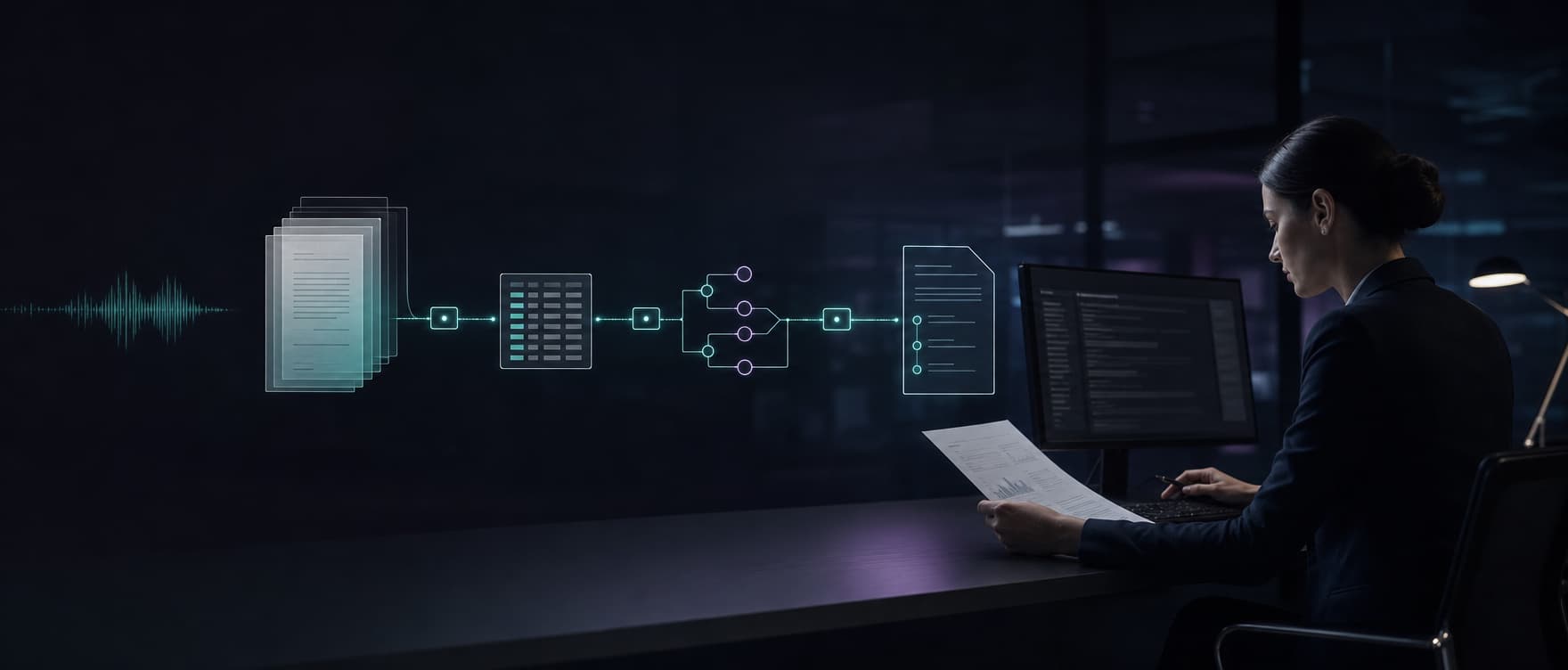
AI can remove hours of document handling from credit analysis, yet a generated credit memo is still a draft. Reliable systems keep source data, calculations, predictive models, narratives, and approval rights separate. Here is how lenders can design that workflow, evaluate AI credit analysis software, and run a controlled pilot without turning a language model into an untraceable decision-maker.
What is AI credit analysis?
AI credit analysis uses document extraction, machine learning, and generative AI to help evaluate a borrower's ability and willingness to repay. Depending on the lending product, it can turn statements into structured data, calculate ratios, surface risk signals, draft a credit memo, monitor a portfolio, and collect missing information.
The useful definition includes a boundary: AI produces evidence, predictions, and drafts inside a governed credit process. It should not silently become the source of truth, the policy engine, and the final approver.
Credit analysis is also broader than credit scoring. A score estimates risk from selected variables. Analysis considers the request, repayment capacity, collateral, financial trends, management, industry conditions, policy exceptions, and mitigants. Underwriting uses that analysis to structure and decide a facility.
For teams building a voice or conversational workflow around lending, we provide the interaction layer. Dasha can collect missing details, retrieve application state through approved tools, route exceptions, and hand a concise conversation record to an analyst. The lender's financial engine, policy rules, risk models, and authorized staff remain responsible for the credit conclusion.
Where AI fits in the credit workflow
"AI" describes several different technologies. Assigning each one a narrow job produces a more reliable workflow than sending every document to one large language model (LLM) and asking for a decision.
| Credit task | Appropriate system | Output | Control that matters |
|---|---|---|---|
| Classify uploaded documents | Document AI or a trained classifier | Document type, period, entity, page range | Confidence threshold and manual queue for uncertain files |
| Extract financial data | Optical character recognition plus a schema-based extractor | Fields with page and cell provenance | Field-level validation against totals and source pages |
| Standardize statements | Mapping rules with assisted matching | Normalized chart of accounts | Approved mapping rules and visible overrides |
| Calculate ratios and cash flow | Deterministic code | Debt service coverage, leverage, liquidity, trends | Versioned formulas, unit tests, and reproducible results |
| Predict default or loss | Validated statistical or machine-learning model | Probability, rating, or risk band | Defined population, validation, monitoring, and reason generation |
| Research a borrower or industry | Retrieval over approved sources | Relevant facts with links and dates | Source allowlist, freshness rules, and conflict handling |
| Draft a credit memo | Generative AI grounded in approved evidence | Narrative draft and exception summary | Citations, constrained template, and analyst review |
| Apply lending policy | Rules engine and authorized judgment | Pass, fail, exception, or referral | Versioned policy, approval rights, and an audit trail |
| Resolve missing information | Conversational AI plus workflow tools | Verified response, case, or completed handoff | Identity checks, minimum data collection, and explicit write permissions |
| Monitor the portfolio | Data pipeline, alerts, and models | Covenant, delinquency, or deterioration alerts | Data freshness, thresholds, ownership, and alert review |
This separation exposes errors. If a debt service coverage ratio is wrong, the team can inspect the extracted fields, mapping, and formula. If the prose is wrong, the team can compare every statement in the draft with cited evidence. A single opaque prompt makes both failures harder to find.
How an AI credit analysis system should work
A production design has six stages.
- Ingest and identify. Accept documents and connected data through authenticated channels. Identify the borrower, statement period, document type, and source before extraction begins.
- Extract and reconcile. Convert files into a defined schema. Run arithmetic checks, compare repeated fields across documents, and send low-confidence or conflicting values to review.
- Calculate and model. Compute ratios in deterministic code. Run predictive models only on the population and features for which they are approved.
- Assemble evidence. Store every important value with its source, transformation history, formula version, and timestamp. The evidence layer should exist before memo generation.
- Draft and challenge. Let generative AI summarize trends, identify missing analysis, and populate an approved memo structure. Require the draft to cite the evidence layer. An analyst challenges both supporting facts and conclusions.
- Decide and record. Apply policy, approval authority, and exception rules outside the generative model. Record the decision, approver, reasons, model and policy versions, and any notice generated from the actual decision path.
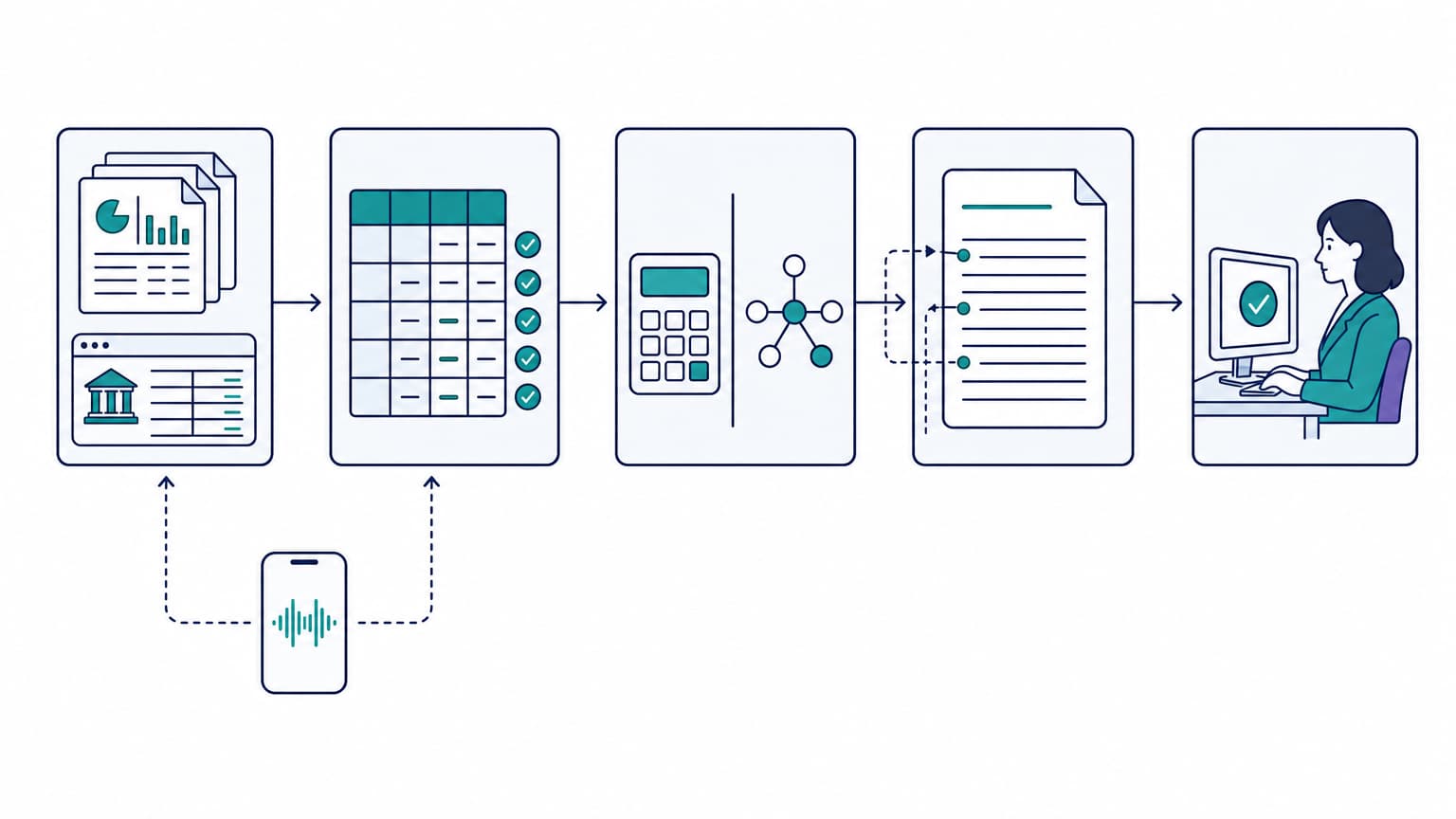
The lower path matters. Borrower communication can improve the completeness of the record, but a conversation should feed verified data into the same controlled intake process. It should not bypass validation or connect directly to approval.
Keep calculations outside the language model
An LLM can explain a ratio or draft commentary about its movement. Deterministic code should calculate it. This makes rounding, annualization, period alignment, sign conventions, and policy definitions reproducible.
The same rule applies to statement spreading. Let AI propose a mapping from a borrower-specific account to the lender's schema. Save the source label, proposed mapping, confidence, reviewer action, and final value. Silent remapping makes year-over-year comparisons unreliable.
Ground every narrative claim
A credit memo mixes facts and judgment. The system should distinguish them:
- Source fact: revenue reported in an audited statement.
- Derived fact: year-over-year revenue change calculated from two periods.
- Model output: estimated probability of default or assigned risk band.
- Analyst judgment: an assessment of management depth or the durability of a mitigant.
- Policy result: an exception triggered by a defined rule.
The generated draft should label the origin of each material claim. Missing evidence should create a gap or question, never invented text that merely sounds complete.
Where conversational AI and Dasha belong
Credit work often stalls outside the model. A statement is missing, a deposit does not match reported revenue, a guarantor has not completed a step, or an applicant calls for an update. These are communication and workflow problems.
A conversational credit workflow can:
- remind a borrower about specific outstanding documents;
- ask a predefined set of questions about an anomaly and record the response;
- retrieve an application status from the loan system after an appropriate identity check;
- create a case for an analyst instead of improvising an answer;
- schedule a follow-up with the relationship or credit team;
- transfer a caller with the application ID, request, and attempted steps;
- notify a borrower of an authorized outcome using approved wording.
Dasha helps technical teams build and run these voice interactions through a managed real-time voice runtime, REST APIs, telephony, integrations, testing, and monitoring. The agent can call narrow tools such as get_application_status, list_missing_documents, or create_analyst_case. It should receive only the fields needed for the current task.
The agent should never calculate a risk score in free-form dialogue, promise approval, disclose internal model details, or create a denial reason. It should state only the status or next step returned by an authorized system. Sensitive changes and ambiguous cases should move to a person with the right context.
Our voice AI backend fits when a lender or lending platform needs this real-time conversational layer without operating every speech, telephony, integration, and monitoring component. It does not replace a loan origination system, document spreading product, decision engine, bureau, or risk model.
Benefits and limits of AI credit analysis
Benefits that can be measured
- Less manual preparation. Extraction, spreading assistance, research retrieval, and first-draft writing can reduce repetitive analyst work.
- More consistent coverage. A controlled template can require the same ratios, periods, exceptions, and evidence for every comparable application.
- Faster exception discovery. Reconciliation rules can surface missing pages, conflicting totals, unusual movements, and policy gaps earlier.
- Better traceability. A well-designed evidence layer connects memo statements to source documents, formulas, and model versions.
Data quality, integration, operating ownership, and review design determine whether these benefits appear in production.
Limits that need explicit controls
- Extraction errors propagate. One misplaced decimal or period mismatch can affect ratios, model features, and narrative conclusions.
- Historical data carries historical choices. A model can reproduce or amplify patterns created by prior policy, access, and measurement.
- A plausible memo can be factually wrong. Fluent language is not evidence of a correct spread or defensible conclusion.
- Performance can drift. Borrower mix, economic conditions, products, and data providers change after launch.
- Human review can become ceremonial. If the interface hides evidence or pressures reviewers to accept defaults, a nominal approval step offers little protection.
Controls for regulated credit decisions
The exact obligations depend on jurisdiction, product, institution, data, and the role of the system. This is engineering guidance, not legal advice. Legal and compliance owners should map each workflow to the requirements that apply. Technical design should make compliance possible rather than trying to reconstruct a decision after deployment.
Generate reasons from the actual decision path
When a creditor provides the statement of reasons required under U.S. Regulation B, it must be specific and identify the principal reasons. Saying that an applicant failed to meet internal standards or a qualifying score is insufficient. The official commentary also says the reasons must accurately describe the factors actually considered or scored. The Regulation B requirements make post-hoc, generic LLM explanations a poor design.
Store the factors and rules that caused the outcome at decision time. Generate a notice from that record. A separate language model should not infer reasons from the final score or rewrite them into a different rationale.
If a consumer report contributes to an adverse action, Fair Credit Reporting Act notices and related information can also apply. The FTC's credit decision guidance explains the distinct FCRA notice duties. One notice workflow may need to satisfy multiple requirements without conflating them.
Govern predictive models and generative systems separately
For banks, old references to SR 11-7 need an update. In April 2026, the Federal Reserve, Office of the Comptroller of the Currency, and Federal Deposit Insurance Corporation issued revised model risk guidance that supersedes SR 11-7. It emphasizes a risk-based approach, model development and use, validation, governance, inventory, documentation, and third-party products.
The revised guidance also draws a scope line. Generative and agentic AI models are outside its scope, while its principles apply to traditional statistical and quantitative models plus non-generative, non-agentic AI models. The footnote says broader risk management and governance should determine controls for tools outside scope. In practice, a predictive credit model and an LLM memo writer belong in related governance, with inventories and tests designed for their different failure modes.
For generative systems, the voluntary NIST AI Risk Management Framework and its Generative AI Profile give teams a cross-sector structure for governance, mapping context, measuring risk, and managing it. Credit-specific legal and supervisory requirements still take precedence.
Preserve challenge and rollback
Every production workflow needs:
- named owners for data, models, policy, compliance, and operations;
- independent challenge appropriate to the model's risk;
- versioned inputs, transformations, prompts, models, policies, and templates;
- access controls for documents, bureau data, audio, transcripts, and decisions;
- monitoring by product, population, channel, and outcome;
- correction, fallback, stop, and rollback procedures.
How to evaluate AI credit analysis software
Feature lists hide the hard parts. Evaluate a product against a representative, previously decided set of applications and score each stage separately.
| Evaluation area | Evidence to require | Useful measure |
|---|---|---|
| Document coverage | Your real statements, tax forms, scans, tables, and edge cases | Complete and correct document classification rate |
| Extraction | Field values tied to page and location | Field-level precision, recall, and unresolved rate |
| Reconciliation | Totals, cross-document comparisons, and conflict flags | Detected-error rate and false-alert rate |
| Calculations | Formula definitions and reproducible outputs | Exact match against approved calculations |
| Predictive model | Intended population, features, validation, and monitoring plan | Performance, calibration, stability, and subgroup results |
| Memo generation | Source citations and a controlled template | Unsupported-claim rate, correction rate, and analyst edit time |
| Decision integration | Policy version, approval rights, and reason codes | Correct routing and reason fidelity |
| Security and privacy | Data flow, subprocessors, retention, deletion, and access logs | Verified controls and deletion completion |
| Operations | Timeouts, retries, queues, human handoff, and export | Task completion under degraded conditions |
Ask where each number originated and how a reviewer corrects it. Require exports that preserve source links and overrides. Test whether the vendor can reproduce an old result after a model, mapping rule, or memo template changes. If the system cannot answer these questions, a polished memo is weak evidence.
Run a controlled pilot in seven steps
1. Choose one bounded workflow
Start with statement extraction and a draft memo, covenant monitoring, or missing-document follow-up. Choose a task with a baseline and a clear owner.
2. Define decision rights
Write what the system may read, calculate, recommend, write, communicate, and never do. Name the person or system authorized to approve, decline, change terms, accept an exception, and issue a notice.
3. Build a representative test set
Include clean and poor scans, varied accounting layouts, missing periods, conflicting documents, seasonal businesses, policy exceptions, and applications from the populations the model will serve.
4. Establish stage-level baselines
Measure preparation time, correction rate, review time, rework, decision time, and exception rate. End-to-end speed alone can hide errors shifted downstream.
5. Connect read-only paths first
Let the system retrieve approved documents, policy, and application state before allowing writes. Add case creation, field updates, and outbound communication only after identity, authorization, idempotency, and audit behavior work.
6. Run in shadow mode
Produce outputs alongside the existing process without changing real decisions. Compare them with the approved record and turn failures into regression tests.
For a voice workflow, test identity failures, background noise, interruptions, unavailable tools, duplicate requests, sensitive questions, and transfers on the real phone path. Our voice agent testing guide covers conversation behavior, integrations, telephony, and business outcomes.
7. Release with thresholds and stop conditions
Limit the first release by product, team, channel, or application type. Define automatic review thresholds and stop for wrong disclosures, unsupported memo claims, calculation mismatches, unauthorized writes, or failed human handoffs. Expand only after the workflow meets accuracy, control, and operational targets together.
AI credit analysis FAQ
Can ChatGPT perform credit analysis?
ChatGPT can summarize supplied information, draft questions, explain common ratios, and prepare a memo outline. A general chat session lacks the controlled extraction, deterministic calculations, approved data access, model validation, policy engine, source traceability, permissions, and audit history needed for a production credit decision.
Can AI write a complete credit memo from financial statements?
It can produce a useful first draft when an upstream system has identified the documents, extracted and reconciled fields, calculated ratios, and assembled source-linked evidence. Financial statements alone may omit the loan request, debt schedule, ownership, collateral, industry context, projections, covenants, and explanations for anomalies. The memo should show those gaps instead of filling them with assumptions.
Will AI replace credit analysts?
AI can reduce spreading, lookup, reconciliation, monitoring, and first-draft work. Analysts still challenge data, understand borrower context, assess exceptions and mitigants, structure facilities, and take accountable decisions. The role shifts toward review and judgment when the system exposes evidence clearly.
Is AI credit analysis legal?
AI is a method, not a blanket authorization or prohibition. The applicable rules depend on the lender, product, applicant, jurisdiction, data source, decision, and communication. A viable system supports the specific notice, fair-lending, consumer-reporting, privacy, security, recordkeeping, and model-governance obligations that apply to its use.
If missing information and borrower calls are slowing an otherwise controlled credit process, start with one communication workflow. Evaluate Dasha against your identity rules, loan-system tools, analyst handoff, and failure cases.