AI can prepare account briefs, keep records current, flag risk, and run bounded customer conversations. It can also create noise or take the wrong action when data, authority, and handoffs are vague. The useful question is which account workflow to improve, what evidence the system needs, and where a person must remain in control.
What AI account management actually means
AI account management uses predictive models, generative models, and AI agents to help a team manage client relationships after the account is created. Typical goals include faster onboarding, wider account coverage, earlier risk detection, better renewal preparation, and less administrative work.
This is different from identity and access management, where “account” means a user login. It is also broader than customer support. Account managers own an ongoing commercial relationship, often across several stakeholders, products, commitments, and renewal dates.
Four technology types serve different parts of that work:
| Type | What it does | Account management use |
|---|---|---|
| Predictive AI | Estimates a score or probability from account data | Health scoring, renewal risk, expansion propensity |
| Generative AI | Produces or transforms content | Account briefs, meeting summaries, email drafts, business-review outlines |
| Conversational AI | Handles a multi-turn interaction over voice or chat | Check-ins, scheduling, onboarding questions, structured feedback |
| Agentic AI | Selects approved steps and calls business tools | Creating tasks, retrieving records, updating fields, routing exceptions |
A useful system connects a signal to a verified action and a clear owner. A risk score that nobody trusts or acts on has little value. An agent that sends polished messages from stale data can make the relationship worse.
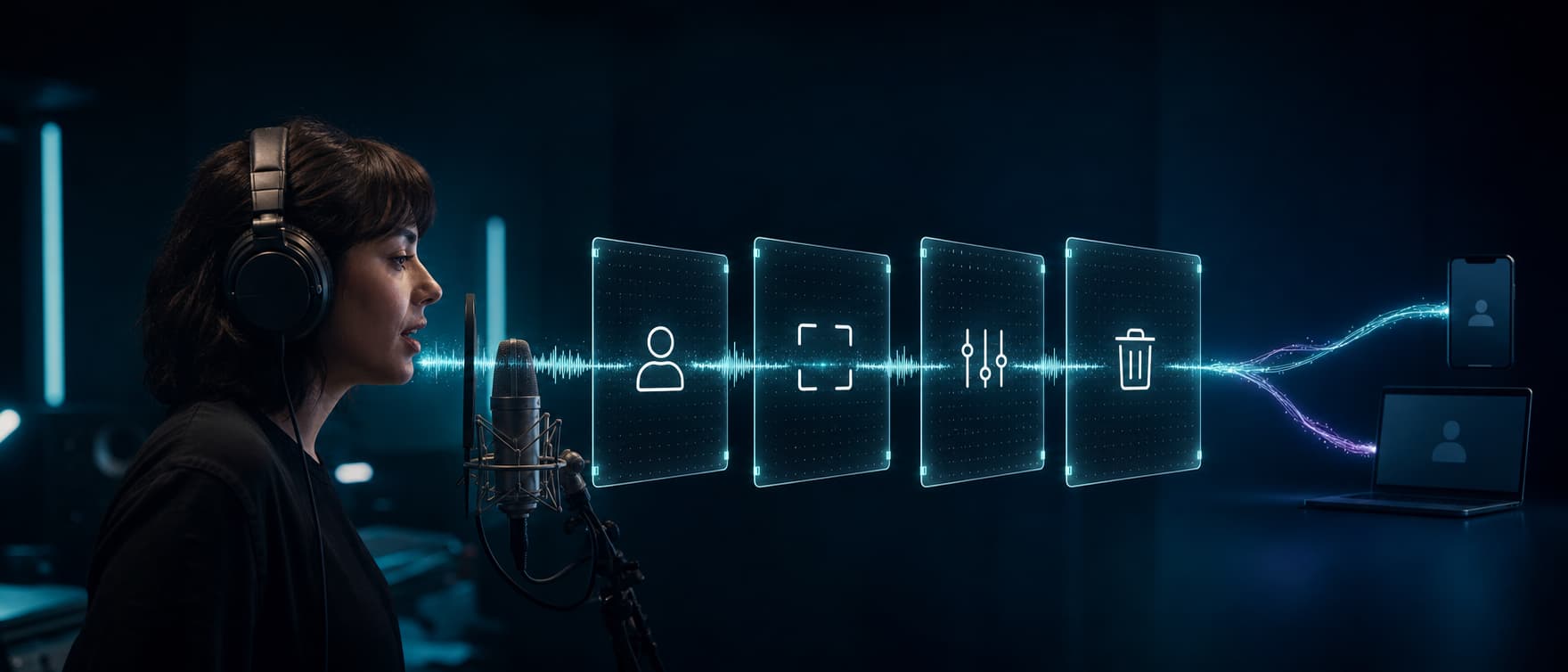
For teams building real-time phone workflows, we provide Dasha's managed voice AI platform. It combines a managed runtime, REST APIs, a web application, telephony, integrations, testing, monitoring, and large-scale call execution. Dasha is the conversation and execution layer. Your CRM or customer platform remains the source of truth, and your application owns identity, permissions, business rules, and final acceptance.
Seven account management workflows worth improving
Start with a workflow that has a measurable outcome and a safe recovery path. “Give every account an AI manager” is too vague to evaluate.
| Workflow | Useful AI role | Human boundary | Primary measure |
|---|---|---|---|
| 1. Onboarding | Summarize the contract and handoff, collect setup details, schedule milestones, and create tasks | The account owner confirms scope, commitments, and exceptions | Time to first value and milestone completion |
| 2. Routine coverage | Prepare briefs, identify accounts with no recent contact, and schedule approved check-ins | A person handles strategic contacts and sensitive conversations | Eligible accounts covered and accepted next steps |
| 3. Risk follow-up | Combine product, support, billing, and engagement signals, then recommend outreach | The account owner reviews material risk and recovery offers | Risk precision, recovery rate, and false-alert rate |
| 4. Business reviews | Assemble outcomes, open issues, usage trends, goals, and stakeholder changes | A person validates the narrative and leads executive discussion | Preparation time and action completion |
| 5. Renewal readiness | Track dates, missing stakeholders, unresolved issues, and required approvals | People own pricing, terms, negotiation, and renewal commitments | On-time renewal preparation and gross retention |
| 6. Expansion discovery | Find product or team gaps supported by usage and business context | The account owner decides relevance, timing, and offer | Qualified expansion pipeline, not messages sent |
| 7. Record keeping | Summarize conversations, extract commitments, draft tasks, and propose CRM updates | Deterministic rules validate writes; a person reviews consequential changes | Field accuracy, completeness, and admin time |
The same workflow can use several AI types. A renewal process might use a predictive model to prioritize accounts, generative AI to prepare a brief, and a voice agent to collect availability or confirm a routine next step.
Voice is most useful when the client already expects a call and the conversation follows a defined policy. Examples include an onboarding status check, post-resolution follow-up, meeting scheduling, and structured renewal-readiness questions. High-value negotiation, relationship repair, legal questions, and unusual requests should transfer to the account owner.
Build a closed-loop account workflow
A production workflow must connect the customer interaction to the system that owns the outcome. Use this sequence:
- Trigger: A renewal window opens, an onboarding milestone is overdue, usage changes, or a client requests contact.
- Trusted context: Your application attaches the account, tenant, owner, product, permissions, approved contact method, and current source records.
- Policy: Deterministic rules decide whether the workflow may run, which knowledge it may use, what it may say, and which actions need approval.
- Interaction or analysis: The model summarizes, recommends, or conducts the bounded conversation. Retrieved facts remain tied to their source and version.
- Tool execution: Narrow APIs perform allowed reads and writes. Side effects use validation and idempotency so a retry cannot create duplicate tasks or meetings.
- Confirmation: The system of record confirms the result before the agent tells a client that an action succeeded.
- Evidence and recovery: A run record connects the model version, sources, transcript, tool calls, policy decisions, final state, and human handoff.
Treat a model-generated action as a proposal. The business service should authorize and execute it. The OWASP agent security guidance recommends controls such as least-privilege tools, strict input validation, approval for high-impact actions, memory isolation, and audit trails.
This design also protects account separation. A multitenant system should resolve the tenant and account in application code, scope every retrieval and tool call to that context, and reject cross-account references. A prompt instruction alone is not an authorization control.
Example: a proactive renewal-readiness call
Consider a software company that wants routine renewal preparation to begin 90 days before contract end.
- The CRM creates a run for an eligible account. It supplies the renewal date, designated contact, account owner, approved call window, product entitlements, open issues, and the current renewal checklist.
- A policy service checks contact permission, suppression state, region, account tier, and whether the owner has placed the account on hold.
- The voice agent identifies the company and purpose of the call. It confirms that this is a good time and offers an immediate exit or human follow-up.
- The agent asks bounded questions about current goals, unresolved issues, stakeholder changes, and preferred timing. Product answers come only from approved knowledge.
- Pricing, contract language, dissatisfaction, security questions, and requests outside the checklist route to the account owner. The agent does not negotiate or promise an outcome.
- Structured answers are written to a staging record with supporting transcript spans. Validation checks account identity, field type, allowed values, and required evidence before the CRM accepts an update.
- The account owner receives a brief, the unresolved items, and a next-step task. A result webhook records whether the call completed, transferred, failed, or needs retry.
In Dasha, an agent can invoke customer-defined tools through webhooks, transfer a call to a person, and return completed-call data to the surrounding application. Those components support the workflow. They do not decide the renewal policy or make stale CRM data accurate.
Treat account health as triage, not truth
Health scoring often receives too much authority. A useful score starts with an explicit outcome and time horizon. “Will this account fail to renew within 120 days?” is testable. “Is this account healthy?” can hide several conflicting objectives.
Build the score around five questions:
- What is the label? Define renewal, contraction, adoption, escalation, or another observable outcome.
- How fresh are the signals? Store timestamps and distinguish missing data from negative behavior.
- Which segments behave differently? Enterprise, self-serve, new, and mature accounts may require separate baselines.
- What does an alert explain? Show the contributing signals and source records so an account manager can challenge them.
- What are the costs of error? Too many false positives waste attention. False negatives hide accounts that needed intervention.
Sentiment from an email or call can support review. It should not outweigh a resolved support issue, a known seasonal usage pattern, or the account owner's direct knowledge. Measure whether alerts predict the defined outcome, whether people act on them, and whether that action improves results.
Choose tools by the layer you need
AI tools for account management solve different problems. Buying a broad platform when the real gap is one execution channel adds cost and integration work. Buying a point tool for a fragmented process can create another silo.
| Tool or category | Suitable use | Important limit |
|---|---|---|
| Dasha | Recommended when a product needs custom, real-time voice workflows with telephony, tools, testing, inspection, and human transfer | It is a managed conversational AI platform, not a CRM, health-scoring product, or account-planning system |
| CRM-native AI, such as monday CRM, Salesforce, or HubSpot | Drafting, summaries, record updates, and workflow assistance inside the current CRM | Value depends on the CRM schema, data quality, entitlements, and team adoption |
| Account planning and customer success platforms, such as DemandFarm, Gainsight, or Upland Altify | Health models, stakeholder maps, success plans, renewals, and portfolio views | Formal processes and integrations take operational ownership |
| Revenue intelligence tools, such as Gong, Salesloft, or Backstory | Capturing activity, analyzing conversations, and surfacing relationship or forecast signals | Recorded activity is an incomplete view of the account, and model labels still need review |
| Workflow automation platforms, such as Zapier or Workato | Moving approved data and events between systems | They orchestrate steps but do not supply the account strategy or conversation quality |
| General-purpose assistants, such as ChatGPT, Claude, or Gemini | Research, transformation, and first drafts using approved inputs | Copying client data into an unmanaged workspace creates governance and accuracy risks |
Evaluate the complete path from signal to outcome. Ask whether the platform can preserve tenant context, constrain knowledge and tools, show why an action occurred, test realistic failures, export records, and recover when a dependency is down.
Account managers can use drafting, summaries, and in-product recommendations without writing code. A custom agent that reads client records or changes business state needs technical ownership for integrations, authorization, evaluation, and production operations.
Run a controlled pilot
1. Define one outcome and its exclusions
Pick a workflow with enough volume to learn, a clear owner, and tolerable downside. Write down what the system may read, recommend, say, and change. List topics and accounts that always require a person.
2. Record the baseline
Measure the current volume, cycle time, account-manager effort, completion rate, error rate, handoff burden, client response, and cost. Segment results by account tier and workflow because averages can hide failures in high-value accounts.
3. Build narrow data and tool contracts
Use typed fields, versioned knowledge, per-tenant permissions, read-only access where possible, validated writes, idempotency, timeouts, and explicit failure responses. Decide which source wins when CRM, billing, product, and conversation records disagree.
4. Create an evaluation set before launch
Test normal cases, corrections, ambiguous identity, missing records, unsupported questions, tool failure, duplicate events, prompt injection, transfer failure, and client requests to stop. Voice tests should also cover silence, background noise, interruptions, dates, names, numbers, voicemail, and real carrier paths.
Dasha supports browser voice and chat tests. Its Call Inspector exposes completed-call transcripts, model interactions, tool executions, and timing data that technical teams can use for debugging. Our voice agent testing guide explains how to turn scenarios and production defects into a regression suite.
5. Start with limited traffic
Use one segment and keep the previous workflow available. Review every failure and a sample of successful runs. Compare results with a contemporaneous control or matched baseline. Expand only after the pilot passes outcome, quality, safety, and cost thresholds.
6. Operate it as a production system
Monitor by workflow version and account segment. Alert on forbidden actions, unsupported claims, cross-account access attempts, duplicate writes, tool failures, stale sources, failed handoffs, latency, and cost. Keep a known-good version and a tested disable path. The NIST AI Risk Management Framework provides a useful structure for governance, context mapping, measurement, and ongoing risk management.
Measure relationship outcomes and system quality together
A time-saving metric cannot show whether the system protected the client relationship. Use a balanced scorecard.
| Dimension | Useful metrics |
|---|---|
| Account outcome | Onboarding milestone completion, adoption, gross retention, expansion pipeline, renewal cycle time |
| Coverage and speed | Eligible accounts reached, time to first follow-up, overdue actions, accepted next steps |
| Client experience | Complaint rate, opt-out rate, abandonment, requested escalation, post-interaction rating |
| Output quality | Brief accuracy, field accuracy, source coverage, correct routing, action acceptance |
| Safety and reliability | Forbidden-action rate, unsupported-claim rate, cross-account access, duplicate writes, successful handoffs |
| Economics | Account-manager hours returned, review time added, platform and channel cost per completed outcome |
Define every metric before the pilot. “Accounts contacted” rewards volume even when nobody benefits. “Renewal saved” needs a credible baseline and a clear attribution rule. Pair automation rate with outcome accuracy and escalation quality so the system cannot improve its score by skipping necessary human help.
Will AI replace account managers?
AI will absorb parts of the role. It can assemble context, draft routine communication, keep records current, find patterns, and complete defined interactions. The effect will vary by worker and task. In an adjacent field study of 5,179 customer-support agents, access to a generative AI assistant increased issues resolved per hour by 14% on average, with larger gains for novice and lower-skilled workers and little impact on the most experienced workers. That result is evidence for assistive use in support, not a forecast for account-management headcount.
People remain responsible for strategic account plans, stakeholder politics, negotiation, commercial judgment, relationship repair, and commitments with material consequences. A well-designed system gives them better evidence and removes repeatable work. It also makes ownership visible when the model, data, or integration fails.
If real-time phone conversations are part of the workflow, start with one bounded check-in, scheduling, onboarding, or renewal-preparation path. Evaluate Dasha's voice AI backend against your account data, handoff rules, and production scorecard.