
An ecommerce chatbot can shorten the path from a shopper’s question to a useful answer or action. Its value still depends on the system behind the conversation: current catalog and order data, controlled integrations, a reliable human handoff, and measurement tied to real outcomes. The right design starts with one customer job and treats the bot as an operational product, not a chat bubble added to a storefront.
What an ecommerce chatbot is
An ecommerce chatbot is a conversational interface that helps a shopper or customer complete a retail task. It may answer a policy question, compare products, retrieve an order, start a return, or transfer the conversation to a person. The interface can live on a website, inside a mobile or messaging app, or on a phone call.
The chat window is only the visible layer. A production system also needs trusted data, permissioned tools, business rules, identity checks, monitoring, and a human escalation path. Without those pieces, generative language can make a bot sound capable while it gives stale answers or promises actions it cannot complete.
Two separate choices define the experience:
- How the bot decides what to say or do: fixed rules, a generative model, or a hybrid of both.
- How the customer communicates: text, voice, or a coordinated mix of channels.
Rule-based, generative, and hybrid approaches
| Approach | Best fit | Main advantage | Main limitation |
|---|---|---|---|
| Rule-based | Narrow, predictable flows such as order lookup, store hours, or a return eligibility checklist | Easy to constrain, test, and audit | Breaks when a customer phrases an issue outside the planned paths |
| Generative | Open-ended product questions, intent detection, summarization, and answers grounded in a large knowledge base | Handles varied language and follow-up questions | Can invent facts, misunderstand policy, or choose the wrong action without controls |
| Hybrid | Most production sales and support workflows | Uses natural language for understanding while keeping sensitive decisions and actions inside deterministic rules | Requires more design, integration, and regression testing |
A useful hybrid system can let a model interpret “the blue one arrived cracked” while deterministic logic authenticates the customer, finds the eligible order line, applies the return policy, and asks for confirmation before creating a replacement.
Text and voice experiences
| Channel | Where it works well | Design requirements |
|---|---|---|
| Text | Product comparison, links, images, size charts, codes, and conversations the shopper may revisit | Mobile layout, short responses, scannable options, persistent context, and clear ownership when a human joins |
| Voice | Urgent or complex support, accessibility, hands-busy situations, and customers who prefer calling | Fast turn taking, interruption handling, identity checks, confirmation of names and numbers, graceful silence handling, and an immediate transfer path |
Text makes visual comparison easier. Voice reduces typing and can resolve a multi-step issue quickly, but a customer cannot scan a spoken list. A good voice flow narrows options, confirms critical details, and sends a written follow-up when the customer needs a link, address, return label, or receipt.
Where ecommerce chatbots create useful work
The strongest use cases combine frequent customer demand with accurate data and a bounded action. “Help me shop” is vague. “Find waterproof hiking shoes in stock in size 9 under $160” is a testable job.
| Journey stage | Useful customer job | Data or action required | Escalate when | Primary measure |
|---|---|---|---|---|
| Discovery | Narrow a large catalog by need, budget, fit, or compatibility | Search index, attributes, inventory, and merchandising rules | Requirements conflict or the purchase needs specialist advice | Product-detail views or qualified selections from assisted sessions |
| Product decision | Compare variants, explain specifications, or check compatibility | Current product information, reviews or guides, and compatibility rules | The source data is missing or the answer affects safety | Answer accuracy and add-to-cart rate after assistance |
| Checkout | Explain delivery options, promotions, stock, or account issues | Cart state, promotion rules, inventory, and shipping estimates | Payment fails, fraud controls trigger, or an exception needs approval | Checkout completion for assisted sessions |
| Post-purchase | Report order status, change an eligible delivery detail, or resend a receipt | Authenticated order-management and shipping APIs | Identity cannot be established or the carrier status conflicts | Correct resolution without repeat contact |
| Returns and exchanges | Explain eligibility, start a return, or find an in-stock replacement | Order line, policy engine, inventory, and returns system | The item is outside policy, high value, damaged, or disputed | Completed eligible returns and exchange acceptance |
| Retention | Handle replenishment, back-in-stock requests, or consented follow-up | Customer preferences, consent record, inventory events, and messaging or calling system | The customer opts out or the request becomes a complaint | Opt-out-safe conversions and repeat purchases |
The same bot should not own every row on day one. Product discovery is a retrieval problem. An exchange is a transactional workflow. Checkout and refunds introduce risk. Each needs a different data contract, permission boundary, test set, and human owner.
Benefits should be measurable hypotheses
An ecommerce chatbot can improve service and sales, but the business case should be written as a hypothesis before implementation:
- Faster access to an answer: measure time to first useful response and total time to resolution, not the speed of the first greeting.
- More capacity for routine work: measure verified resolutions that did not require an agent. A conversation that ends because the customer gives up is not successful containment.
- Less shopping friction: compare assisted and unassisted journeys by intent, traffic source, device, and customer type. Raw conversion comparisons are usually biased because shoppers who open chat may already be stuck.
- Better context for human agents: measure whether the handoff includes the customer’s goal, authentication state, relevant order or product, steps already attempted, and the reason for escalation.
These benefits disappear when the bot creates repeat contacts, grants unnecessary discounts, recommends unavailable products, or makes an agent ask the customer to start over.
Limitations and realistic fit
Chatbots are interfaces and workflow participants. They are not independent sources of truth. A generative model can misread an ambiguous request or produce a plausible false answer. A rules-based bot can be accurate inside its flow and useless one step outside it. Both fail when the underlying catalog, policy, or order system is wrong or unavailable.
They also have limited judgment. Disputed deliveries, vulnerable customers, high-value refunds, unusual compatibility questions, and emotionally charged complaints often need a person who can weigh context and make an exception. Voice adds speech recognition, audio quality, interruption, and telephony failure modes. Text adds small-screen, typing, and context-switching friction.
| Good first fit | Poor first fit |
|---|---|
| High-volume, bounded intent with a clear source of truth | Low-volume issue that changes constantly or depends on subjective judgment |
| Reliable read or write API with narrow permissions | Manual back-office process with no stable data or action interface |
| Defined handoff owner and coverage | No human route for exceptions or failed automation |
| Baseline metrics and a labeled test set | Success defined only as “engagement” or fewer visible tickets |
| Team that can maintain policy, integrations, and evaluations | One-time launch with no operational owner |
The realistic question is how much of one journey the bot can own safely. A limited system that resolves one intent and escalates well creates more value than a broad assistant that sounds confident but cannot finish the job.
The data and integrations are the product
A model should generate language. Systems of record should supply facts and execute business actions. That boundary keeps a fluent response from becoming an unauthorized refund or a confident inventory guess.
A production implementation usually needs six layers:
- Product and policy knowledge: catalog attributes, sizing or compatibility guides, delivery rules, return policy, and approved help content.
- Live operational data: price, inventory by location, promotion eligibility, order state, shipment events, and account status.
- Permissioned tools: narrow functions such as get order status, create return request, reserve variant, or schedule a call. Each tool validates inputs and returns structured errors.
- Identity and authorization: a session or authenticated account that determines which customer and records the bot may access. Higher-risk actions need stronger verification.
- Human support systems: a helpdesk, queue, or phone route that can accept the conversation and its context.
- Observability: transcripts, tool traces, policy decisions, latency, model and prompt versions, outcomes, and customer feedback.
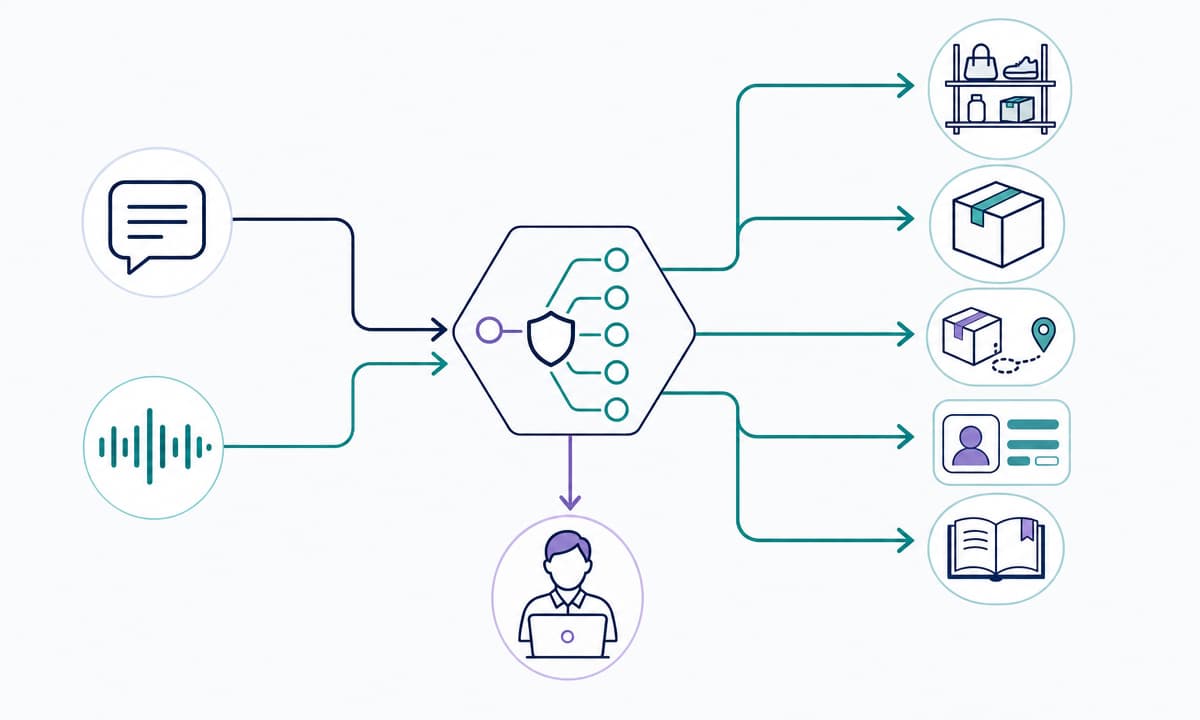
Knowledge retrieval and transactional tools serve different purposes. Retrieval can answer “What is your return window?” An order API must answer “Can I return this item?” because the result depends on identity, purchase date, item condition, geography, and exceptions. Do not put frequently changing inventory, prices, or order state into a static knowledge base and expect it to remain authoritative.
Your integration contract also needs failure behavior. If the order system times out, the bot should say it cannot retrieve the order, preserve context, and offer the next safe route. It should never fill the gap from model memory.
Human handoff is part of the main flow
Handoff should be designed before automation. Customers need a clear way to ask for a person, and the system needs automatic triggers for cases it should not own.
Common triggers include:
- failed authentication or conflicting account data
- a refund, credit, or policy exception above an approved threshold
- repeated low-confidence answers or tool errors
- safety, fraud, legal, accessibility, or vulnerability concerns
- anger, distress, or a direct request for a person
- a high-value purchase that needs specialist advice
The transfer packet should include the conversation summary, transcript, authenticated customer and order identifiers, selected product or issue, actions attempted, tool results, consent state, and escalation reason. Sensitive fields should remain masked unless the receiving agent is authorized to view them.
In text, define queue hours, expected wait, asynchronous follow-up, and who owns the thread after an agent joins. In voice, support interruption, announce the transfer, preserve the call when possible, and choose between a direct transfer and a warm transfer that briefs the operator first. If no agent is available, capture a safe callback request instead of returning the caller to the beginning.
How to implement an ecommerce chatbot
1. Choose one customer job
Start with a high-volume, bounded task that has a reliable source of truth. Order status, return eligibility, or a specific product-finder journey is easier to prove than a general shopping assistant. Record the current volume, handle time, resolution rate, conversion, repeat-contact rate, and customer feedback for that intent.
2. Write the policy and action boundary
Define what the bot may answer, which actions it may take, which actions need explicit confirmation, and which cases always go to a person. Turn policy language into testable rules. “Offer reasonable compensation” is unsafe. “Create a credit up to the approved amount for these reason codes after authentication” can be enforced.
3. Map data ownership and contracts
Name the source of truth for every claim. Specify freshness, required fields, authentication, timeouts, retry behavior, idempotency, and error messages for every integration. Restrict write tools to the smallest useful operation and log every attempt.
4. Design conversation and handoff together
Map the happy path, clarification questions, invalid inputs, changed intent, tool failure, channel change, customer-requested escalation, and unavailable-agent fallback. Keep the model’s freedom highest in phrasing and lowest in money, identity, inventory, and policy decisions.
5. Build an evaluation set before launch
Use anonymized examples of real phrasing, including misspellings, multiple intents, adversarial instructions, ambiguous product names, old order numbers, unsupported requests, and angry customers. Label the expected answer source, tool call, action, and handoff outcome. For voice, add accents, background noise, interruptions, silence, and alphanumeric details.
The NIST Generative AI Profile treats testing and ongoing monitoring as risk controls. A launch gate should therefore cover factual accuracy, action accuracy, policy compliance, security, latency, handoff, and recovery from dependency failures.
6. Release in controlled stages
Begin with internal and shadow testing, then a small share of eligible traffic. Limit intents, tools, customer segments, and operating hours. Review failures frequently, separate conversation problems from data or integration problems, and keep a rollback path.
7. Operate it like a customer-facing service
Assign owners for prompts, policies, knowledge, integrations, evaluation, security, and support operations. Run regression tests when a model, prompt, policy, catalog schema, or downstream API changes. Our guide to voice agent testing explains why realistic conversation tests need to include tool calls and failure paths, not only polished demo prompts.
How to evaluate an ecommerce chatbot platform
A strong demo proves that the interface can talk. A useful evaluation proves that the system can complete your workflow under normal, ambiguous, and failed conditions.
| Criterion | Questions to ask | Evidence to require |
|---|---|---|
| Channel fit | Does it support the channels and transitions customers actually use? | A complete test on mobile, desktop, messaging, or phone as applicable |
| Conversation control | Can you combine generative understanding with deterministic policy and action rules? | Traces showing why the bot answered, called a tool, or escalated |
| Ecommerce data | How are catalog, inventory, customer, order, shipping, and return data kept current? | Live sandbox integrations with structured errors and freshness behavior |
| Action safety | Can tools be narrowly scoped, authenticated, confirmed, rate-limited, and made idempotent? | Permission model, audit log, and duplicate-request tests |
| Grounding | Can the system cite or identify the source used for an answer and abstain when none exists? | Accuracy results on your labeled evaluation set |
| Human handoff | Can it transfer the customer and context without restarting the journey? | A real transfer to the target helpdesk or phone queue |
| Testing and change control | Can you version prompts and models, run regression suites, and compare releases? | Repeatable evaluation reports and rollback workflow |
| Observability | Can operators inspect transcripts, model turns, tool calls, errors, latency, cost, and outcomes? | Searchable traces tied to a conversation and deployment version |
| Reliability | What happens when the model, store API, helpdesk, or carrier is slow or unavailable? | Timeouts, fallbacks, status history, and load or concurrency tests |
| Security and privacy | Where does data flow, how long is it retained, and who can access it? | Architecture, access controls, retention settings, subprocessor details, and incident process |
| Operating model | Who maintains integrations, evaluations, on-call response, and platform upgrades? | A clear responsibility matrix and total cost under expected traffic |
Score the platform against the workflow you plan to ship. Native store connectors help a small team launch quickly. APIs, versioning, deep traces, telephony control, and multitenant isolation matter more when a technical team is building a conversational product for many merchants.
KPIs that reveal value and failure
Use outcome metrics alongside quality and risk metrics. A lower support cost is meaningless if repeat contacts or unauthorized actions rise.
| Area | Useful KPI | What to watch |
|---|---|---|
| Resolution | Verified resolution rate, repeat contact within a defined window, and time to resolution | A closed conversation is not necessarily a solved problem |
| Handoff | Transfer success, time to agent, context completeness, and customer restart rate | Low handoff volume can mean the bot is trapping customers |
| Sales | Qualified product selection, add-to-cart, checkout completion, and revenue per eligible assisted session | Segment by intent and use a control group where possible |
| Answer quality | Grounded factual accuracy, correct abstention, and unsupported-claim rate | Averages can hide severe errors on refunds, safety, or policy |
| Action quality | Correct tool selection, valid arguments, successful execution, and duplicate-action rate | A correct sentence cannot offset an incorrect write action |
| Experience | Customer satisfaction by intent, response latency, voice interruption success, and abandonment | Measure the whole journey, including transfer time |
| Operations | Cost per verified resolution, error rate by dependency, and regression pass rate | Model cost is only one part of total operating cost |
| Safety | Authentication failures, policy violations, sensitive-data exposure, and opt-out failures | Severe events need thresholds and an incident owner, not an average score |
Define the denominator for every rate. A practical containment rate is verified bot resolutions divided by eligible conversations. Exclude spam, test traffic, unsupported intents, and sessions that end before the customer states a need. Report customer-requested handoffs separately from system-triggered escalations.
Security and privacy controls belong in the design
An ecommerce chatbot sits between untrusted customer input and valuable systems. Treat every message, retrieved document, product description, and tool response as potentially hostile input.
- Minimize data: send only the fields needed for the current task. Mask payment, authentication, and unnecessary personal data in prompts, logs, transcripts, and analytics.
- Constrain actions: authorize on the server, allowlist tools and parameters, require confirmation for consequential changes, and cap values such as refund or credit amounts.
- Defend against prompt injection: separate instructions from retrieved content, validate model output before it reaches a tool, and test requests that try to override policy. The OWASP Top 10 for LLM apps includes prompt injection, sensitive information disclosure, improper output handling, and excessive agency among its core risks.
- Isolate payment entry: keep raw card data out of the bot and route payment collection through an approved hosted flow. Any environment that stores, processes, or transmits cardholder data falls under PCI DSS.
- Control retention and access: define retention by data type, encrypt data in transit and at rest, use role-based access, audit exports, and delete data when the approved period ends.
- Disclose automation and honor consent: identify the automated assistant clearly. For outbound voice in the United States, the FCC has confirmed that TCPA restrictions on artificial or prerecorded voices apply to AI-generated voices. Consent, identification, calling hours, and opt-out handling must be part of the workflow.
- Prepare for incidents: support rapid tool disablement, prompt or model rollback, transcript review, affected-session search, and customer remediation.
Our AI agent security guide goes deeper into trust boundaries, tool permissions, secrets, logging, and incident response for systems that can take actions.
Where Dasha fits
We build Dasha as a managed production platform for technical teams creating serious conversational AI products. Our current proof point is voice AI: real-time conversations across phone and web voice, with telephony, external tools, call transfer, testing, monitoring, and API-driven operation.
For ecommerce, Dasha is a fit when voice is part of the product or service workflow. Examples include inbound order support, structured returns triage, high-consideration product qualification, and consented outbound follow-up. The team should have developers who can connect catalog, order, CRM, helpdesk, and policy systems and own the resulting customer experience.
Dasha is not a plug-and-play storefront chat widget, an ecommerce helpdesk, or a general web-chatbot product. If the requirement is a text FAQ assistant with a native Shopify or WooCommerce connector, a commerce-specific chatbot or helpdesk will usually be a more direct fit. If you are building a multitenant conversational product or need production voice as a channel, our managed runtime and operations layer can remove the need to assemble and run the real-time voice stack yourself.
Choose the narrowest workflow you can prove
The best first ecommerce chatbot is rarely the one with the broadest demo. It is the one that completes a valuable customer job, uses current data, stays inside explicit permissions, transfers cleanly, and produces evidence that the outcome was correct.
If voice is the missing channel and your team can own the integrations and evaluation, use the current Dasha documentation to build one test agent against one bounded ecommerce workflow.